

NIRF ranking parameters play a crucial role in determining how colleges and universities are evaluated under India’s National Institutional Ranking Framework (NIRF). As institutions increasingly focus on quality enhancement, national visibility, student outcomes, and academic excellence, understanding these parameters has become essential for principals, directors, IQAC coordinators, department heads, and institutional leaders.
Many institutions participate in NIRF rankings but struggle to understand how scores are calculated and which areas require improvement. Often, colleges focus only on data submission without developing long-term strategies to strengthen the indicators that directly influence rankings.
This guide explains the NIRF ranking framework, its major parameters, scoring methodology, common mistakes, improvement strategies, and how institutions can strengthen their readiness for future NIRF assessments.
1. Understanding NIRF Ranking Parameters
The National Institutional Ranking Framework (NIRF) was introduced by the Ministry of Education to assess and rank higher education institutions across India.
NIRF evaluates institutions using a structured framework that measures multiple aspects of institutional performance rather than focusing on a single indicator.
Objectives of NIRF
- Promote quality enhancement
- Encourage institutional competitiveness
- Improve transparency
- Support informed student decisions
- Benchmark institutional performance
The framework uses multiple ranking metrics to assess institutions comprehensively.
2. Why NIRF Rankings Matter for Colleges and Universities
Enhances Institutional Reputation
Higher rankings improve visibility among students, parents, recruiters, and academic stakeholders.
Supports Strategic Planning
The framework helps institutions identify strengths and improvement areas.
Encourages Data-Driven Decision Making
NIRF promotes evidence-based planning and institutional assessment.
Improves Student Attraction
Strong rankings often increase student applications and admissions interest.
Strengthens Quality Assurance
The framework aligns with broader institutional quality improvement initiatives.
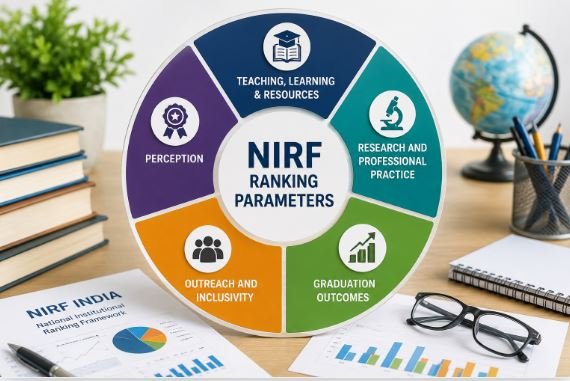
3. The Five Major NIRF Ranking Parameters Explained
1. Teaching, Learning & Resources (TLR)
This parameter evaluates the academic environment and institutional resources.
Key Indicators
- Faculty-student ratio
- Faculty qualifications
- Faculty experience
- Financial resources
- Learning infrastructure
Why It Matters
A strong teaching-learning environment contributes significantly to institutional quality and student success.
2. Research and Professional Practice (RP)
Research productivity is a major component of NIRF assessments.
Indicators Include
- Publications
- Citations
- Research projects
- Intellectual property
- Patents
Improvement Strategies
- Encourage faculty publications
- Strengthen research collaborations
- Promote funded projects
- Support innovation initiatives
3. Graduation Outcomes (GO)
Graduation Outcomes measure the success of students after completing their programs.
Key Metrics
- Placement performance
- Higher education progression
- Competitive examination success
- Graduation rates
Importance
Strong student outcomes indicate effective teaching-learning processes and institutional support systems.
4. Outreach and Inclusivity (OI)
This parameter evaluates institutional diversity and inclusiveness.
Indicators
- Regional diversity
- Gender diversity
- Economically disadvantaged students
- Facilities for differently abled students
Institutional Focus Areas
- Inclusive policies
- Student support systems
- Diversity initiatives
5. Perception (PR)
Perception measures how stakeholders view the institution.
Sources of Perception Data
- Academic peers
- Employers
- Public stakeholders
Improvement Strategies
- Strengthen industry engagement
- Enhance academic visibility
- Improve outreach activities
4. How NIRF Scores Are Calculated
Each parameter carries a specific weightage.
| Parameter | Weightage (%) |
|---|---|
| Teaching, Learning & Resources | 30 |
| Research and Professional Practice | 30 |
| Graduation Outcomes | 20 |
| Outreach and Inclusivity | 10 |
| Perception | 10 |
Data Validation Process
NIRF verifies submitted information through:
- Documentary evidence
- Public databases
- Institutional disclosures
Importance of Accurate Data
Incorrect or inconsistent data can affect ranking performance and institutional credibility.
5. Common Mistakes Institutions Should Avoid
Focusing Only During Submission Period
NIRF readiness should be a year-round activity.
Weak Data Management Systems
Many institutions struggle with fragmented data sources.
Underreporting Achievements
Research outputs and student achievements are often not documented effectively.
Inaccurate Faculty Data
Faculty records should be updated regularly.
Poor Placement Documentation
Institutions must maintain detailed placement records and evidence.
Lack of Strategic Improvement Plans
Institutions should focus on continuous enhancement rather than ranking submission alone.

6. Best Practices to Improve NIRF Performance
1. Build Strong Data Management Systems
Maintain centralized repositories for:
- Faculty information
- Student records
- Research outputs
- Placement data
2. Strengthen Research Ecosystems
Promote:
- Publications
- Collaborative projects
- Research funding
- Innovation activities
3. Improve Graduation Outcomes
Focus on:
- Placement support
- Career guidance
- Industry partnerships
- Higher education opportunities
4. Enhance Outreach and Inclusivity
Develop initiatives that support diversity and inclusion.
5. Strengthen Institutional Branding
Improve perception through:
- Academic achievements
- Industry engagement
- Public outreach
Recommended NIRF Readiness Roadmap
1: Data Audit
2: Gap Analysis
3: Improvement Planning
4: Evidence Collection
5: Internal Review
Phase 6: NIRF Submission Readiness
7. How BGC Can Help with NIRF Ranking Readiness
Bhavya Gyan Consultants assists colleges and universities in improving their NIRF preparedness through structured assessment and strategic planning.
BGC Services Include
- NIRF Data Audit
- NIRF Gap Analysis
- Ranking Strategy Development
- Documentation Support
- Research Performance Assessment
- Placement Data Management
- Academic Audit Services
- Institutional Performance Reviews
Our team helps institutions understand NIRF criteria, strengthen evidence systems, and develop long-term ranking improvement strategies.
Official External Resources
Conclusion
Understanding NIRF ranking parameters is essential for institutions seeking to improve academic quality, national visibility, and institutional performance. The framework evaluates institutions across teaching, research, graduation outcomes, outreach, and perception, providing a comprehensive assessment of institutional effectiveness.
Institutions that adopt a strategic, data-driven approach to NIRF preparation are better positioned to strengthen performance indicators and achieve sustainable improvements over time.
FAQs:
NIRF ranking parameters are the criteria used by the National Institutional Ranking Framework to evaluate higher education institutions.
NIRF primarily evaluates institutions using five broad parameters: Teaching, Learning & Resources, Research, Graduation Outcomes, Outreach & Inclusivity, and Perception.
Teaching, Learning & Resources and Research & Professional Practice generally carry the highest weightage.
Graduation outcomes measure student success through placements, higher studies, and examination performance.
Institutions can improve by strengthening research, enhancing student outcomes, improving documentation, and maintaining accurate data systems.




1 thought on “NIRF Ranking Parameters Explained: A Complete Guide for Higher Education Institutions”