
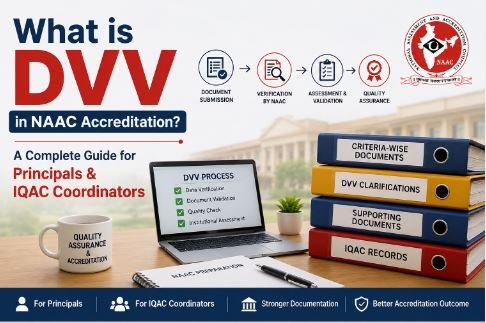
Every college preparing for NAAC accreditation eventually runs into one confusing term: DVV. It shows up on the portal, in circulars, and in every IQAC meeting once the Self Study Report is submitted. Yet most staff can explain accreditation in general but freeze the moment someone asks, “what exactly is DVV in NAAC?”
This guide breaks down DVV in plain language. You will learn what it means, why it exists, how the process actually works, and what your institution can do today to avoid last-minute panic when a clarification request lands in your inbox. Whether you are an IQAC coordinator handling your first accreditation cycle or a principal reviewing institutional readiness, this article gives you a working understanding of DVV from start to finish.
What Does DVV Mean in NAAC Accreditation?
DVV stands for Data Validation and Verification. It is the stage in the NAAC assessment cycle where the data an institution uploads through its Self Study Report (SSR) is checked against real evidence. In simple words, NAAC does not take your claims at face value. Every number you report — faculty count, student progression, research output, placement figures — is matched against documents you have already uploaded or are asked to submit.
The process is largely software driven for quantitative metrics, which is why institutions sometimes call it a “portal-based check.” A DVV partner assigned by NAAC reviews the uploaded proof and either accepts the data, asks for a clarification, or flags a metric as unsupported. Qualitative metrics follow a different path and are verified later, during the physical peer team visit, so DVV specifically deals with the numbers and records an institution can prove on paper.
It helps to remember that DVV is not a punishment stage. It exists because NAAC grades hundreds of institutions every cycle, and a consistent, evidence-based check is the only fair way to compare a small rural college against a large urban university on the same scale. Institutions that see DVV as routine record-keeping, rather than an obstacle, usually clear it with far less stress.
Why DVV Matters in the NAAC Process
DVV is not a formality. It directly shapes your final CGPA score before the peer team even visits campus. A poorly handled DVV stage can pull down scores in criteria that your institution otherwise performs well in — simply because the supporting proof was missing, mismatched, or uploaded in the wrong format. This means two institutions with genuinely similar academic performance can end up with noticeably different grades purely because one managed its documentation and the other did not.
- It confirms that your institutional claims are backed by verifiable records.
- It protects the credibility of the entire NAAC grading system.
- It gives institutions a structured chance to correct genuine data errors before final scoring.
- It reduces disputes during the peer team visit stage.
Not sure if your institutional data can survive a DVV check?
How the DVV Process Works
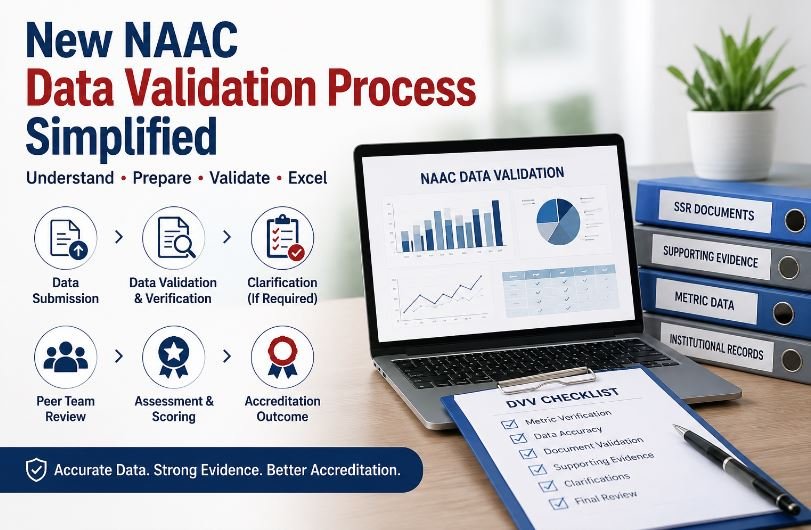
The DVV process follows a fairly predictable sequence once your institution submits its SSR. Understanding each stage helps departments plan their evidence collection well in advance instead of scrambling later.
Step 1: Data Submission Through SSR and Extended Profile
The process begins when your institution completes its SSR preparation and uploads quantitative and qualitative data along with the extended profile. This data forms the base record that DVV will later check against.
Step 2: Quantitative Metric Verification
Quantitative metrics (QnM) are checked first, mostly through an automated system supported by a DVV partner. Each metric needs a supporting document, and the NAAC portal typically allows a limited file size per metric, so institutions must plan document sizes and formats carefully before upload.
Step 3: Clarification Requests
Where data looks incomplete, inconsistent, or unsupported, NAAC raises a clarification request against the specific metric. This is the stage most people simply call “DVV objections.” Institutions receive a defined window to respond with corrected data or additional proof.
Step 4: Institutional Response and Closure
Once your institution replies with the requested proof, the metric is either accepted or sent back for review. Institutions that ignore the response window risk losing marks on that metric entirely, so timely, well-organised responses matter as much as the original data. Strong IQAC coordination during this window makes a measurable difference to how fast clarifications close.
Common Reasons Institutions Get DVV Objections

Most DVV objections are avoidable. They usually come down to a handful of recurring, fixable issues rather than genuinely weak institutional performance. Knowing these patterns in advance lets your IQAC team build checks directly into the SSR preparation workflow instead of discovering them after a clarification request arrives.
- Supporting documents missing an official letterhead, signature, or date.
- Data in the SSR not matching figures reported to AISHE or NIRF.
- Scanned files exceeding the per-metric upload limit set by the portal.
- Evidence uploaded for the wrong academic year or wrong department.
- Links shared through personal cloud drives instead of the institution’s own website.
- No single owner responsible for a metric, so nobody replies within the deadline.
What Documents Are Typically Needed for DVV
The exact list depends on your institution’s criteria and metrics, but most colleges need to keep the following categories ready and criterion-wise before SSR submission.
- Faculty appointment letters, qualification certificates, and experience records.
- Student enrolment, progression, and result records for the last five years.
- Research publications, patents, consultancy, and project sanction letters.
- Financial statements, audited utilisation certificates, and budget allocation reports.
- Governance records such as minutes of meetings, committee constitution orders, and policies.
- Student support evidence, including scholarships, placement letters, and grievance records.
Institutions that maintain criteria-wise documentation support systems throughout the academic year rarely scramble when the DVV window opens, since every document is already tagged to its metric and criterion.
DVV Timeline in the NAAC Accreditation Cycle
DVV does not happen in isolation. It sits at a specific point in the larger accreditation journey, and understanding where it falls helps institutions plan resources without last-minute overload.
- IIQA submission – the institution registers its intent to apply and shares basic eligibility data.
- SSR and extended profile submission – detailed quantitative and qualitative data is uploaded criterion-wise.
- DVV stage – quantitative metrics are checked against supporting evidence, and clarifications are raised where needed.
- Clarification window – institutions respond within the given deadline with corrected data or documents.
- Peer team visit – qualitative metrics are verified on campus once the DVV stage is closed.
Because DVV directly precedes the peer team visit, a messy clarification stage often carries forward into awkward, avoidable questions during the campus visit itself.
DVV vs Peer Team Visit: What Is the Difference?
Institutions often confuse DVV with the peer team visit, but the two check very different things. DVV verifies quantitative, document-backed metrics through an online, largely automated process. The peer team visit stage, on the other hand, verifies qualitative metrics (QlM) through physical observation, interviews, and campus inspection. DVV happens before the visit and effectively decides how much groundwork the peer team will need to redo on campus.
How to Prepare Your Institution for DVV

Preparation is far cheaper than correction. Institutions that build a documentation habit well before SSR submission rarely face serious DVV trouble.
Build a Digital Evidence Repository
Keep every certificate, report, and circular organised criterion-wise in a digital evidence repository rather than scattered across personal laptops and department drives. This alone prevents the single biggest cause of delayed clarification responses.
Assign Department-Level Data Owners
Every metric should have one named person responsible for its accuracy and its supporting proof. Without ownership, clarification requests sit unanswered simply because no one feels it is their job to respond.
Train Faculty and Staff on Evidence Standards
Data owners often understand their subject well but are unfamiliar with what NAAC actually expects as valid proof. A short internal orientation, covering acceptable file formats, signature requirements, and naming conventions, prevents a surprising number of objections. This training is especially useful for newer faculty members who join mid-cycle and inherit responsibility for a metric they did not originally document.
Cross-Check Data With AISHE and NIRF Records
Before submission, compare your SSR figures against what your institution has already reported to AISHE and NIRF. Mismatched numbers across government portals are one of the fastest ways to trigger a DVV clarification, since evaluators frequently cross-verify institutional data across these sources. If your institution is also reviewing its wider accreditation roadmap, it can help to read how the NAAC accreditation process for colleges works end to end, so DVV preparation fits into the bigger timeline rather than being handled in isolation.
Want a criterion-wise DVV readiness check before you submit your SSR?
What Happens After DVV Clarification Is Completed
Once every metric is either accepted or corrected, your institutional CGPA for the quantitative section is largely locked in. From here, the file moves toward IIQA and peer team scheduling. A clean DVV stage also gives your institution more confidence walking into the peer visit, since the qualitative discussion is no longer clouded by unresolved data disputes.
It is worth noting that institutions cannot reopen a closed metric later simply because they found better evidence. This is exactly why front-loading documentation, rather than treating DVV as a reactive exercise, protects your final grade far more reliably than trying to fight individual objections after the fact.
Practical Checklist Before You Submit for DVV
- Every metric has a named document owner and a backup contact.
- All figures match AISHE, NIRF, and internal ERP records.
- Supporting files are signed, dated, and within the portal’s size limit.
- Evidence is hosted on the institution’s own website, not personal cloud storage.
- A criterion-wise index makes every document traceable in under a minute.
- Someone is tracking the clarification window on the NAAC portal daily.
If building this checklist internally feels stretched across an already busy IQAC team, a structured DVV Clarification Support engagement can take the documentation load off your staff while keeping full institutional control over the final submission.
Conclusion
DVV is simply NAAC’s way of making sure that what your institution claims on paper is what your records actually show. It rewards colleges that keep clean, criterion-wise documentation year-round, and it penalises last-minute scrambling. Treat DVV preparation as an ongoing IQAC habit rather than a one-time SSR task, and the clarification stage becomes routine instead of stressful. The institutions that struggle the least with DVV are rarely the largest or the wealthiest — they are simply the ones that treated documentation as a continuous process rather than an annual scramble before submission.
Ready to make your next DVV cycle stress-free?
FAQs:
DVV means Data Validation and Verification. It checks if your SSR data matches real supporting evidence.
A DVV partner assigned by NAAC reviews quantitative metrics through the online portal system.
The unanswered metric may be scored as unsupported, lowering your institutional CGPA.
No. NAAC requires evidence on the institution’s own website, not third-party drives.
No. DVV checks quantitative data online; the peer team verifies qualitative aspects on campus.
Assign data owners, cross-check AISHE and NIRF figures, and keep signed evidence ready.
External Resources
- NAAC Official Website – naac.gov.in
- AISHE Portal – All India Survey on Higher Education
- UGC – University Grants Commission



2 thoughts on “What is DVV in NAAC Accreditation? Meaning, Process and Preparation Guide”