

Every college preparing for NAAC accreditation eventually asks the same question: who actually runs this process on the ground? The answer, in almost every case, is the Internal Quality Assurance Cell, or IQAC. The IQAC role in NAAC accreditation goes far beyond paperwork. It is the internal engine that plans, records, monitors and reports every quality initiative an institution runs through the year, long before any external evaluator arrives on campus.
Without a functioning IQAC, most colleges struggle to submit a strong Self Study Report, respond to DVV clarifications on time, or keep their AQAR filings current. Departments end up scrambling for old records, faculty cannot recall which activities happened in which academic year, and management is left guessing whether the institution is actually accreditation-ready. This is rarely a resourcing problem. It is almost always a systems problem, and IQAC is the system NAAC expects every institution to build.
This guide breaks down exactly how IQAC supports the NAAC accreditation process, what documentation it must maintain, how AQAR and DVV fit into the yearly cycle, and how institutions can strengthen this cell well before their next accreditation cycle begins. If your college has faced last-minute panic before a peer team visit, or has never fully understood why AQAR filing matters, this article will help you build a clearer, more practical picture of quality assurance and where to start improving it.
What Is IQAC and Why Was It Created
The Internal Quality Assurance Cell is a permanent institutional body that every college and university sets up to build and sustain quality in academic and administrative functions. It is not a temporary committee formed a few months before an accreditation visit. NAAC expects IQAC to function every single day of the academic year, whether or not an accreditation cycle is currently active.
NAAC introduced the IQAC concept so that quality improvement would not remain a one-time exercise done only before accreditation visits. Before this system existed, many institutions treated accreditation as an external event to be managed once every five to seven years, with intense last-minute effort and very little continuity between cycles. The result was predictable: strong SSRs followed by years of silence, and then a rushed, disorganized scramble when the next cycle approached.
Why IQAC Matters for NAAC Accreditation
Institutions with a genuinely active IQAC tend to have three clear advantages during accreditation. First, their evidence is already organized by the time SSR preparation begins, so departments are not searching for two-year-old records under deadline pressure. Second, their AQAR history shows a believable pattern of continuous improvement rather than a single burst of activity right before submission. Third, their staff already understand the criteria-wise structure NAAC uses, which makes DVV clarifications faster and far less stressful to answer.
IQAC as the Bridge Between Institution and NAAC

Role of IQAC in the NAAC Accreditation Process
IQAC’s responsibilities run through almost every stage of the accreditation journey, not just the final submission. Below are the areas where its role is most direct, most time-consuming, and most measurable in terms of accreditation outcome.
SSR Preparation and Criteria-wise Evidence
AQAR Submission Every Year
DVV Clarification Support
Continuous Quality Improvement Plans
Beyond documentation, IQAC is expected to design and monitor Quality Improvement Plans, or QIPs, for each academic and administrative department. These plans set measurable goals for teaching quality, research output, student support and governance, and IQAC reviews progress against them at regular intervals throughout the year rather than waiting for an annual review meeting.
This ongoing monitoring is what separates institutions that show real, cumulative growth across accreditation cycles from institutions whose SSRs look almost identical each time. NAAC evaluators can generally tell the difference between genuine, tracked improvement and a report written to sound impressive without underlying data to support it.
IQAC Documentation: What Institutions Must Maintain
Common IQAC Documentation Mistakes
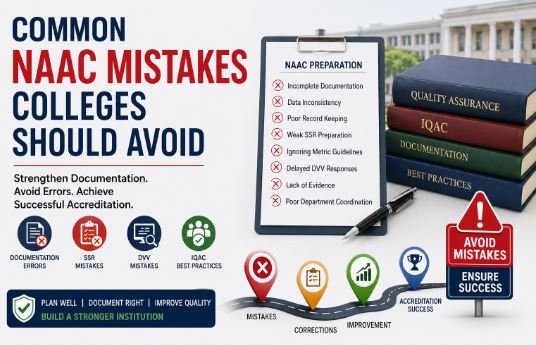
- Keeping records only during accreditation years instead of continuously
- Storing evidence in inconsistent formats across departments
- Failing to link activities directly to the correct NAAC criteria
- No single person or team responsible for year-round data tracking
- Missing digital backups of physical documentation and photographs
- Treating IQAC as a paperwork formality instead of a functioning quality body
- Not archiving previous AQAR and SSR submissions for future reference
Each of these mistakes is fixable, and none of them require large budgets to correct. What they usually need is a clear ownership structure inside the institution, a simple but consistent filing method, and a habit of recording activity as it happens rather than reconstructing it months later. Institutions that fix even two or three of these gaps typically notice a visible improvement in how smoothly their next SSR comes together.
Why AQAR Compliance Protects Your Accreditation Status
Delayed or inconsistent AQAR filing is one of the most common reasons institutions face avoidable questions during their next accreditation cycle. NAAC expects AQAR to reflect a realistic, evidence-backed picture of the institution’s yearly progress, not a rushed summary written just before the SSR deadline. Evaluators can usually tell when an AQAR has been written retroactively to fill a gap, because the level of detail and the supporting data simply do not match a genuine year-long record.
When AQAR is filed consistently and accurately, it becomes the strongest supporting document behind every claim made in the next SSR, making the entire re-accreditation process considerably smoother. It also gives institutional leadership an honest, year-by-year view of where quality efforts are working and where they are not, which is useful well beyond accreditation itself. Many institutions only realize the value of this consistent record once they are deep into preparing their next SSR and can clearly see the difference between years with strong AQAR data and years without it.
Building a Genuine Quality Assurance Culture
A genuine quality culture also changes how departments behave day to day. Faculty begin documenting activities as routine practice rather than an added burden, department heads start reviewing outcomes rather than just attendance, and students see visible follow-up on the feedback they submit. None of this requires large investment. It requires consistent process, clear ownership, and leadership support for IQAC as a functioning body rather than a symbolic committee that exists only on paper.
How BGC Strengthens Your IQAC and NAAC Readiness
Who Should Be Part of the IQAC Committee
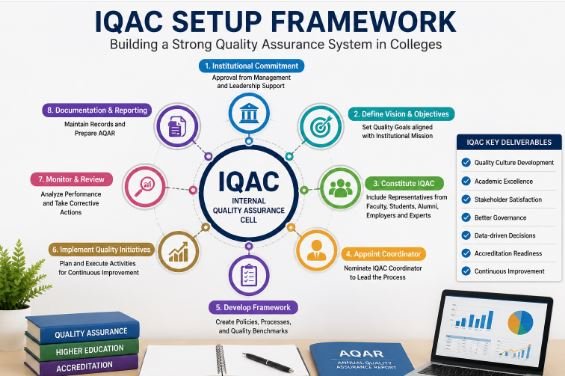
NAAC guidelines outline a broad-based composition for IQAC, and institutions that follow this structure closely tend to run a more balanced, credible quality system. The committee is generally chaired by the head of the institution and includes senior academic and administrative staff, teachers representing different departments, a management representative, a student representative, an alumni representative, and where possible, an external expert from industry or academia.
This broad representation matters for a practical reason: quality issues rarely sit in just one department. A gap in student support might involve academics, administration and hostel management at the same time. A committee that includes voices from across the institution is far more likely to catch these cross-department issues early, rather than after they show up as a weakness during SSR review.
It also helps to formally rotate responsibilities within the committee every few years, rather than leaving the same two or three people responsible for IQAC indefinitely. This prevents institutional knowledge from being lost when a key coordinator retires or moves on, and it keeps the committee’s thinking fresh rather than repeating the same annual routine without questioning whether it still works.
When Should IQAC Start Preparing for the Next Cycle
A common mistake institutions make is treating accreditation preparation as something that begins six to twelve months before the SSR deadline. In reality, an effective IQAC is preparing continuously, and the visible “preparation phase” is really just the point where scattered, ongoing records are compiled into a formal report.
In practical terms, this means IQAC should be reviewing department-wise activity every semester, not once a year. Feedback from students and parents should be analyzed and acted on within the same academic term it was collected, not carried forward unresolved. AQAR should be drafted as the year progresses and finalized soon after the academic year closes, rather than left until a filing deadline is announced. Institutions that follow this rhythm consistently find that their actual SSR-writing phase becomes a compilation exercise rather than a research project done under pressure.
IQAC’s Role Beyond NAAC: NIRF and NBA Readiness
A well-run IQAC does not just support NAAC. The same evidence base — activity records, feedback data, research output and governance documentation — feeds directly into other institutional benchmarking exercises, particularly NIRF ranking submissions and NBA accreditation for eligible programs. Institutions that maintain this data consistently through IQAC rarely need to build separate documentation systems each time a new ranking or accreditation requirement appears.
This overlap is one of the strongest arguments for investing in IQAC as a long-term institutional function rather than a NAAC-specific formality. Data collected once, and collected well, can serve multiple purposes across the year, saving departments from repeating the same evidence-gathering exercise under different names for different evaluators.
Conclusion
The IQAC role in NAAC accreditation is not a side task handled once every few years — it is the institution’s ongoing quality backbone. Strong IQAC documentation, consistent AQAR filing, and organized DVV response systems together decide whether an accreditation cycle feels manageable or chaotic. None of this depends on institution size or budget. It depends on whether quality assurance is treated as a continuous responsibility or an occasional formality.
FAQs:
IQAC plans, documents and reports quality initiatives, forming the evidence base for accreditation.
Yes. AQAR must be filed annually to keep accreditation status active and credible.
SSR preparation becomes rushed, and DVV clarifications are harder to answer accurately.
Senior faculty, administrators, a student representative, and often an external quality expert.
Yes, and it should — early setup makes the first SSR far easier to prepare.
DVV verifies specific data claims in the SSR through documentary proof and clarifications.
No, its role is continuous — accreditation years simply compile ongoing quality work.
3 thoughts on “Role of IQAC in NAAC Accreditation: A Complete Guide for Colleges”