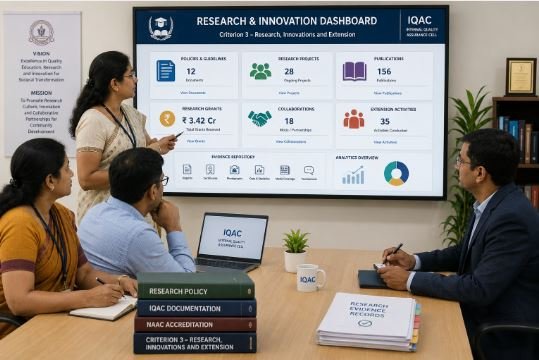
If you work in an IQAC office, you have heard both terms every week: SSR and AQAR. Many college staff use them like they mean the same thing. They do not. Each report has a different purpose, a different timeline, and a different role in NAAC accreditation success.
This confusion often leads to weak documentation and last-minute panic. It also affects how your college performs during Data Validation and Verification (DVV). Once you understand SSR vs AQAR clearly, planning your institution’s quality cycle becomes much simpler.
In this guide, we break down what each report means, why both matter, and how to build a system that keeps your college ready for NAAC, every single year, not just during accreditation season.
What Is SSR in NAAC Accreditation?
SSR stands for Self-Study Report. It is the master document your college submits once, during a full NAAC accreditation cycle. Think of it as your institution’s complete quality story, covering everything from teaching methods to governance to student support.
The SSR is built under NAAC’s structured criteria. It combines Quantitative Metrics (QnM), which need numbers and hard evidence, and Qualitative Metrics (QlM), which need descriptive write-ups about your institutional practices.

Key Components of SSR
A complete SSR usually includes:
- Institutional profile and history
- Curriculum design and academic flexibility
- Teaching, learning, and evaluation records
- Research, innovation, and extension activities
- Infrastructure and learning resources
- Student support and progression data
- Governance, leadership, and management systems
- Institutional values and best practices
Because SSR covers five years of institutional work, SSR preparation needs early planning, not a last-minute scramble. Institutions that build documentation systems early always submit stronger, more consistent reports.
Struggling with scattered SSR data across departments?
What Is AQAR in NAAC Accreditation?
AQAR stands for Annual Quality Assurance Report. Unlike SSR, which happens once every accreditation cycle, AQAR is filed every single year by your Internal Quality Assurance Cell (IQAC).
AQAR records what your institution actually did that academic year. It captures specific activities, outcomes, and improvements linked to each NAAC criterion. It works like a yearly diary of quality actions your college has taken.

Key Components of AQAR
A well-prepared AQAR generally covers:
- Academic activities completed during the year
- New initiatives and quality improvement plans
- Feedback analysis and corrective actions taken
- Faculty development programs conducted
- Student support activities and outcomes
- Research output and publications during the year
- IQAC meeting records and follow-up actions
Since AQAR feeds directly into your next SSR, keeping accurate IQAC report records each year saves enormous effort later. Colleges that skip annual AQAR filing often struggle badly when the next SSR cycle begins.
Falling behind on your annual AQAR filing?
SSR vs AQAR: Key Differences
Here is a simple comparison to keep the two reports clear in your mind.
| Aspect | SSR | AQAR |
| Full form | Self-Study Report | Annual Quality Assurance Report |
| Frequency | Once per accreditation cycle | Every academic year |
| Scope | Full institutional performance | One year’s quality activities |
| Prepared by | IQAC with all departments | IQAC, using yearly data |
| Purpose | Institutional evaluation for accreditation | Continuous quality monitoring |
| Data type | Five-year cumulative data | Single-year activity data |
| Submission | NAAC portal, during accreditation | NAAC portal, every year |
Both reports depend on the same base: accurate, organized institutional records maintained by your IQAC Services team throughout the year.
Why SSR Matters for Your Institution
The SSR decides how the outside world evaluates your college’s academic quality. A weak SSR can lead to poor grading, rejected claims, and repeated Data Validation and Verification (DVV) queries. A strong SSR does the opposite.
It helps your institution:
- Present its true strengths with clear, organized evidence
- Improve credibility with students, parents, and funding bodies
- Prepare for a smoother Peer Team Visit
- Reduce the chance of DVV clarification queries
If your college has already faced confusing queries during data checks, professional DVV Clarification Support can help you respond correctly and on time.
Why AQAR Matters for Your Institution
AQAR is easy to ignore because it feels routine. But skipping or rushing it creates a chain reaction. Weak AQAR data means weak SSR data later, since your SSR is essentially built from years of AQAR records.
Regular AQAR filing helps your institution:
- Track real progress on quality goals every year
- Build a reliable data trail for the next SSR cycle
- Show NAAC continuous improvement, not one-time effort
- Keep your IQAC active, visible, and accountable
Institutions that treat AQAR as a yearly habit, not a yearly burden, always find SSR preparation far less painful when the cycle finally arrives.
When Should Colleges Prepare SSR and AQAR?

Timing is where most institutions go wrong. AQAR has a fixed annual rhythm, while SSR follows the accreditation cycle.
AQAR Timeline
As per NAAC guidelines, accredited institutions must submit AQAR on or before 31st December every year, regardless of their accreditation date. For example, a college accredited in September still follows the same 31st December deadline for that academic year’s AQAR.
Over a standard 5-year accreditation cycle, an institution must submit 4 AQARs in total. Institutions with an extended 7-year validity (granted for an ‘A’ grade across three consecutive cycles) must submit 6 AQARs. Missing this deadline gets recorded as a late submission and can affect your standing when the next SSR cycle opens.
In practice, this means AQAR preparation should begin right after the academic year ends in May or June, not in December. Starting early gives departments time to compile accurate data, gives the IQAC time to verify evidence, and leaves a buffer for NAAC’s post-submission clarification queries, which must be answered within 15 days of being raised.
SSR Timeline
SSR preparation should start well before your accreditation window opens, ideally 9 to 12 months in advance. This gives departments enough time to compile five years of records without last-minute pressure.
Who Is Responsible for SSR and AQAR in Your College?
Ownership confusion is another reason these reports slip. NAAC places the IQAC at the center of both, but neither report can succeed without support from the whole institution.
The IQAC’s Role
The IQAC coordinates data collection, verifies evidence, drafts narratives, and manages the final upload for both SSR and AQAR. It also runs internal reviews before submission to catch gaps early.
The Department’s Role
Every academic and administrative department must supply its own evidence: faculty records, event reports, results, and student feedback. When departments treat this as a one-time favor to the IQAC instead of a routine duty, both reports suffer.
The Management’s Role
Leadership must back the process with budget, staff time, and a digital infrastructure. Without management support, even a motivated IQAC struggles to maintain year-round documentation.
Common Mistakes Institutions Make with SSR and AQAR
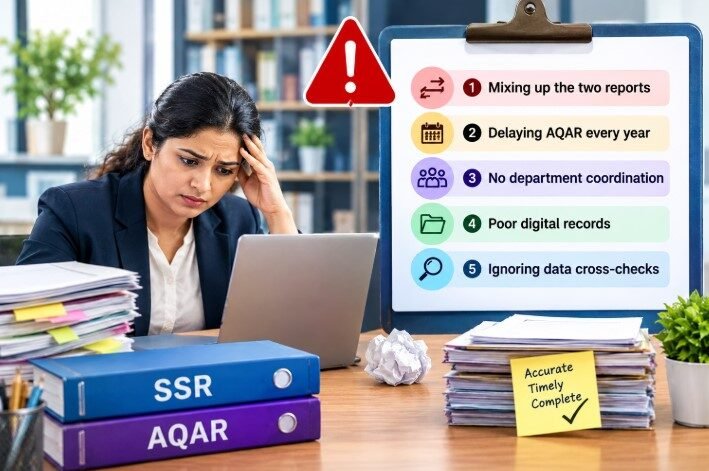
Even experienced IQAC teams fall into a few repeated traps:
- Mixing up the two reports. Some teams submit AQAR-style summaries when NAAC expects full SSR detail, or the reverse.
- Delaying AQAR every year. Filing three years of AQAR at once creates data gaps and inconsistent records.
- No department coordination. Faculty rarely know what evidence the IQAC actually needs from them.
- Poor digital records. Paper files and scattered folders slow down both SSR and AQAR preparation.
- Ignoring data cross-checks. Numbers in SSR must match AISHE, NIRF, and university records, or DVV flags them instantly.
For a complete step-by-step approach to avoiding these errors, this detailed NAAC accreditation roadmap from ManTech Publications is a useful reference for institutions starting their first cycle.
Not sure if your documentation is ready?
How SSR and AQAR Work Together in the NAAC Cycle
Think of AQAR as the yearly building blocks, and SSR as the finished structure built from those blocks. NAAC does not want a one-time performance. It wants proof of consistent, year-on-year improvement.
This is why NAAC often expects institutions to have a set number of AQARs on record before allowing a fresh SSR cycle. If your AQAR trail is missing or weak, your SSR submission can get delayed or questioned during DVV.
A good practice is to treat every AQAR as a mini rehearsal for your next SSR. Use the same format, the same evidence style, and the same criteria-wise structure. This habit alone can reduce SSR preparation time by months.
Building a Documentation System That Works for Both
The real solution to the SSR vs AQAR confusion is not more effort during submission season. It is a better system running all year round.
A working documentation system should include:
- A shared digital folder structure for every NAAC criterion
- Clear ownership, with one nodal officer per department
- Monthly or quarterly evidence uploads, not year-end scrambles
- A simple internal calendar linking AQAR deadlines to SSR preparation stages
- Regular IQAC meetings with recorded minutes and follow-up tracking
Institutions that also want to strengthen faculty research output, one of the most heavily weighted SSR metrics, can benefit from working with established academic publishers. Partnering with a scholarly platform such as ManTech Publications for indexed journal access supports Criterion 3 evidence in both SSR and AQAR.
If your college needs hands-on support building this kind of system, our NAAC Accreditation Consultancy team can set it up around your existing structure, without disrupting daily academic work.
For students and parents evaluating colleges before admission, checking whether an institution files its AQAR regularly is one of the fastest ways to judge its quality culture. You can explore accredited colleges and courses on BhavyaGyan before making a final decision.
Want a documentation system built around your college?
Conclusion
SSR and AQAR are not competing reports. They are two parts of the same quality story. SSR shows where your institution stands after years of work. AQAR shows what your institution did this year to get there. Colleges that manage both well never fear a NAAC cycle. They walk into it prepared, with evidence ready and confidence high.
If your team needs structured support with either report, Bhavya Gyan Consultants can guide your IQAC through SSR preparation, AQAR management, and everyday documentation systems.
Ready to strengthen your SSR and AQAR process?
FAQs:
SSR is a one-time, five-year institutional report. AQAR is filed every year with that year’s data.
AQAR must be submitted every academic year by the IQAC.
No. Missing AQARs weaken your future SSR and delay your next cycle.
The IQAC prepares both, using data and evidence from every department.
Yes. Strong yearly AQAR records make SSR preparation faster and accurate.
BGC offers documentation support, IQAC coordination, and criteria-wise evidence systems.
External Resources
All links below open official government resources in a new tab for further reference:
- National Assessment and Accreditation Council: Official NAAC Portal
- University Grants Commission India: Official UGC Website
- All India Survey on Higher Education: Official AISHE Portal