
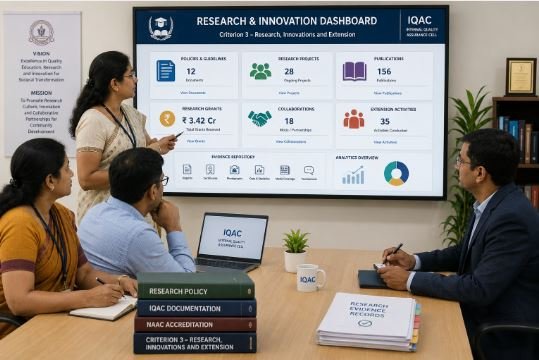
Research activities may be taking place across an institution, yet the available research documentation often fails to present a complete and verifiable institutional picture. Faculty members may have publications, departments may conduct seminars, research cells may organise workshops, and the accounts section may hold grant records—but the evidence remains scattered across personal computers, files, emails and registers.
This becomes a serious concern when an institution begins preparing for NAAC Criterion 3. Accreditation teams need more than a list of activities. They need structured research evidence that connects policies, approvals, participation, expenditure, outputs, outcomes and quality review.
This guide explains how colleges and universities can build a reliable research documentation system, prepare a practical Criterion 3 documentation checklist, identify common evidence gaps and create a sustainable process that supports NAAC, IQAC, AQAR, NIRF and institutional research planning.
Request a research documentation audit for institutional readiness.
1. What Does Research Documentation Mean in Higher Education?
Research documentation is the organised collection of policies, approvals, records, financial documents, activity reports, outputs and outcome evidence related to an institution’s research ecosystem.
It is not limited to faculty publication lists.
A complete documentation system may cover:
- Institutional research policies
- Research and Development Cell records
- Research committee constitution and meetings
- Research ethics and academic integrity mechanisms
- Sponsored and non-sponsored research projects
- Government and non-government grants
- Faculty and student publications
- Books, chapters and conference proceedings
- Patents, copyrights and other intellectual property
- Innovation and entrepreneurship initiatives
- Incubation and start-up support
An institution may have considerable research activity but still appear weak during an audit if these records are incomplete, inconsistent or difficult to retrieve.
Research activity versus research evidence
A useful distinction for IQAC and research teams is:
| Research activity | Research evidence |
|---|---|
| A faculty member publishes a paper | Publication copy, journal details, author affiliation, DOI or URL, indexing verification and institutional database entry |
| A research workshop is conducted | Approval, invitation, programme schedule, attendance, resource-person details, photographs, feedback, expenditure and outcome report |
| A grant is sanctioned | Proposal, sanction order, amount received, account records, utilisation documents, progress reports and project outputs |
| An MoU is signed | Signed agreement, validity period, objectives, activity reports, beneficiary records and outcomes |
| A patent application is filed | Application details, inventor records, filing receipt, institutional affiliation and current status |
| An extension programme is organised | Need assessment, approval, attendance, activity evidence, collaborating-agency confirmation and impact record |
Documentation is a chain, not a single file
Strong research evidence normally follows a traceable chain:
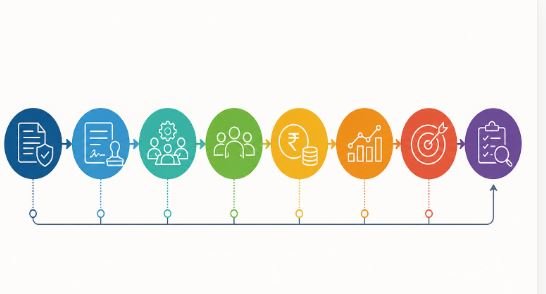
Policy → Planning → Approval → Implementation → Participation → Financial record → Output → Outcome → Review
A missing link may weaken the credibility of the complete claim.
For example, photographs of a research seminar may establish that an event occurred, but they do not necessarily establish its academic purpose, participant profile, expenditure or learning outcome. Similarly, an MoU document proves that an agreement was signed, but not that meaningful collaboration took place.
The aim of research documentation is therefore not to produce more paperwork. It is to preserve a reliable institutional history of research decisions, activities and results.
2. Why Does Research Documentation Matter for NAAC Criterion 3?
NAAC Criterion 3 broadly examines an institution’s research, innovation and extension environment. The applicable indicators and metrics depend on the institution category and current manual, but institutions are generally expected to demonstrate that research is supported through systems rather than isolated individual effort.
Good documentation helps an institution show that its research culture is:
- Policy-supported
- Ethically governed
- Institutionally monitored
- Financially traceable
- Academically productive
- Collaborative
- Socially or economically relevant
- Sustained over time
It connects institutional claims with verifiable proof
An SSR, AQAR or institutional presentation may state that the college promotes research. That statement becomes more credible when supported by:
- An approved research policy
- A functional research committee or RDC
- Budget allocation
- Seed-money records
- Research incentives
- Project and publication data
- Ethics and plagiarism procedures
Without these records, the narrative may remain descriptive rather than demonstrable.
It reduces inconsistencies across reports
Research data may appear in multiple institutional systems:
- AQAR
- SSR
- NIRF
- AISHE
- Annual reports
- Faculty profiles
- Department reports
When each unit maintains a separate spreadsheet, the reported numbers may differ. Publication totals may not match faculty profiles. Grant amounts may differ from audited accounts. Active MoUs may include expired agreements. Patent filings may be counted as granted patents.
A central research database reduces these inconsistencies.
It supports Data Validation and Verification readiness
Research-related claims often contain details that can be independently checked, such as:
- Funding-agency names
- Sanction amounts
- Project duration
- Journal details
- DOI information
- Patent numbers
- Awarding bodies
- MoU validity
A strong evidence-management system enables the institution to retrieve these records quickly and respond accurately when clarification is required.
It improves institutional decision-making
Research documentation is not useful only during accreditation.
A structured database can help management determine:
- Which departments are research-active
- Which faculty members require mentoring
- Which disciplines attract external funding
- Whether internal seed money produces outputs
- Which collaborations are active
- Which facilities are underused
The same records that support accreditation can therefore support budgeting, recruitment, faculty development and strategic planning.
It protects institutional credibility
Unverified journals, duplicate publication entries, incorrect affiliations, exaggerated beneficiary counts and unsupported collaboration claims create reputational risks.
Good research documentation introduces verification before data is publicly reported or submitted. This protects the institution from accidental overstatement and makes the final evidence more defensible.
3. What Should Strong NAAC Criterion 3 Research Evidence Demonstrate?
An effective evidence file should not merely answer whether an activity occurred. It should demonstrate the quality and maturity of the institutional process behind it.
3.1 Policy and governance
The institution should be able to explain how research is governed.
Possible evidence includes:
- Approved research policy
- Research and Development Cell constitution
- Research committee orders
- Roles and responsibilities
- Organisational structure
- Research ethics policy
- Plagiarism-prevention policy
- Intellectual-property policy
- Consultancy policy
- Seed-money or research-incentive policy
A policy downloaded from another institution or created immediately before an audit is not a substitute for implementation evidence.
Strong documentation connects a policy to decisions, budgets, programmes and outcomes.
3.2 Research promotion and capacity building
Institutions should document how faculty members and students are encouraged to participate in research.
Evidence may include:
- Research methodology workshops
- Proposal-writing sessions
- Publication ethics programmes
- Intellectual-property awareness activities
- Statistical software training
- Research mentoring
- Faculty research incentives
- Conference support
- Seed grants
For each programme, record the objective, target participants, approval, attendance, feedback and follow-up outcome.
3.3 Funding and resource mobilisation
Grant records should establish both the source of funding and institutional management of the project.
A complete project file may contain:
- Call for proposal or funding announcement
- Submitted proposal
- Institutional forwarding letter
- Sanction order
- Principal investigator and co-investigator details
- Project duration and approved budget
- Amount received
- Separate ledger or financial record
- Procurement and expenditure documents
Institutions should distinguish clearly between:
- Sanctioned amount
- Amount received
- Expenditure incurred
- Ongoing project
- Completed project
- Submitted proposal
- Approved project
A proposal submitted to an agency should not be counted as a sanctioned grant.
3.4 Publications and scholarly output
Publication documentation should establish authorship, institutional affiliation, bibliographic details and authenticity.
A practical publication record may capture:
- Faculty name
- Employee ID
- Department
- Title
- Publication type
- Journal or publisher
- Volume, issue and pages
- Month and year
- ISSN or ISBN
- DOI or permanent URL
- Author position
- Institutional affiliation as printed
Do not rely only on faculty-submitted lists. Every entry should pass through an institutional verification process.
3.5 Research ethics and academic integrity
Research quality cannot be demonstrated through quantity alone.
Institutions should maintain records relating to:
- Research code of ethics
- Academic integrity awareness
- Plagiarism-detection procedures
- Ethics committee or integrity panel constitution
- Research proposal review
- Informed-consent processes, where applicable
- Conflict-of-interest declarations
- Data management
The UGC’s academic integrity regulations and research guidance provide useful official reference points. Institutions should adapt procedures to their statutory status, programmes and disciplinary requirements.
Book a consultation to improve research documentation systems.
3.6 Innovation and intellectual property
Innovation records may include:
- Innovation policy
- Institution Innovation Council activities
- Incubation support
- Idea competitions
- Prototype development
- Hackathons
- Entrepreneurship programmes
- Start-up mentoring
- Patent applications
Status descriptions must be precise.
“Patent filed,” “patent published,” “patent examined” and “patent granted” are not interchangeable.
3.7 Extension, outreach and social impact
Extension documentation should connect institutional expertise with community needs.
A strong file may contain:
- Community need assessment
- Programme proposal
- Approval
- Partner organisation details
- Beneficiary group
- Attendance or beneficiary records
- Photographs with captions
- Learning or service material
- Feedback
- Expenditure
- Outcome report
- Follow-up activity
- Partner acknowledgement
- Impact indicators
Avoid presenting every commemorative-day activity as meaningful extension work. The record should explain the community issue addressed and the result of the intervention.
3.8 Collaboration and MoUs
Institutions should separate the number of signed agreements from the number of active collaborations.
For every MoU, maintain:
- Signed document
- Effective date
- Expiry date
- Scope
- Responsible coordinator
- Planned activities
An inactive MoU with no activity provides limited evidence of collaboration.
4. Step-by-Step Research Documentation Framework for NAAC
The following framework can be used by universities, autonomous colleges and affiliated colleges, with modifications based on the applicable NAAC manual.
Step 1: Confirm the applicable framework
Before designing folders or collecting documents, confirm:
- Institution category
- Accreditation cycle
- Applicable NAAC manual
- Assessment period
- Current metric requirements
- Prescribed data templates
- Supporting-document limits
- Website disclosure requirements
- Do not build the repository from an outdated checklist circulated informally through WhatsApp or email.
Create a controlled master copy of the current requirement sheet and record:
- Source
- Version
- Date downloaded
- Person responsible for monitoring updates
Step 2: Form a Criterion 3 documentation team
Research documentation cannot be managed by one IQAC member alone.
A practical team may include:
- Criterion 3 coordinator
- Research or RDC coordinator
- IQAC representative
- Department research coordinators
- Accounts representative
- Librarian
- Innovation or IIC coordinator
Define responsibilities in writing.
For example:
| Role | Main responsibility |
| Criterion coordinator | Overall planning and metric mapping |
| Department coordinator | Collection and first-level verification |
| Librarian | Publication and bibliographic verification |
| Accounts section | Grant and expenditure reconciliation |
| Research cell | Project, ethics and policy records |
| IQAC | Consistency, review and institutional reporting |
| Website team | Public upload and link maintenance |
| Internal auditor | Sample checking and gap reporting |
Step 3: Prepare a metric-to-evidence matrix
Create a working matrix that maps every applicable requirement to:
- Data needed
- Evidence needed
- Responsible department
- Responsible officer
- Reporting period
- Source record
- Current status
- Verification status
Recommended status labels:
- Available and verified
- Available but incomplete
- Available but inconsistent
- Not available
- Not applicable
- Awaiting approval
- Awaiting website upload
This matrix becomes the institution’s control document.
Step 4: Conduct a baseline research documentation audit
The audit should cover both central and departmental records.
Review:
- Research policy files
- Research committee minutes
- Faculty publication records
- Grant files
- Consultancy files
- Patent records
- Innovation activities
- Extension records
- Collaboration files
- Ethics records
- Accounts data
- Annual reports
- AQAR figures
- NIRF research data
Do not ask departments only whether evidence exists. Inspect the evidence.
A baseline audit should identify:
- Missing records
- Unsupported claims
- Duplicate entries
- Incorrect classifications
- Date mismatches
- Amount mismatches
- Expired agreements
- Broken links
- Unapproved policies
- Missing signatures
- Weak outcome reporting
- Personal-drive dependency
Step 5: Create standard templates
Templates reduce variation between departments.
Useful templates include:
- Faculty research profile
- Publication submission form
- Publication verification sheet
- Research project master form
- Grant tracker
- Research event report
- Extension activity report
- MoU activity report
- Consultancy project record
- Patent and IPR tracker
- Research award verification form
- Student research project sheet
- Research outcome report
- Evidence index
- Department monthly submission sheet
Every template should contain document-control fields such as:
- Academic year
- Department
- Prepared by
- Verified by
- Approval date
- Version
- Supporting-file reference
- Website URL, if applicable
Step 6: Establish a publication verification workflow
A reliable workflow may be:
- Faculty member submits the publication through a standard form.
- Department coordinator checks completeness.
- Library or research cell verifies bibliographic information.
- Institutional affiliation is checked.
- Duplicate entries are removed.
- Publication type and year are confirmed.
- Indexing claims are verified, where relevant.
- The record is approved for the institutional database.
- The publication copy and verification record are archived.
- Approved data are used for AQAR, SSR, NIRF and annual reporting.
Faculty CVs can be a source, but they should not be treated as final verified evidence.
Step 7: Reconcile research grants with accounts
Grant data should be checked jointly by the research cell and finance section.
Reconcile:
- Sanction order
- Approved amount
- Amount received
- Financial year
- Ledger entry
- Expenditure
- Balance
- Utilisation status
- Project duration
- Completion status
Maintain separate values for sanctioned, received and spent amounts.
The final institutional claim should match audited financial records and supporting project documents.
Step 8: Build a digital folder architecture
A recommended structure is:
Criterion-3/
│
├── 00-Master-Control/
│   ├── Applicable-Manual/
│   ├── Metric-Evidence-Matrix/
│   ├── Responsibility-Matrix/
│   └── Audit-Reports/
│
├── 01-Research-Policy-and-Governance/
├── 02-Research-Grants-and-Projects/
├── 03-Innovation-and-IPR/
├── 04-Publications-and-Awards/
├── 05-Consultancy/
├── 06-Extension-and-Outreach/
├── 07-Collaborations-and-MoUs/
├── 08-Research-Ethics/
├── 09-Department-Submissions/
├── 10-Website-Uploads/
└── 11-Final-Metric-Files/
Within each category, organise records by academic year and department.
Avoid creating a separate, unconnected folder structure for every reporting exercise.
Step 9: Adopt a file-naming convention
A consistent file name may follow this pattern:
AcademicYear_Department_Category_Activity_Date_Version
Examples:
2025-26_Physics_ResearchWorkshop_2025-09-18_v1.pdf2024-25_Commerce_PublicationRegister_Verified_v2.xlsx2025-26_RDC_MeetingMinutes_2025-08-12_Signed.pdf2024-25_Chemistry_GrantSanction_SERB_Project01.pdf
Avoid names such as:
- Final.pdf
- Final-new.pdf
- Latest-final-2.pdf
- Scan0004.pdf
- Criterion3data.xlsx
Step 10: Create one evidence index per claim
Every consolidated evidence file should begin with an index.
The index may show:
| Serial no. | Document | Page range | File reference | Verification note |
| 1 | Institutional research policy | 1–12 | RP-01 | Approved by governing body |
| 2 | Research committee order | 13–15 | RP-02 | Current composition |
| 3 | Meeting minutes | 16–32 | RP-03 | Three meetings |
| 4 | Research activities | 33–70 | RP-04 | Year-wise records |
| 5 | Outcome summary | 71–78 | RP-05 | Reviewed by IQAC |
An evidence index saves time for both the institution and reviewer.
Step 11: Verify before consolidation
Use at least two verification levels:
Level 1: Source verification
The department checks whether the record is genuine, complete and related to the correct reporting period.
Level 2: Institutional verification
IQAC, research cell, library, accounts or another competent unit checks classification, consistency and suitability for institutional reporting.
High-risk data—such as grants, publications, patents and awards—should receive specialist verification.
Step 12: Conduct a cross-report consistency check
Compare final research data across:
- SSR
- AQAR
- NIRF
- AISHE, where relevant
- Annual report
- Department report
- Audited statement
- Website
- Faculty profile
- Governing-body presentation
A difference may be legitimate because definitions or reporting periods differ. Where this happens, document the reason instead of silently changing figures.
Step 13: Test website evidence
Before submission or audit, check every public evidence link for:
- Correct document
- Public access without login
- Readable scan
- Complete pages
- Correct year
- Appropriate title
- No confidential personal information
- Stable URL
- Mobile and desktop access
- No broken redirect
Create a website-link tracker with the last testing date.
Step 14: Conduct a mock documentation audit
Select a sample from every major evidence category.
The reviewer should test:
- Authenticity
- Completeness
- Relevance
- Legibility
- Consistency
- Approval
- Date
- Classification
- Traceability
- Public accessibility, where required
The audit should result in a corrective-action report, not merely a meeting.
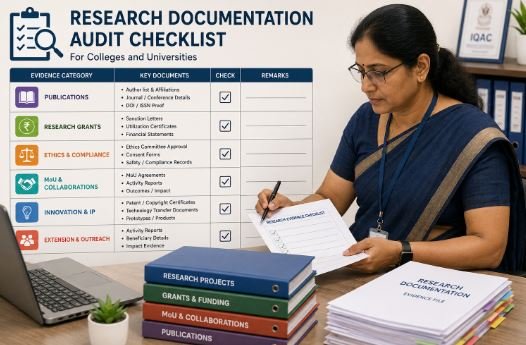
5. Category-Wise Research Evidence Checklist for NAAC Criterion 3
The checklist below is a practical institutional reference. It should be aligned with the latest applicable NAAC requirements before use.
5.1 Research governance checklist
- Approved research policy
- Policy approval record
- Research and Development Cell constitution
- Research committee orders
- Roles and responsibilities
- Annual research plan
- Research budget
- Seed-money procedure
- Research incentive procedure
- Consultancy policy
- IPR policy
- Ethics policy
- Plagiarism-prevention mechanism
- Research committee minutes
- Annual research review
- Action-taken reports
5.2 Research project and grant checklist
- Proposal call
- Submitted proposal
- Institutional forwarding
- Sanction order
- Investigator details
- Project duration
- Approved budget
- Amount received
- Ledger extract
- Purchase records
- Progress report
- Utilisation certificate
- Completion report
- Project output
- Project outcome or impact
- Funding-agency correspondence
5.3 Publication checklist
- Publication title
- Faculty author
- Department
- Journal or publisher
- Publication year
- Volume, issue and pages
- DOI or permanent link
- ISSN or ISBN
- Publication copy
- Institutional affiliation
- Publication type
- Indexing verification, where applicable
- Duplicate check
- Institutional approval or verification
- Master database entry
5.4 Research ethics checklist
- Code of research ethics
- Academic integrity policy
- Ethics committee constitution
- Integrity-panel constitution, where applicable
- Committee meeting records
- Ethical-clearance applications
- Ethical-clearance decisions
- Informed-consent formats
- Plagiarism software procedure
- Similarity-check records
- Research ethics training
- Publication ethics training
- Data-management guidance
- Complaint-handling process
- Conflict-of-interest declaration
5.5 Innovation and IPR checklist
- Innovation policy
- Innovation committee or council records
- Incubation support
- Innovation competitions
- Prototype records
- Mentor records
- Start-up support
- Patent application receipt
- Patent publication details
- Patent grant certificate
- Copyright registration
- Inventor affiliation
- Technology-transfer record
- Commercialisation outcome
- Innovation award evidence
5.6 Extension and outreach checklist
- Need assessment
- Activity proposal
- Approval
- Date and location
- Collaborating organisation
- Target group
- Attendance or beneficiary record
- Activity material
- Photographs with captions
- Expenditure
- Feedback
- Outcome assessment
- Follow-up
- Partner acknowledgement
- Annual extension summary
5.7 Collaboration and MoU checklist
- Signed MoU
- Effective date
- Expiry date
- Scope
- Institutional coordinator
- Partner coordinator
- Activity plan
- Activity reports
- Participation records
- Financial record, where applicable
- Outputs
- Outcomes
- Annual review
- Renewal status
- Closure record
5.8 Digital repository checklist
- Standard folder structure
- Role-based access
- Naming convention
- Version control
- Backup schedule
- Evidence index
- Verification status
- Broken-link check
- Privacy review
- Archive policy
- Department submission calendar
- Repository owner
- Recovery procedureChange log
- Final approved folder
6. Common Research Documentation Mistakes Institutions Should Avoid
Mistake 1: Starting evidence collection near the accreditation deadline
Last-minute collection creates pressure and encourages departments to submit incomplete or unverified records.
Better approach: Collect and verify research data monthly or quarterly.
Mistake 2: Treating a faculty CV as final evidence
A CV is self-reported and may use inconsistent classifications.
Better approach: Use CVs as source documents, then verify every institutional claim.
Mistake 3: Counting submitted projects as funded projects
Proposal submission demonstrates effort but not successful funding.
Better approach: Maintain separate categories for submitted, shortlisted, sanctioned, ongoing and completed projects.
Mistake 4: Reporting sanctioned value as money received
A sanctioned project amount may be released in instalments.
Better approach: Record approved, received and utilised values separately.
Mistake 5: Combining all publication types
Journal articles, books, edited books, chapters, conference papers and popular articles should not be mixed without classification.
Better approach: Define publication categories in the master database.
Mistake 6: Relying on screenshots as primary evidence
Screenshots may be cropped, outdated or difficult to authenticate.
Better approach: Preserve the original document or stable official record. Use screenshots only as supplementary evidence when necessary.
Mistake 7: Listing expired or inactive MoUs
A signed agreement without activity does not demonstrate sustained collaboration.
Better approach: Maintain an active-MoU register and activity tracker.
Mistake 8: Using photographs without context
A photograph alone rarely establishes the objective, participants or outcome.
Better approach: Include dated captions, approvals, attendance, reports and outcome evidence.
Mistake 9: Confusing output with outcome
A workshop is an activity. A report is an output. Improved proposal submissions or funded projects may be outcomes.
Better approach: Define intended outcomes during planning and measure them after the activity.
Mistake 10: Ignoring institutional affiliation in publications
A publication may belong to the reporting period but may not show the institution as the author’s affiliation.
Better approach: Verify affiliation exactly as it appears in the published work and apply the current reporting rule consistently.
Mistake 11: Creating policies without implementation records
A newly drafted policy does not prove an established process.
Better approach: Link the policy to meetings, budgets, approvals, activities and review records.
Mistake 12: Maintaining evidence only in personal accounts
Evidence stored in a faculty member’s personal email or drive may be lost after transfer or retirement.
Better approach: Use an institution-owned repository with controlled access and backup.
Mistake 13: Uploading confidential information publicly
Research records may contain personal contact data, signatures, bank information, student identifiers or confidential project details.
Better approach: Conduct a privacy review and create redacted public copies where necessary.
Mistake 14: Allowing different teams to report different totals
IQAC, the research cell, library and NIRF team may each maintain separate numbers.
Better approach: Use one verified institutional research database with defined data ownership.
Mistake 15: Preparing evidence files without an index
Large PDFs become difficult to review.
Better approach: Add an index, page numbers, document labels and a concise explanatory note.
7. Best-Practice Roadmap for Sustainable Research Documentation
A sustainable system should operate throughout the accreditation cycle.
Phase 1: First 30 days—diagnosis and control
- Confirm the applicable manual
- Appoint coordinators
- Prepare the metric-evidence matrix
- Audit existing records
- Identify high-risk gaps
- Finalise templates
- Create the folder structure
- Define verification roles
Expected result: The institution knows what exists, what is missing and who is responsible.
Phase 2: Days 31–60—data cleaning and verification
- Verify faculty publications
- Reconcile grant data
- Review policies and approvals
- Classify patents accurately
- Check MoU validity
- Complete missing event records
- Standardise department submissions
- Remove duplicate records
Expected result: Existing evidence becomes more accurate and usable.
Phase 3: Days 61–90—repository and reporting integration
- Upload approved files
- Create evidence indexes
- Link central and departmental records
- Align AQAR, NIRF and annual-report data
- Test website links
- Train department coordinators
- Conduct sample audits
- Issue corrective actions
Expected result: The institution has a working research evidence repository.
Phase 4: Quarterly review
Every quarter, review:
- New publications
- New project proposals
- Sanctioned grants
- Project progress
- Research events
- Ethics approvals
- Patents and innovation activity
- Extension programmes
- MoU activities
- Website links
- Department compliance
Phase 5: Annual institutional research review
The annual review should answer:
- Did research participation improve?
- Did publication quality improve?
- Were more proposals submitted?
- Were more projects funded?
- Did seed money produce measurable outputs?
- Did collaborations remain active?
- Were ethical-review processes followed?
- Did innovation initiatives produce prototypes or IPR?
- Did extension projects create measurable benefit?
- What action is required next year?
Document the review through minutes, analysis and an action plan.
Recommended ownership model
A useful principle is:
- Departments generate and submit records.
- Specialist units verify the records.
- IQAC monitors consistency.
- Management reviews performance and resources.
- The website team publishes approved evidence.
This division prevents both central overload and uncontrolled departmental reporting.
Use a single source of truth
The institutional research database should become the approved source for reporting.
Suggested master registers include:
- Faculty research register
- Publication register
- Project and grant register
- Patent and IPR register
- Research award register
- Consultancy register
- MoU register
- Extension activity register
- Ethics approval register
- Student research register
Each register should have a named owner and a documented update frequency.8. How Bhavya Gyan Consultants Can Help With Research Documentation
Creating a research evidence system requires coordination between IQAC, the research cell, departments, library, accounts, innovation teams and institutional management.
Bhavya Gyan Consultants supports higher education institutions in reviewing and structuring these systems through a practical, institution-specific approach.
Build reliable research evidence with expert institutional guidance.
Research documentation audit
BGC can review available records to identify:
- Missing evidence
- Incomplete evidence chains
- Duplicate data
- Publication-verification gaps
- Grant and accounts mismatches
- Inactive collaboration records
- Weak outcome documentation
- Folder and naming inconsistencies
- Website evidence gaps
- Responsibility and workflow issues
The objective of an audit is to provide a clear improvement roadmap—not to create unsupported records or promise an accreditation result.
Criterion-wise evidence mapping
Support may include mapping existing institutional records against the applicable Criterion 3 requirements and preparing:
- Metric-evidence matrix
- Department responsibility map
- Research data formats
- Evidence indexes
- Gap tracker
- Corrective-action calendar
- Verification workflow
Learn more about BGC’s NAAC Accreditation Consultancy.
Research documentation system development
BGC’s Research Documentation Services can help institutions establish practical structures for publications, projects, grants, innovation, ethics, collaborations and research outcomes.
Support can be aligned with the institution’s size, programmes, research maturity and existing digital systems.
IQAC and departmental coordination
Where research data are fragmented, stronger institutional coordination may be required.
BGC’s IQAC Services can support:
- Documentation workflows
- Department reporting systems
- Evidence calendars
- Quality review processes
- AQAR coordination
- Institutional data consistency
Academic and documentation audits
A wider Academic and Administrative Audit can examine how research processes connect with faculty development, finance, governance, academic planning and institutional quality systems.
NIRF research data alignment
Research information may also contribute to institutional ranking and performance analysis.
BGC’s NIRF Ranking Support can help institutions structure and validate relevant research data without maintaining conflicting databases.
Accreditation website structuring
Supporting documents and institutional research information may need organised public presentation.
BGC’s Website Structuring for Accreditation can support:
- Research policy pages
- Research-cell pages
- Project and publication sections
- IPR and innovation pages
- Extension records
- Collaboration pages
- Public evidence folders
- Stable document links
9. Request a Research Documentation Audit
Is your institution’s research evidence complete, consistent and audit-ready?
Bhavya Gyan Consultants can review your existing research documentation, identify Criterion 3 evidence gaps and prepare a practical department-wise improvement roadmap.
A documentation audit may examine:
- Research policies and governance records
- Projects and grant documentation
- Publication verification systems
- Research ethics evidence
- Patent and innovation records
- Extension and collaboration files
- Digital repository structure
- AQAR, SSR, NIRF and website consistency
Request a Research Documentation Audit: Contact Bhavya Gyan Consultants
No accreditation grade or outcome should be guaranteed. The purpose of the consultation is to improve evidence quality, institutional systems and readiness.
Conclusion:
Effective research documentation is not a last-minute exercise completed only for NAAC submission. It is a continuous institutional system that records how research is planned, approved, funded, implemented, verified and reviewed.
For NAAC Criterion 3, institutions must move beyond collecting certificates, photographs and publication lists. Strong research evidence should create a clear and traceable connection between policies, approvals, activities, financial records, outputs, outcomes and institutional improvement.
Colleges and universities can strengthen their readiness by using standard templates, maintaining a central digital repository, assigning clear responsibilities, verifying data regularly and conducting periodic documentation audits. These practices also improve AQAR reporting, NIRF data preparation, research planning and institutional decision-making.
Bhavya Gyan Consultants supports institutions in identifying evidence gaps, organising Criterion 3 records and developing practical documentation workflows. Request a Research Documentation Audit to assess the completeness, consistency and readiness of your institution’s research evidence.
FAQs:
Research documentation is the organised evidence of an institution’s research policies, governance, projects, grants, publications, ethics systems, innovation, intellectual property, consultancy, collaborations and extension outcomes.
The exact documents depend on the applicable NAAC manual and institution type. Common records may include research policies, committee minutes, grant sanction orders, project files, publication details, patent records, ethics documents, MoUs, extension reports and outcome evidence.
Usually, a certificate alone is not the strongest evidence of a publication.
The institution should preserve bibliographic details, the publication copy or official record, author affiliation, DOI or permanent URL, journal or publisher information and an internal verification record.
A college can organise evidence by category, academic year and department. It should use standard file names, controlled access, version management, backups and an evidence index.
Official External Link:
1 thought on “Research Documentation for NAAC: A Practical Criterion 3 Guide”