
IQAC setup is one of the most important initiatives for colleges and universities aiming to build a culture of continuous quality improvement and accreditation readiness. While many institutions focus on quality enhancement only during NAAC accreditation cycles, sustainable institutional excellence requires a dedicated mechanism that continuously monitors, evaluates, and improves academic and administrative processes.
The Internal Quality Assurance Cell (IQAC) serves as the central quality management system within a higher education institution. It coordinates quality initiatives, promotes evidence-based decision-making, supports accreditation preparedness, and drives institutional development. For principals, directors, IQAC coordinators, faculty leaders, and accreditation teams, establishing a well-functioning IQAC is essential for achieving long-term quality goals.
This guide explains the concept of IQAC, its importance, the step-by-step process for IQAC establishment, common challenges, best practices, and how institutions can strengthen their quality assurance systems.
1. Understanding IQAC and Its Purpose
The Internal Quality Assurance Cell (IQAC) is an institutional mechanism designed to promote continuous quality improvement in academic and administrative activities.
The primary objective of IQAC is to develop and maintain a culture of quality through systematic planning, implementation, monitoring, and evaluation.
Objectives of IQAC
- Promote quality enhancement initiatives
- Develop quality benchmarks
- Facilitate academic and administrative improvement
- Support accreditation readiness
- Strengthen documentation systems
- Encourage stakeholder participation
- Monitor institutional performance
Key Functions of a Quality Cell
A well-structured quality cell helps institutions:
- Coordinate quality initiatives
- Maintain institutional records
- Analyze performance indicators
- Prepare accreditation-related reports
- Support strategic planning
2. Why IQAC Setup Matters for Colleges and Universities
Supports Continuous Quality Improvement
Institutions that establish IQAC early are better positioned to monitor quality indicators and implement timely improvements.
Strengthens Accreditation Readiness
NAAC emphasizes quality culture rather than short-term compliance.
An effective IQAC supports:
- Documentation management
- Evidence collection
- Internal reviews
- Continuous improvement activities
Enhances Governance and Leadership
IQAC provides institutional leadership with reliable data for planning and decision-making.
Improves Academic Performance
Through regular monitoring, institutions can improve:
- Teaching-learning practices
- Student outcomes
- Research productivity
- Faculty development
Facilitates Stakeholder Engagement
Students, faculty, alumni, employers, and management contribute valuable feedback to institutional improvement.
3. Step-by-Step IQAC Establishment Process
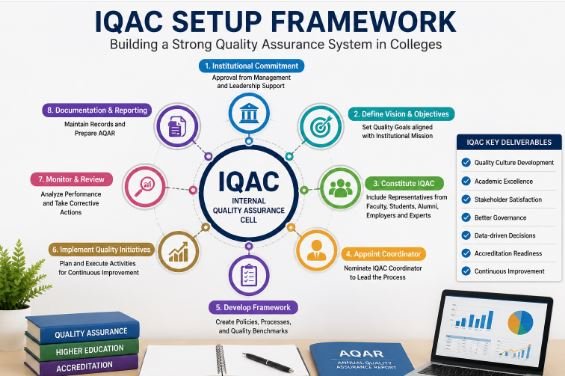
Step 1: Obtain Institutional Approval
The first step in IQAC establishment is obtaining approval from institutional leadership.
The governing body or management should formally approve the creation of the IQAC.
Step 2: Define Vision and Objectives
The institution should clearly define:
- Quality goals
- Improvement priorities
- Expected outcomes
These objectives should align with the institution’s mission and strategic plan.
Step 3: Constitute the IQAC Committee
An effective IQAC should include representation from multiple stakeholders.
Recommended Composition
| Stakeholder | Role |
|---|---|
| Principal | Chairperson |
| Senior Faculty | Members |
| Administrative Officers | Members |
| IQAC Coordinator | Coordinator |
| Alumni Representative | Member |
| Employer Representative | Member |
| Student Representative | Member |
Step 4: Appoint an IQAC Coordinator
The coordinator serves as the operational leader of the IQAC.
Responsibilities include:
- Planning meetings
- Managing documentation
- Coordinating activities
- Monitoring quality initiatives
Step 5: Develop an IQAC Framework
The institution should establish:
- Quality benchmarks
- Performance indicators
- Reporting systems
- Review mechanisms
Step 6: Create Quality Policies
Develop policies related to:
- Academic quality
- Research promotion
- Student support
- Governance practices
Step 7: Establish Documentation Systems
Documentation is a critical component of the IQAC process.
Create repositories for:
- Meeting minutes
- Reports
- Feedback records
- Action Taken Reports
- Performance data
Step 8: Initiate Quality Activities
The IQAC should begin implementing quality enhancement initiatives across the institution.
4. Essential Documentation and Operational Framework
Core IQAC Documents
A newly established IQAC should maintain:
- IQAC constitution order
- Member list
- Meeting schedules
- Annual plans
- Quality policies
Operational Records
Maintain:
- Meeting minutes
- Attendance records
- Activity reports
- Feedback analyses
- Improvement action plans
Annual Quality Assurance Report (AQAR)
One of the major responsibilities of IQAC is preparing AQAR.
AQAR documents:
- Quality initiatives
- Institutional achievements
- Performance indicators
- Improvement outcomes
Internal Quality Reviews
Regular reviews help identify:
- Strengths
- Weaknesses
- Opportunities
- Improvement priorities
Documentation Checklist
1. IQAC formation order
2. Member details
3. Quality objectives
4. Meeting records
5. Annual plans
6. AQAR preparation system
7. Feedback mechanisms
8. Action Taken Reports
5. Common Mistakes Institutions Should Avoid
Treating IQAC as a NAAC Committee
IQAC should function throughout the year rather than only during accreditation preparation.
Weak Documentation Practices
Many institutions fail to maintain evidence systematically.
Lack of Stakeholder Involvement
Quality improvement requires participation from all stakeholders.
Poor Follow-Up on Recommendations
Identifying issues without implementing improvements reduces effectiveness.
Infrequent Meetings
Regular meetings are essential for monitoring progress and maintaining momentum.
Limited Data Utilization
Institutions should use data actively for planning and decision-making.

6. Best Practices for Effective IQAC Functioning
1. Establish a Quality Culture
Quality should become part of daily institutional operations.
2. Conduct Regular Academic Audits
Academic audits help identify improvement opportunities.
3. Develop Performance Dashboards
Monitor:
- Student outcomes
- Faculty achievements
- Research productivity
- Institutional performance
4. Strengthen Documentation Systems
Maintain organized digital repositories.
5. Promote Faculty Participation
Faculty engagement is essential for successful quality initiatives.
6. Encourage Innovation
Support:
- Research projects
- Industry collaborations
- Technology adoption
7. Monitor Continuous Improvement
Every recommendation should lead to measurable actions.
Recommended IQAC Roadmap
1: Quality Assessment
2: IQAC Formation
3: Documentation Setup
4: Quality Benchmark Development
5: Institutional Reviews
6: Continuous Improvement Monitoring
7. How BGC Can Help with IQAC Setup
Bhavya Gyan Consultants supports colleges and universities in establishing effective IQAC systems aligned with accreditation and quality assurance requirements.
BGC Services Include
- IQAC Establishment Support
- Quality Framework Development
- Documentation Systems Design
- AQAR Preparation Guidance
- Academic Audit Services
- NAAC Readiness Assessments
- Quality Benchmark Development
- Institutional Performance Reviews
- Capacity Building Workshops
Our experts help institutions create sustainable quality assurance systems that support long-term institutional excellence.
Official External Resources
- University Grants Commission (UGC)
- National Assessment and Accreditation Council (NAAC)
- Ministry of Education
Conclusion
A successful IQAC setup is not merely about forming a committee. It involves creating a robust quality assurance framework that continuously drives institutional improvement. Through systematic planning, documentation, monitoring, and stakeholder engagement, colleges and universities can build a sustainable quality culture that supports accreditation readiness and academic excellence.
Institutions that invest in effective IQAC establishment today are better prepared to meet future challenges and achieve long-term quality objectives.
FAQs:
IQAC setup refers to establishing an Internal Quality Assurance Cell responsible for monitoring and improving institutional quality.
The committee should include institutional leaders, faculty members, administrative staff, students, alumni, and employer representatives.
Institutions should conduct meetings regularly throughout the year to monitor quality initiatives and institutional performance.
Institutions should conduct meetings regularly throughout the year to monitor quality initiatives and institutional performance.
Formation orders, meeting minutes, quality policies, annual plans, AQAR records, and action taken reports should be maintained.