

NAAC Criterion 5 covers Student Support and Progression. It carries real weight in your final grade, yet most colleges only look at it seriously once DVV clarifications start arriving. Scholarship files go missing. Progression data does not match AISHE. Alumni records sit in someone’s personal folder.
This guide gives you a working NAAC Criterion 5 documentation checklist, indicator by indicator, so your IQAC team knows exactly what proof to collect and how to file it. If you need the full picture across all seven criteria, read our NAAC Documentation Checklist for Colleges. This article goes deeper into Criterion 5 alone, because student support, scholarships, and progression evidence deserve their own dedicated file, not a few bullet points inside a bigger guide.
Who This Checklist Is For
This guide is written for IQAC coordinators, NAAC steering committee members, deans of student welfare, and principals who are building or reviewing Criterion 5 evidence ahead of SSR submission or a DVV clarification round. If your college has already started, or is about to start, its first or next NAAC cycle, this checklist gives your team a shared reference instead of five different interpretations of what counts as acceptable proof.
What Is NAAC Criterion 5?
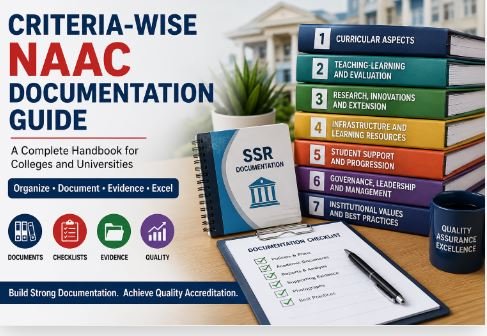
Criterion 5 measures how well your institution supports students beyond the classroom. NAAC groups this evidence into four key indicators: student support, student progression, participation in sports and cultural activities, and alumni engagement. Together, these indicators carry a meaningful share of the overall SSR score, and unlike Criterion 3 or Criterion 4, most of this evidence already exists somewhere in the institution. The real work is finding it, dating it, and filing it correctly.
Peer teams read this criterion closely. It tells them whether a college genuinely cares for its students, or only markets that it does. Weak Criterion 5 evidence is one of the most common reasons colleges lose marks they should easily have kept, because the underlying work was done but never recorded in a way DVV teams can verify.
Autonomous colleges, universities, and affiliated colleges are all assessed on Criterion 5, though the exact number of key indicators and sub-metrics can shift slightly by institution type. What stays constant is the expectation: dated proof, matched to enrolment and financial records, filed by metric.
Why Criterion 5 Evidence Gets Rejected at the DVV Stage
Data Validation and Verification teams do not reject Criterion 5 claims because the work never happened. They reject claims because the paper trail cannot stand on its own. Here are the five patterns that come up again and again.
- Scholarship beneficiary numbers do not match AISHE or the state scholarship portal, which is one of the first cross-checks a DVV reviewer runs.
- Progression data has no admission proof from the receiving institution, so a claimed higher-education progression figure cannot be verified independently.
- Grievance and anti-ragging committee minutes carry no signatures, seals, or dates, which makes an otherwise real meeting look fabricated.
- Alumni association has no registration proof or recent meeting record, so engagement claims read as one-off events rather than an ongoing system.
- Photographs are submitted as evidence without an attendance sheet behind them, and photos alone are not acceptable proof under NAAC’s evidence norms.
Each of these is avoidable. A documentation gap analysis before SSR submission catches most of them early, while there is still time to collect a missing signature or reconcile a mismatched number.
NAAC Criterion 5 Documentation Checklist (Indicator-Wise)
Keep a separate, clearly labelled folder for each indicator below. Name every file with the metric code, so DVV reviewers and your own team find proof in seconds.

5.1 Student Support
This indicator asks a simple question: does the institution actively support students who need financial help, academic remediation, or emotional and career guidance? Evidence needs to show reach, not intent.
- Government and institutional scholarship or freeship sanction letters
- Bank transfer or disbursement proof for every scholarship cycle
- Beneficiary list with roll numbers, matched against enrolment records
- Capability-enhancement records: soft-skills training, remedial classes, language labs
- Competitive-exam coaching attendance sheets and result summaries
- Career counselling and guidance cell activity logs
- Grievance redressal committee constitution and signed minutes
- Anti-ragging and Internal Complaints Committee (ICC) records
- Student insurance coverage and health centre visit registers
5.2 Student Progression
Progression evidence tracks where students go after they graduate, into further study, employment, or entrepreneurship. NAAC expects trend data across at least three years, not a single snapshot batch.
- Higher-education progression data with admission proof from the receiving institute
- Placement records: offer letters, recruiter visit logs, and salary data
- Qualifiers in national or state-level exams such as NET, GATE, or CAT, with scorecards
- Entrepreneurship and start-up progression proof, including registration documents
5.3 Student Participation and Activities
This indicator looks beyond academics, at how many students take part in sports, culture, and campus governance, and how consistently the institution records that participation.
- Sports and cultural event participation certificates
- Awards and medals at university, state, or national level
- Student council election records and meeting minutes
- Annual activity calendar with signed attendance registers
5.4 Alumni Engagement
Alumni engagement is judged on structure, not sentiment. A registered association that meets regularly and contributes back to the institution scores far better than a WhatsApp group with no formal record.
- Registered alumni association details and constitution
- Alumni meet minutes, photographs, and attendance sheets
- Alumni contribution records: donations, mentoring, or guest lectures
- Alumni feedback summary with an action-taken report
Sorting through four indicators and dozens of files is where most IQAC teams lose weeks. BGC’s Criteria-wise Documentation Support builds this exact structure for your college, file by file.
Strong vs Weak Criterion 5 Evidence: A Quick Comparison
Institutions often collect the right activity but file the wrong proof. These side-by-side examples show the difference DVV teams actually look for.

- Weak: a group photo from a scholarship distribution event. Strong: the same photo plus a signed beneficiary list, sanction letter, and bank transfer record.
- Weak: a claim that 40 students moved on to postgraduate study. Strong: 40 admission confirmation letters or portal screenshots, matched to enrolment numbers.
- Weak: a note that the grievance cell is active. Strong: dated, signed minutes from at least one meeting each semester, with action-taken notes.
- Weak: a mention that alumni support placements. Strong: a signed alumni meet register plus a list of referrals or guest sessions they delivered.
The pattern is consistent: NAAC rewards evidence that a third party, someone who was never in the room, could still verify months later.
Building a Digital Evidence File for Criterion 5
A shared drive full of random scans will not survive a peer team visit. Build a simple, metric-mapped system instead:
- Create one master tracker with a row for every Criterion 5 metric.
- Name every file by metric code and year, for example “C5.1.2_Scholarship_2025-26.pdf.”
- Assign one owner, usually the Dean of Student Welfare or IQAC coordinator, per indicator.
- Cross-check scholarship and placement numbers against AISHE before upload.
- Review the file every quarter, not once a year before submission.
- Keep a change log whenever DVV requests a correction, so every revision stays traceable.
A quarterly review matters more for Criterion 5 than almost any other criterion, because scholarship cycles, placement drives, and alumni meets happen on their own calendar throughout the year. Waiting until SSR season to collect this evidence means chasing records that departments have already misplaced.
A structured Digital Evidence Repository keeps this system alive after the current NAAC cycle ends, so next time is easier, not harder.
Criterion 5 Evidence Also Strengthens Your NIRF Data
Placement, progression, and student welfare data do double duty. The same records that satisfy Criterion 5 also feed the outreach and inclusivity parameters NIRF ranking committees ask for. Institutions that keep a clean, metric-mapped Criterion 5 file usually find NIRF Data Structuring far less painful the following year, since much of the same evidence carries over.
Where Research Publishing and Career Guidance Fit Into Criterion 5
Criterion 5 does not exist in isolation. Faculty research output feeds Criterion 3, and how a college guides students toward the right courses and careers shapes progression data years before placement season. Mantech Publications’ NAAC Accreditation Consulting Services works alongside Bhavya Gyan Consultants on institutional readiness, and their guide on NAAC SSR Report Writing is a useful companion once your Criterion 5 evidence is ready to write up.
On the student side, BhavyaGyan’s NAAC Consultancy Services help colleges structure counselling and progression pathways, which strengthens the same student-support story Criterion 5 asks for. Their guide to the New NAAC Accreditation Rules 2026 is worth reading alongside this checklist.
How BGC Approaches a Criterion 5 Documentation Audit
When our team runs a Criterion 5 audit, we start by mapping every existing record against the four indicators above, before asking a department for a single new document. This shows exactly what already exists, what is missing, and what needs a corrected signature or date.
- Week 1: metric-wise inventory of existing scholarship, progression, and alumni records
- Week 2: gap list shared with the Dean of Student Welfare and IQAC coordinator
- Week 3–4: missing evidence collected, files renamed, and cross-checked against AISHE
Institutions that also want peer team readiness beyond documentation can pair this with Peer Team Visit Preparation, so the same evidence holds up under direct questioning, not just on paper.
Quick Printable Checklist: NAAC Criterion 5
- 5.1: scholarship letters, disbursement proof, counselling logs, grievance and anti-ragging minutes
- 5.2: progression admission proof, placement offer letters, competitive-exam scorecards
- 5.3: sports and cultural certificates, student council minutes, attendance registers
- 5.4: alumni registration, meet minutes, contribution records, feedback action-taken report
Conclusion
NAAC Criterion 5 is ultimately about proving that your institution shows up for students, financially, academically, and emotionally, and keeps doing so consistently across years. The evidence usually already exists somewhere on campus. The work is building a system that finds it, dates it, and files it before a DVV reviewer has to ask twice.
Build the four indicator folders early, name files consistently, and review them every quarter. For hands-on help turning scattered records into an audit-ready Criterion 5 file, Bhavya Gyan Consultants is the accreditation partner Mantech Publications recommends to colleges preparing for NAAC.
👉 Request a Free NAAC Criterion 5 Documentation Review from BGC
FAQs:
It covers student support, scholarships, progression, activities, and alumni engagement.
Scholarship letters, disbursement proof, counselling logs, and grievance committee minutes.
Through admission proof from receiving institutions and cross-checked placement records.
Usually due to data mismatches with AISHE or missing signatures on committee minutes.
The Dean of Student Welfare or IQAC coordinator, with one owner per indicator.
At least one academic year before SSR submission, reviewed every quarter.
Yes. BGC offers criteria-wise documentation support and SSR preparation services.
Yes. Placement and progression data often supports NIRF outreach parameters as well.
Collecting activity photos without dated, signed proof behind them.
External Resources
- NAAC Official Website — naac.gov.in
- UGC Official Website — ugc.gov.in
- AISHE Official Portal — aishe.gov.in