
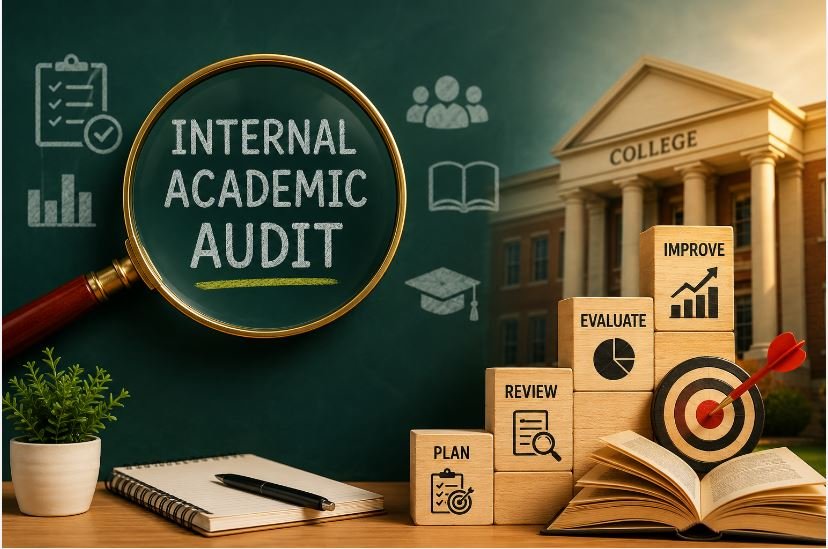
Most institutions only think seriously about academic quality when an accreditation visit is approaching. A well-run internal academic audit changes that pattern, turning quality review into a routine institutional habit rather than a periodic scramble. This guide covers what an internal academic audit actually involves, how to run one well, and how it connects directly to your NAAC and NBA readiness. If your institution has not yet built a broader accreditation timeline around this, our guide on how to start NAAC preparation in a college is a useful starting point.
Institutions that run internal audits well tend to describe the same shift: what used to feel like an external inspection preparing for another external inspection starts to feel like the institution simply paying attention to its own work. That shift in framing changes how faculty engage with the process, from something to survive to something that genuinely improves their teaching.
What Is an Internal Academic Audit?
An internal academic audit is a self-conducted evaluation an institution runs on its own academic practices, examining curriculum delivery, teaching methods, assessment quality, and learning outcomes. Unlike an external accreditation visit, it is entirely introspective: the institution reviews itself, identifies its own strengths and gaps, and acts on the findings before an outside body ever gets involved.
- Ensures academic practices meet the institution’s own internal quality standards
- Improves the actual quality of teaching and learning, independent of any external evaluation
- Builds a documented, evidence-based record that prepares the institution for NAAC or NBA review
- Creates a structured feedback loop between classroom practice and institutional decision-making
🚀 Ready to build a structured, continuous internal academic audit process?
Why Internal Academic Audits Matter Beyond Accreditation
It is tempting to treat academic review purely as accreditation preparation, but institutions that do only that miss most of the actual value. A genuinely useful internal audit changes how departments teach and assess, not just how well they can describe it on paper.
- Creates a non-punitive space where faculty can identify gaps in their own teaching without fear of penalty, which encourages honest self-reflection rather than defensive reporting
- Gives faculty structured, evidence-based feedback instead of ad hoc criticism, making development conversations more constructive
- Surfaces patterns across departments that would otherwise stay invisible until an external assessor asks a pointed question
- Builds institutional muscle memory for continuous improvement, so accreditation cycles become confirmations of ongoing quality rather than one-off performances

The Internal Academic Audit Process, Step by Step
- Planning: Define the scope and objectives of the audit, identify which departments and areas will be reviewed, and allocate the resources and personnel needed
- Execution: Conduct a comprehensive review of curriculum design, teaching methods, and assessment strategies across the selected departments
- Reporting: Document findings clearly, highlighting both commendable practices and specific areas needing attention
- Action Plan: Develop a concrete plan addressing identified gaps and building on existing strengths, with clear ownership and timelines
This cycle should run continuously, not as a single annual event. Institutions that treat each phase as a distinct, dated exercise, rather than a loose ongoing effort, get far more consistent results across departments.
📋 Want your internal audit process structured to feed directly into your SSR or SAR evidence?
Who Should Govern the Audit Process
A credible internal academic audit needs a steering committee separate from the departments it evaluates, so findings carry genuine institutional weight rather than reading as self-assessment alone. Without this separation, audits tend to drift toward confirming what a department already believes about itself, rather than surfacing genuine blind spots.
- Senior academic leaders, to give the audit institutional authority and ensure findings translate into real decisions
- IQAC representatives, since this committee ultimately owns the connection between audit findings and accreditation evidence
- Faculty representatives from outside the department being reviewed, to bring an informed but independent perspective
- Administrative staff, to support data collection and documentation throughout the process
What a Teaching-Learning Audit Actually Covers
The teaching learning audit component is usually the heart of an internal academic audit, since it touches the areas that most directly affect student outcomes. This is also the area where generic, box-ticking audits differ most sharply from genuinely useful ones.
- Course files and academic records, checked for completeness and consistency across faculty
- Curriculum delivery against the planned syllabus, verifying pace and coverage match what was intended
- Assessment design and question paper quality, checking alignment with stated learning outcomes
- Student performance data and result trends, reviewed for patterns that might indicate teaching or assessment gaps
- Feedback mechanisms, confirming that student and peer feedback is actually collected and acted upon
🎓 Need help structuring a teaching-learning audit that ties directly into NBA’s CO-PO attainment data?
A Practical Timing Model: Pre-Term, Mid-Term, and Post-Term Audits
One widely used approach, adopted by several Indian technical institutions, splits the academic audit into three checkpoints across a single term rather than one end-of-term review.
- Pre-term audit: Reviews course plans and preparedness before teaching begins, catching gaps in syllabus mapping or resource readiness early.
- Mid-term audit: Checks actual delivery progress against the plan, giving faculty time to course-correct before the term ends.
- Post-term audit: Reviews final outcomes, assessment quality, and result patterns, feeding directly into the next term’s action plan.
Institutions using this model often score each parameter against a defined rubric, rating course files and delivery as complete, partially complete, or incomplete, then converting these ratings into a simple numeric scale used for both institutional tracking and individual faculty feedback.
📅 Want to design a term-wise audit rubric suited to your institution?
A Real Audit vs a Compliance Checklist
It is worth being honest about the difference, since many institutions run something that looks like an audit but functions as a paperwork exercise. A checklist asks whether a document exists. A genuine audit asks whether the underlying practice it describes is actually happening, and whether it is working.
- A checklist confirms a course file was submitted; an audit checks whether the syllabus was actually covered at the stated pace
- A checklist confirms a feedback form was collected; an audit checks whether anything changed as a result of that feedback
- A checklist confirms an assessment was conducted; an audit checks whether the assessment actually measured the intended learning outcome
This distinction is exactly why the action plan stage matters so much. A checklist ends at confirmation. A genuine audit ends at a specific, owned commitment to change something.

How Internal Academic Audits Strengthen NAAC and NBA Readiness
A consistently run internal audit builds exactly the kind of continuous evidence trail that NAAC and NBA expect to see, rather than evidence assembled retroactively before a visit. Our guide on how to prepare evidence for DVV covers how to structure this evidence once collected, and our SSR Preparation Guide for Colleges shows how audit findings can feed directly into criterion-wise SSR content.
Common Mistakes Institutions Make With Internal Academic Audits
- Running the audit only once a year, right before an accreditation deadline, instead of on a continuous cycle
- Treating findings as a compliance checklist rather than genuine input for improvement
- Skipping the action plan stage entirely, so the same gaps reappear audit after audit
- Allowing departments to audit themselves without any independent review, weakening the credibility of the findings
Conclusion
An internal academic audit is only as valuable as the action taken after it. Institutions that run this process continuously, govern it independently, and genuinely act on what it reveals build both stronger teaching quality and a naturally accreditation-ready evidence trail. Treat it as an ongoing improvement habit rather than a pre-accreditation formality, and the benefits show up in classroom quality long before any external assessor arrives. The institutions that struggle most during NAAC or NBA visits are consistently the ones running their first real audit the same year they submit their SSR.
Once your audit process is running consistently, our guide on how to write strong SSR responses shows how to turn that ongoing evidence into a compelling accreditation narrative.
FAQs:
To assess and improve teaching quality and prepare institutions for external accreditation.
A steering committee independent of the department being reviewed.
Continuously, ideally with checkpoints across each academic term.
Course files, curriculum delivery, assessment design, and result trends.
It builds a continuous evidence trail rather than last-minute documentation.


3 thoughts on “Internal Academic Audit Process: A Practical Guide for Colleges”