
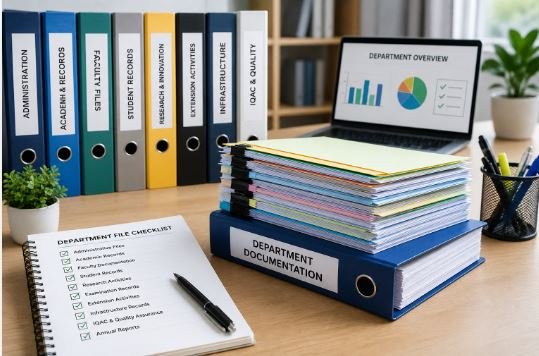
Most institutions understand what DVV checks. Far fewer know how to actually build evidence that survives it. Good DVV evidence preparation is a discipline of its own, separate from writing a strong SSR narrative. This guide covers exactly that: how to organise, format, and self-check your evidence before it ever reaches the portal. If you need the conceptual background first, our guide on what DVV actually is covers the process, timeline, and portal rules in detail.
Strong evidence preparation is not about collecting more documents. It is about collecting the right documents, in the right format, organised so that every claim in your SSR can be traced back to proof within seconds.
Why Evidence Preparation Should Start Years Before Submission
NAAC assesses institutions against a rolling five-year window, which means evidence preparation cannot realistically begin the semester before SSR submission. A bridge course held three years ago still needs attendance records today, and a research grant from two cycles back still needs to be traceable when DVV asks for it.
Institutions that build their evidence habits early, logging documents as activities happen rather than reconstructing them later, consistently submit stronger, more consistent evidence than those who start the search only once SSR drafting begins. Treat evidence preparation as a standing IQAC responsibility, not a project that starts and ends with a single accreditation cycle.
🚀 Ready to build a DVV-proof evidence repository before your next submission? Get Criteria-wise Documentation Support from BGC today.
What “DVV-Ready” Evidence Actually Means
Strong NAAC evidence shares a few consistent traits, regardless of which criterion it supports.
- It is traceable: every document connects clearly to the specific metric it supports
- It is authentic: signed, dated, and issued by the correct authority
- It is current: valid at the time of submission, not expired or pending renewal
- It is consistent: figures match across every criterion that references the same activity
- It is accessible: hosted correctly, within file size limits, and reachable without login barriers

Building Your Evidence Repository: File Organisation That Survives DVV
A disorganised evidence folder is one of the most common reasons institutions scramble during DVV, even when the underlying proof exists somewhere on a department computer. Build your repository with retrieval speed in mind from day one.
- Create one folder per metric ID, not per department, so evidence maps directly to what a reviewer is checking
- Use a consistent naming convention: year, metric ID, and a short description, for every file
- Maintain a single master index spreadsheet that links every metric to its folder location and file names
- Assign one person per criterion as the evidence owner, responsible for keeping that folder complete and current
- Back up the entire repository outside the institution’s primary server, in case of local system failure
🗂️ Want your evidence repository structured and metric-mapped before you start SSR drafting? Get Criteria-wise Documentation Support from BGC.
Formatting Rules Every Evidence File Must Follow
Beyond the well-known 5 MB file size limit, a few formatting habits consistently separate evidence that clears DVV smoothly from evidence that draws unnecessary queries. None of these require special software or expertise, just consistent attention before upload.
- Scan documents at a resolution that keeps text legible, not just visually present, since illegible scans are treated as incomplete evidence
- Use PDF format wherever possible, since it renders consistently across devices and reviewers
- Ensure every official document carries a visible signature and, where applicable, an institutional stamp or letterhead
- Avoid submitting raw, unedited photographs of documents when a proper scan is possible
- Attach an English translation alongside any regional-language document, rather than submitting the translation separately
Evidence for QnM vs QlM: What “Proof” Looks Like for Each
Understanding what counts as strong DVV proof differs depending on the type of metric you are supporting.
- For quantitative metrics (QnM): Attendance registers, admission data, result sheets, MoUs with dates and signatures, and financial records that match the exact figure claimed.
- For qualitative metrics (QlM): Circulars, event reports with photographs, committee meeting minutes, feedback analysis reports, and third-party certificates or letters that support the practice described.
A useful test for any piece of evidence is to ask whether a reviewer, with no other context, could look at the document and independently confirm the claim it supports. If the answer is no, the evidence needs strengthening before submission, not after a clarification request.
📁 Not sure if your current evidence would hold up to that test? Get DVV Clarification Support from BGC for a review before you submit.
Cross-Verification: Making Your Evidence Internally Consistent
The same achievement often appears in more than one criterion. A placement figure might support both Criterion 5 and Criterion 2, and a research grant might appear under both Criterion 3 and Criterion 7. DVV frequently catches institutions where these repeated figures do not match exactly.
- Build a master evidence index that flags every figure appearing in more than one criterion
- Assign one reviewer to check cross-references before final submission, separate from the criterion-wise writing teams
- Confirm that annexure numbers referenced in your SSR text match the actual file names in your repository
- Re-check totals and percentages for basic arithmetic accuracy, since simple calculation errors are a common, avoidable flag

Conducting a Mock DVV Self-Audit Before Submission
The single most effective preparation step is to simulate DVV yourself before NAAC does. Ask someone outside your writing and documentation team to review a sample of your evidence with fresh eyes, since anyone too close to the drafting process tends to read intent into a document rather than checking what it actually proves.
- Pick 10 to 15 metrics at random and check whether the evidence fully supports the claim without additional explanation
- Test every hosted link from a different device or network to confirm it is publicly accessible
- Confirm every file opens correctly and displays legibly, not just that it exists in the folder
- Time how long it takes to locate evidence for a given metric; slow retrieval usually signals a folder structure problem
✅ Want an external, expert self-audit before you finalise your evidence? Book a Free DVV Readiness Check with BGC.
Who Should Own Evidence Preparation
Evidence quality drops sharply when it becomes everyone’s job and no one’s responsibility. A clear ownership structure prevents gaps from going unnoticed until the final weeks.
- IQAC coordinator: owns the overall evidence repository and the master index across all criteria
- Criterion-wise leads: responsible for evidence completeness within their assigned criteria, reporting gaps early
- Department nodal officers: collect and forward department-level evidence on a fixed schedule, not on request
- One designated reviewer: checks formatting, signatures, and cross-criteria consistency before final submission
This structure works best when it operates year-round, with periodic check-ins, rather than being assembled for the first time right before a submission deadline.
Common Evidence Preparation Mistakes
- Collecting evidence only after DVV clarifications arrive, instead of building it alongside SSR drafting
- Storing evidence department-wise instead of metric-wise, which slows retrieval during review
- Hosting large files on third-party drives instead of the institution’s own website
- Submitting scanned documents too low in resolution to read clearly
- Failing to check that the same figures match across every criterion where they are mentioned
Conclusion
Strong DVV evidence preparation is built long before submission, not scrambled together after a clarification request arrives. Organise your repository by metric, follow formatting rules consistently, match figures across every criterion, and run a self-audit before you submit. Institutions that treat evidence preparation as an ongoing discipline, not a pre-deadline task, consistently face fewer clarifications and clear DVV faster.
FAQs:
It is traceable, authentic, current, consistent, and easily accessible to a reviewer.
By metric, since that is how DVV reviewers search for proof.
PDF, scanned at a resolution that keeps text clearly legible.
Maintain a master index tracking every figure used across multiple criteria.
A pre-submission review simulating how a DVV reviewer would check your evidence.
5 thoughts on “How to Prepare Evidence for DVV: A Practical Guide for NAAC Submissions”