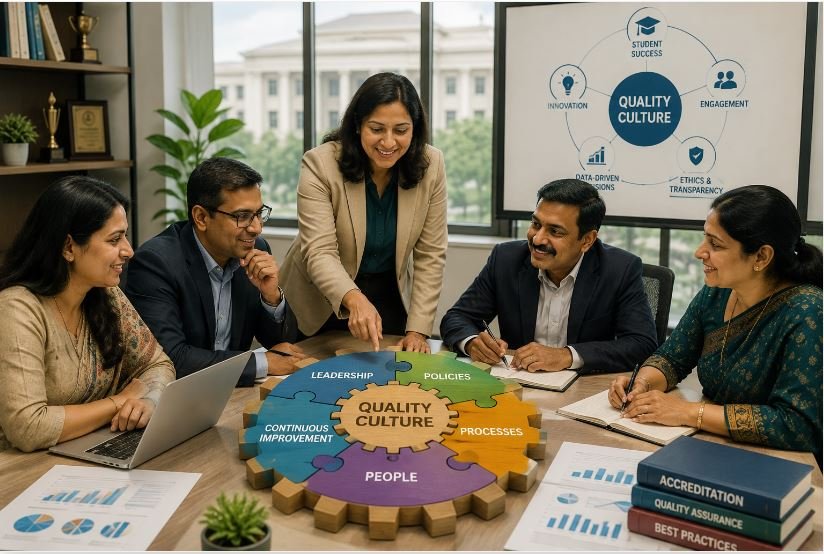
Most consultancies help colleges pass an audit. Fewer help colleges build something that outlasts it. When we talk about quality culture in colleges, we mean the difference between an institution that scrambles before every NAAC cycle and one where good documentation, honest feedback, and continuous improvement are simply how things work, whether or not an assessor is arriving next month. This post covers how BGC approaches that goal specifically with our client institutions. For the underlying framework and general principles behind quality culture, our guide on how to build continuous quality improvement in colleges lays out the theory; this post is about how we actually put it into practice.
What We Mean by Quality Culture, in Practice
It is easy to talk about quality culture in the abstract. In practice, it looks like specific, observable habits: a department that updates its evidence folder the week an event happens, not the week before submission; an IQAC that reviews feedback every semester instead of once a year; faculty who can explain their own course outcomes without needing a script prepared by someone else.
None of these habits require expensive tools or large teams. They require a system that makes the right behaviour the easy behaviour, and enough institutional patience to let that system take hold over a full academic year rather than expecting it overnight.
🚀 Ready to see how this approach applies to your institution?
Why Quality Culture Is Harder to Build Than a Quality Process
Any consultancy can help an institution draft a stronger SSR for one cycle. Building genuine quality culture is a different, harder problem, because it depends on people continuing to do the right things after the consultancy engagement ends, not just during it. This is the distinction we design our entire engagement model around.
A process can be handed over on a checklist. A culture cannot. It has to be practiced repeatedly, by the institution’s own people, until it stops feeling like an imposed requirement and starts feeling like normal work. This takes longer than producing a single strong SSR, which is exactly why so many consultancies avoid it in favour of faster, more billable deliverables.

Where We Start With Every Institution
We do not open an engagement with a template. Every institution’s starting point, existing IQAC maturity, documentation habits, faculty workload, and prior accreditation history, is genuinely different, and treating two colleges the same way produces weak results for at least one of them. A first-time applicant and an institution renewing its third cycle need almost entirely different starting conversations.
- A structured readiness diagnostic across every criterion, identifying real gaps rather than assuming a standard set of weaknesses
- An honest conversation with leadership about current culture, not just current documentation, since the two are related but not identical problems
- A realistic assessment of internal capacity, so the plan we build matches what the institution’s own team can actually sustain going forward
This diagnostic-first approach is the same one covered in our guide on how to start NAAC preparation in a college, which we apply directly with every institution we work with, not just describe in general terms.
📋 Want an honest, institution-specific readiness diagnostic before committing to a full engagement?
How BGC Builds Sustainable Systems, Not Just One-Time Fixes
The core philosophy behind our BGC consultancy approach is straightforward: our job is to make ourselves progressively less necessary, not more. An engagement that leaves an institution dependent on us for every future cycle has not actually built quality culture; it has just outsourced it.
- We train IQAC teams and criterion-wise leads directly, rather than producing final documents without involving the people who will need to defend them during a peer visit
- We introduce internal audit habits designed to run continuously with the institution’s own staff, not to depend on us returning every semester
We also help institutions set up documentation systems, covered in our guide on how to prepare evidence for DVV, that keep working long after our engagement ends, not just for the current cycle. Our guide on the internal academic audit process reflects the same audit methodology we help institutions build internally, so it continues running with or without us involved.
🔄 Want a documentation and audit system your own team can sustain independently?
What Changes When Quality Culture Takes Hold
Institutions that successfully build this kind of culture tend to describe the same shifts, regardless of their size or stream. None of these changes happen in the first month of an engagement; they build gradually across an academic year as new habits replace old ones.
- Evidence collection stops being a pre-deadline scramble and becomes a routine part of how departments already operate
- DVV clarifications drop noticeably, since evidence is consistent and complete from the first submission rather than assembled hastily
- SSR drafting cycles shorten over time, since criterion-wise data is already organised rather than needing to be reconstructed each cycle
- Peer team visits feel less like a performance and more like a walkthrough of genuine, ongoing practice

Why Institutional Quality Requires More Than a Consultant
We are direct with every institution we work with about this: no consultancy, including us, can build institutional quality on your behalf. We can structure the process, train the team, and catch the gaps a busy internal team might miss under deadline pressure. But leadership buy-in, faculty participation, and follow-through between our engagements are entirely the institution’s own work. Institutions that expect a consultancy to do this work for them, rather than with them, tend to see the culture shift fade within a year or two of the engagement ending.
- We treat ourselves as a catalyst for the institution’s own systems, not a permanent substitute for them
- We stay engaged beyond the immediate SSR cycle, supporting AQAR submissions and planning for the next accreditation cycle, rather than disappearing once a result is announced
- We measure our own success by whether an institution needs less support from us over time, not more
🚀 Ready to build a quality culture that outlasts your next accreditation cycle?
Conclusion
Building genuine quality culture in colleges is slower and less flashy than producing a polished SSR for one cycle, but it is the only approach that actually compounds over time. Our engagements are built around that goal specifically: diagnose honestly, train the people who will carry the work forward, build systems that survive our departure, and stay involved beyond the immediate result. That is the difference between an institution that passes an audit and one that has genuinely changed how it operates, and it is the difference we aim for with every institution we work with.
If you want the underlying principles behind this approach, our guide on continuous quality improvement in colleges is a useful companion to this post.
FAQs:
A diagnostic-first, ownership-focused model built to reduce dependency over time.
We train and guide institutional teams to write it, rather than replacing their voice entirely.
Yes, including AQAR support and planning for the next cycle.
By embedding sustainable documentation and audit habits the institution’s own team can run independently.
Yes, the same diagnostic-first model applies to both first cycles and renewals.
External Resources
Related posts:
NAAC 2025–26: Indian Colleges के लिए Complete Guide — Binary Accreditation, MBGL, Transition Rules औ...

Website Structuring for Accreditation: A Practical Guide for Colleges
How to Build Continuous Quality Improvement in Colleges