

Every NBA visit brings the same panic to engineering departments. Files go missing. Signatures are pending. Faculty scramble to find three-year-old attendance registers. This happens because departments treat documentation as a last-minute task, not an ongoing system.
A proper NBA documentation checklist changes that. It turns scattered department files into an organized, evidence-based record that peer teams can verify in minutes, not hours. This guide breaks down exactly what departments need to prepare, how to organize it, and when to start.
Why an NBA Documentation Checklist Matters for Departments
NBA accreditation is an outcome-based process. Peer teams do not just read your Self-Assessment Report (SAR). They verify every claim against physical or digital NBA evidence. If a department claims 90% CO attainment, assessors expect to see the actual assessment records, marks, and calculation sheets behind that number. For a wider view of the process, read this guide on NBA accreditation in India by Mantech Publications.
Without a checklist, departments face three recurring problems:
- Evidence exists but is scattered across faculty laptops, registers, and old files
- Data does not match between the SAR, department records, and the institute website
- Departments try to rebuild years of records in the final weeks before a visit
A checklist-driven approach avoids all three. It also helps institutions build a stronger public reputation, since students often compare NBA-accredited colleges before choosing where to apply. If you want expert support across the full process, BGC’s NBA accreditation consultancy team can guide your institution end to end.
What Counts as Valid NBA Evidence

Before building a checklist, it helps to understand what NBA evidence actually looks like. Evidence is not a description. It is proof.
Direct vs Indirect Evidence
Direct evidence includes answer scripts, assignments, project reports, and lab records that show what students actually achieved. Indirect evidence includes student feedback, alumni surveys, and employer feedback that support the outcomes indirectly.
Common Evidence Gaps Departments Face
- No fixed format for storing CO attainment sheets
- Faculty transfers happen without handover of records
- No backup exists for digital OBE records
- Committee minutes are signed but never filed
- Old syllabus versions get mixed with the current one
- Student consent or permission forms go missing from project files
Fixing these gaps early is the first job of every department NBA coordinator. Most gaps are not caused by a lack of effort. They happen because no single person owns the documentation process from start to finish. Assigning one coordinator per criterion, backed by a faculty committee, solves this problem quickly.
The Core NBA Documentation Checklist for Departments

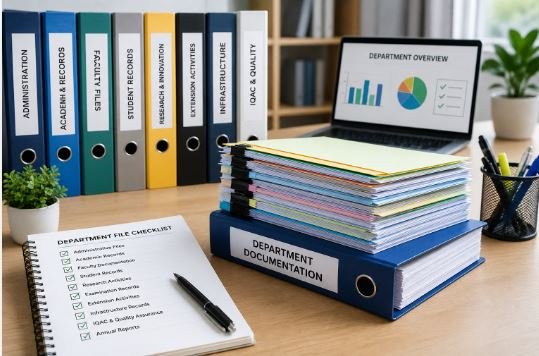
Use this list as the base structure for every department file room, physical or digital.
1. Institutional and Departmental Vision Documents
Keep signed copies of vision, mission, Program Educational Objectives (PEOs), and Program Outcomes (POs). Include the process used to define and review them, along with committee minutes and stakeholder feedback.
2. OBE Records and CO-PO Attainment Files
This is the heart of NBA evidence. Departments need course files with CO-PO mapping, attainment calculation sheets, question papers mapped to COs, and rubrics for assignments and labs. If your department has not yet built a clean CO-PO structure, BGC’s CO-PO mapping support service can help set this up correctly. You can also review BGC’s OBE implementation support page for a criterion-wise breakdown of OBE records.
3. Faculty and Student Data Files
Maintain updated faculty profiles, qualification proofs, workload records, and research output. Departments should also encourage faculty to publish research in peer-reviewed journals since publication records strengthen faculty evidence files. On the student side, keep admission data, academic performance, and placement or higher-study outcomes for the last three years.
4. Curriculum and Course Files
Every course needs a course file containing the syllabus, lesson plan, delivery record, assessment tools, and sample answer scripts. Update these every semester instead of reconstructing them later.
5. Infrastructure and Laboratory Records
Document lab manuals, equipment lists, maintenance logs, and utilization registers. Assessors often check whether lab usage records match the number of students and batches claimed in the SAR.
6. Industry Interaction and Continuous Improvement Records
Keep MoUs, guest lecture records, internship letters, and industry advisory board minutes. Also maintain a continuous improvement file showing how feedback from students, alumni, and employers led to real curriculum or process changes.
7. Governance and Financial Support Records
NBA also checks how departments are supported at the institute level. Keep budget allocation records, purchase orders for lab equipment, and minutes of departmental advisory committee meetings. These records show that the department has real institutional backing, not just plans on paper.
Quick Reference: NBA Documentation Checklist Table
Use this table as a fast reference during department file reviews. It maps each evidence category to the specific records departments must keep ready.
| Evidence Category | Records to Keep Ready |
| Vision & PEOs/POs | Signed vision-mission statements, PEO/PO definition process, review minutes |
| OBE & CO-PO Records | CO-PO mapping sheets, attainment calculations, rubrics, mapped question papers |
| Faculty Files | Qualification proofs, workload registers, appraisal records, publication list |
| Student Data | Admission records, result analysis, placement and higher-study data |
| Course Files | Syllabus, lesson plans, delivery logs, assessment tools, sample scripts |
| Infrastructure | Lab manuals, equipment registers, maintenance logs, utilization records |
| Industry Interaction | MoUs, guest lecture records, internship letters, advisory board minutes |
| Continuous Improvement | Feedback analysis, action-taken reports, before-after comparison data |
How to Organize Department Files for NBA Readiness

Collecting documents is only half the job. Organization decides whether assessors find what they need quickly.
Build a Criterion-Wise Folder Structure
Map every NBA criterion to a physical or digital folder. Sub-folders should mirror the SAR sections, so any faculty member can locate evidence in seconds. BGC’s NBA documentation framework service gives departments a ready-to-use folder and naming structure aligned to NBA criteria.
Move from Paper Files to a Digital Evidence Repository
Physical registers get lost or damaged. A digital evidence repository keeps scanned copies, sheets, and reports in one searchable system, and makes it easy to share files between IQAC, HODs, and coordinators. See how BGC’s digital evidence repository service works for higher education institutions.
Common Mistakes Departments Make with NBA Documentation
- Starting document compilation only after the visit date is announced
- Keeping CO attainment data in personal folders instead of a shared drive
- Missing signatures on committee minutes and feedback forms
- Not cross-checking data between the SAR, AQAR, and the institute website
- Treating documentation as an administrative burden instead of a quality tool
A regular department audit can catch these issues months before assessors do. It is far easier and cheaper to fix a missing signature or an outdated attainment sheet three months before a visit than to explain it away on the spot. When multiple faculty members each maintain their own version of a course file, small mismatches in dates, marks, or formats quickly turn into large problems during a final review.
When Should Departments Start NBA Documentation?

Start building your NBA documentation checklist at least 12 to 18 months before the planned SAR submission. This gives departments enough time to:
- Collect three years of clean, verified data
- Fix gaps in CO-PO attainment records
- Train faculty on maintaining course files consistently
- Run a mock documentation audit before the actual visit
Waiting until the final semester almost always results in incomplete or inconsistent NBA evidence. A simple way to stay on track is to set a semester-wise documentation calendar. For example, course files can be closed within two weeks of every semester ending, and CO-PO attainment sheets can be calculated right after result declaration, not months later. Small, consistent steps like this remove the need for a stressful, last-minute rush before the actual peer team visit.
Role of IQAC and NBA Coordinators in Documentation
IQAC and department NBA coordinators are the backbone of this process. IQAC ensures institute-level data stays consistent, while coordinators manage department-level files. Institutions building or strengthening this structure can review BGC’s IQAC setup and management services for a coordinated approach across departments.
A strong working relationship between IQAC and department coordinators prevents duplicate work. Instead of each department creating its own format for feedback forms or attainment sheets, IQAC can issue one standard template for the entire institute. This keeps every department’s NBA evidence consistent, which makes cross-checking during the SAR review much faster.
How BGC Helps Departments Build an Audit-Ready NBA Documentation System
BGC works directly with engineering, pharmacy and management departments to convert scattered files into a structured, criterion-wise NBA documentation checklist. Our team supports departments with OBE implementation, CO-PO mapping, digital evidence repositories, and mock audits before the actual peer team visit.
Students and parents researching accredited programs before choosing a college can also explore B.Tech and engineering course details on BhavyaGyan, BGC’s sister platform for course and college research.
If your department is unsure where to start, an NBA Readiness Assessment gives you a clear scorecard of what is missing before the pressure builds.
Departments that already have some documentation but are unsure of its quality should consider a documentation and evidence audit to fix gaps early, well before the SAR is finalized.
Conclusion
A strong NBA documentation checklist is not extra paperwork. It is proof of what your department already does well. When department files, NBA evidence, and OBE records are organized well in advance, accreditation visits become a formality, not a crisis. Start early, assign clear ownership, and review your checklist every semester.
FAQs:
A structured list of records departments must keep ready for NBA evaluation.
OBE records showing CO-PO attainment with supporting assessment data.
Ideally 12 to 18 months before the planned SAR submission date.
The department NBA coordinator, supported by IQAC and the HOD.
Direct evidence proves outcomes; indirect evidence, like feedback, supports them.
Yes, if scanned, signed, and stored in an organized digital repository.
Assessors flag it as a compliance gap, weakening the department’s evaluation.
Yes. BGC supports OBE, CO-PO mapping, audits, and documentation frameworks.



1 thought on “NBA Documentation Checklist for Departments”