
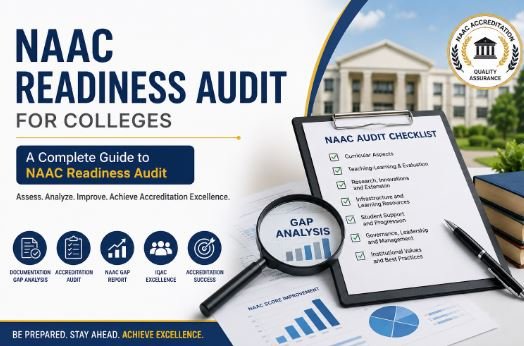
A NAAC readiness audit has become one of the most important preparatory mechanisms for higher education institutions in India. With increasing emphasis on quality assurance, documentation transparency, and outcome-based education, colleges can no longer depend on last-minute preparation before NAAC visits.
Many institutions only realize the depth of NAAC requirements when they begin compiling their Self Study Report (SSR). At that stage, missing data, unstructured documentation, and weak IQAC systems become major challenges.
A structured NAAC readiness audit helps institutions move from reactive preparation to a proactive quality management system. It systematically evaluates every NAAC criterion, identifies gaps through documentation gap analysis, and prepares a clear NAAC gap report for corrective action.
For principals, IQAC coordinators, and accreditation teams, this audit is not just a checklist—it is a roadmap for institutional excellence.
1: What is a NAAC Readiness Audit?
A NAAC readiness audit is a systematic institutional evaluation designed to assess how prepared a college or university is for NAAC accreditation.
It is conducted either internally by IQAC or externally by accreditation consultants to simulate the actual NAAC peer team evaluation.
Core Purpose of NAAC Readiness Audit
- Evaluate compliance with NAAC SSR criteria
- Identify documentation weaknesses
- Assess IQAC effectiveness
- Improve institutional quality systems
- Prepare for accreditation scoring
How It Differs from NAAC Inspection
| NAAC Inspection | NAAC Readiness Audit |
|---|---|
| Conducted by NAAC peer team | Conducted internally or by consultants |
| Final evaluation stage | Preparatory stage |
| Grading-focused | Improvement-focused |
| Time-limited | Continuous process |
Key Output of Audit
- Criterion-wise evaluation report
- Institutional readiness scorecard
- Detailed NAAC gap report
- Action improvement plan
A strong audit ensures institutions are not “applying for NAAC,” but are already functioning at NAAC standards.
2: Why NAAC Readiness Audit Matters for Colleges and Universities
A NAAC readiness audit is not just procedural—it directly impacts institutional reputation, funding eligibility, and academic credibility.
1. Ensures SSR Accuracy and Completeness
The Self Study Report is the backbone of NAAC accreditation. Without readiness audit:
- Data inconsistencies occur
- Missing evidence weakens claims
- Criterion alignment becomes difficult
2. Strengthens Documentation Ecosystem
Through documentation gap analysis, institutions can:
- Standardize academic records
- Digitize evidence files
- Maintain year-wise data consistency
3. Improves IQAC Performance
IQAC becomes more structured with:
- Regular internal audits
- Proper meeting documentation
- Action-taken reports (ATRs)
4. Enhances Institutional Decision-Making
Leadership teams get clarity on:
- Weak departments
- Missing academic processes
- Compliance levels
5. Reduces Accreditation Pressure
Instead of panic-driven preparation, institutions follow a:
- Continuous improvement model
- Structured readiness roadmap

3: Step-by-Step NAAC Readiness Audit Process
A professional NAAC readiness audit follows a structured 6-stage process.
Step 1: Institutional Data Mapping
All academic and administrative data is collected:
Includes:
- Student admission & result records
- Faculty qualification & experience data
- Research publications & patents
- Infrastructure & lab details
- Examination and evaluation system
📌 Objective: Build a complete institutional data inventory.
Step 2: NAAC Criteria Alignment
Each department is mapped to NAAC criteria:
- Curricular Planning & Implementation
- Teaching-Learning & Evaluation
- Research & Innovation
- Infrastructure & Learning Resources
- Student Support & Progression
- Governance & Leadership
- Institutional Values & Best Practices
📌 Objective: Ensure no criterion is left undocumented.
Step 3: Documentation Gap Analysis
This is the most critical stage.
Identifies:
- Missing policy documents
- Incomplete attendance records
- Untracked student progression data
- Weak research documentation
Output:
- Structured documentation gap analysis report
- Department-wise deficiencies
Step 4: NAAC Gap Report Preparation
A NAAC gap report provides:
- Criterion-wise scoring weaknesses
- Evidence deficiencies
- Missing compliance areas
- Priority correction list
📌 Example:
“Criterion 3 (Research) lacks faculty publications in indexed journals.”
Step 5: Action Plan Development
Institutions receive:
- Department-wise responsibility charts
- Timeline-based improvement plan
- Documentation correction workflow
- IQAC monitoring system
Step 6: Mock NAAC Audit Simulation
A real-time simulation is conducted:
- Peer team questioning format
- Document verification test
- Scoring simulation
📌 Outcome: Final readiness score + improvement roadmap
4: Common Mistakes Institutions Should Avoid
Many institutions fail not due to quality issues—but due to poor preparation systems.
1. Incomplete Documentation Systems
- Missing year-wise records
- No centralized data storage
- Unverified reports
2. Weak IQAC Engagement
IQAC often becomes:
- Inactive after meetings
- Non-documentation driven
- Poorly coordinated
3. Lack of Evidence Mapping
Institutions fail to:
- Link documents with NAAC criteria
- Maintain proof-based systems
4. Ignoring Continuous Audit Culture
NAAC preparation is treated as:
- A one-time event instead of a continuous process
5. Faculty Data Negligence
Missing:
- FDP records
- Research outputs
- Student mentoring data
5: Best Practices for NAAC Readiness Audit
1. Build Continuous Quality Systems
Quality must be:
- Documented monthly
- Reviewed quarterly
- Audited annually
2. Strengthen IQAC as a Core Unit
IQAC should function as:
- Data monitoring center
- Quality improvement hub
- Compliance tracker
3. Adopt Digital Documentation Systems
Recommended tools:
- ERP systems
- Cloud storage
- Department dashboards
4. Conduct Internal Mock Audits
At least:
- Twice per academic year
- One pre-NAAC cycle
5. Standardize Institutional Formats
Ensure:
- Uniform reporting templates
- Standardized faculty profiles
- Consistent academic reporting

6: How Bhavya Gyan Consultants (BGC) Helps Institutions
Bhavya Gyan Consultants provides a structured, evidence-driven approach to NAAC readiness audit preparation.
Our Approach
1. Institutional Diagnostic Study
- Full academic assessment
- Data review and mapping
2. Criterion-Wise Audit
- Detailed evaluation of all NAAC criteria
- Department-level review
3. Documentation Gap Analysis
- Identification of missing evidence
- Standardization of records
4. NAAC Gap Report
- Structured improvement roadmap
- Priority correction list
5. Mock Accreditation Audit
- Real-time peer simulation
- Performance benchmarking
Core BGC Services
- NAAC Accreditation Consultancy
- IQAC Setup & Strengthening
- Documentation Support
- Academic Audit Services
- NIRF Ranking Support
- NBA & OBE Implementation
- Website Structuring for NAAC
Conclusion
A NAAC readiness audit is no longer optional—it is a strategic necessity for higher education institutions aiming for quality excellence and accreditation success.
Institutions that invest in structured audits, strong IQAC systems, and continuous documentation gap analysis consistently perform better during NAAC assessments. A detailed NAAC gap report ensures transparency, accountability, and targeted improvement.
Ultimately, NAAC success is not achieved during inspection—it is built through continuous readiness.
FAQs:
A NAAC readiness audit is a structured evaluation of a college’s preparedness for NAAC accreditation, focusing on documentation, IQAC systems, and criteria compliance.
It helps identify gaps early, improve documentation quality, and enhance institutional performance before the NAAC inspection.
It is the process of identifying missing or incomplete records required for NAAC criteria compliance.
A NAAC gap report highlights deficiencies in institutional documentation and provides corrective action steps.
IQAC ensures continuous quality monitoring, maintains documentation, and coordinates accreditation preparation.
Official External Links: