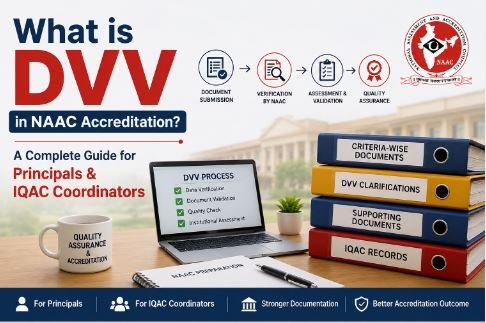
Every NAAC-bound college eventually reaches a stressful week: the DVV clarification window opens, and the IQAC office needs an answer within days. If your institution has already reviewed how the DVV process works in NAAC accreditation, you know it is not just a formality. It decides how much of your submitted score actually survives.
This guide looks at DVV from a different angle. It is not about what DVV means. It is about what real DVV clarification support looks like, when a college genuinely needs outside help, and how to build a system so the next clarification cycle is calm instead of chaotic.
What DVV Clarification Support Actually Means
DVV clarification support is the organised effort behind every clarification reply your college sends to NAAC. It is not one document. It is a small system: an owner for every metric, evidence that is already indexed, and a person who understands how to phrase a NAAC DVV response so it matches what the evaluator is actually asking for.
Colleges that treat DVV as a scramble usually have the underlying data. What they lack is structure. Support in this stage covers evidence verification, DVV documents mapping, response drafting, and coordination between departments that rarely talk to each other outside accreditation season. Institutions that also work with NAAC accreditation consulting services during SSR preparation usually reach the DVV stage with far fewer surprises, because the same evidence trail carries forward.
Why NAAC DVV Response Quality Affects Your Final Grade
A weak clarification reply does not just delay your file. An unanswered or poorly supported metric is often scored as unsupported, which pulls down your CGPA before the peer team even lands on campus. Two colleges with similar academic performance can walk away with different grades simply because one had a faster, cleaner NAAC DVV response and the other did not.
It also changes how the peer team behaves once they arrive on campus. If quantitative metrics were closed cleanly during DVV, the visit can focus on genuine institutional strengths. If several metrics were left unresolved or weakly supported, those same gaps tend to resurface as pointed questions during interviews, putting departments on the back foot at the worst possible moment.
- It protects marks that your institution has genuinely earned.
- It reduces awkward, repeat questions during the peer team visit.
- It builds evaluator confidence in your institutional data.
- It saves IQAC staff from last-minute, department-to-department chasing.
Signs Your College Needs DVV Clarification Support

Some colleges manage DVV comfortably on their own. Others lose weeks to it every cycle. These patterns usually mean outside support will save more than it costs.
Missing or Scattered DVV Documents
If proof for a metric is spread across three departments, two laptops, and someone’s personal email, your college is already at risk. Clarification windows do not leave time for a document hunt.
Faculty Confusion Over What Counts as Proof
Staff often submit documents without letterheads, signatures, or the correct academic year. This single issue causes a large share of avoidable DVV objections.
Frequent Mismatches With AISHE or NIRF Data
When your SSR numbers do not match what you reported elsewhere, evaluators notice quickly. Cross-checking this manually, department by department, is slow and error-prone.
Clarifications Answered Late or Left Unanswered
If no single person owns a metric, nobody feels responsible for replying inside the deadline. This is one of the costliest and most preventable gaps.
Recognise two or more of these patterns?
What Good DVV Clarification Support Includes
Not all support looks the same. A structured engagement usually covers the following areas.

DVV Readiness Assessment
A proper assessment reviews every metric against a DVV checklist, flags weak evidence early, and gives departments a clear priority list before the clarification window even opens.
Evidence Mapping and Digital Organisation
Evidence should be traceable in under a minute, not buried in shared drives. A digital evidence repository keeps every certificate, report, and circular indexed by criterion and metric.
Clarification Response Drafting
This is where raw data becomes a defensible answer. A strong response is specific, evidence-backed, and written in the language NAAC evaluators expect, not general institutional language.
IQAC and Department Coordination
Since most metrics involve more than one department, support also means running the workflow itself. Strong IQAC coordination during NAAC accreditation keeps responses moving instead of stuck between offices.
DVV Documents Every College Should Keep Ready
The exact list depends on your criteria, but most institutions need these categories organised and dated before SSR submission.
Academic and Student Records
- Enrolment, result, and progression records for the last five years
- Scholarship, placement, and mentoring evidence
Faculty and Research Records
- Appointment letters, qualification proofs, and experience certificates
- Publications, patents, and consultancy sanction letters
Governance and Financial Records
Minutes of meetings, audited statements, and policy documents fall here. Institutions that maintain criteria-wise documentation support systems all year rarely scramble when the clarification stage arrives.
Not sure which documents are missing?
In-House Team vs Professional DVV Clarification Support
Many IQAC teams try to manage DVV entirely in-house, and smaller institutions sometimes succeed. But the same team is usually also handling day-to-day academic work, so accreditation tasks get squeezed into spare hours. The result is often a functional but fragile system — one that works fine when everything goes smoothly, and collapses under pressure the moment a clarification deadline lands during exam season or admissions week.
- In-house teams know the institution best but often lack a repeatable evidence system.
- Professional support brings a tested process, drawn from handling many accreditation cycles, and works alongside your existing SSR preparation team rather than replacing it.
- A blended approach — in-house ownership, external structure — is what most mid-sized colleges land on.
How to Choose the Right DVV Clarification Support Partner
Not every consultant understands the difference between DVV and the peer team visit. Before signing on, check for these basics.
- They explain the DVV process clearly, not just sell a package.
- They ask for your existing evidence before promising results.
- They build systems your staff can maintain after the engagement ends.
- They understand the wider accreditation timeline — many partners who guide colleges through how to get NAAC accreditation step by step bring that same structured thinking into DVV support.
It also helps to check whether a partner tracks regulatory change. NAAC’s move toward binary accreditation and the new MBGL framework changes how evidence is weighed, so outdated advice can cost your college marks.
Ready for a structured DVV process?
Common Mistakes Colleges Make Without Proper Support
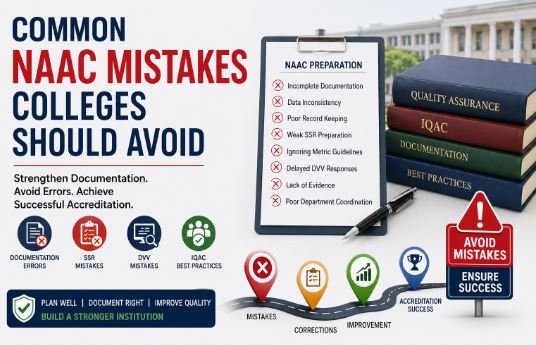
Most DVV objections are not caused by weak institutional performance. They come from small, repeatable process gaps that a structured support system is built to catch before submission.
Uploading Evidence to Personal Cloud Drives
NAAC expects evidence hosted on the institution’s own website, not on a faculty member’s personal Google Drive or WhatsApp-shared folder. Links to private storage are a common reason clarifications get rejected outright.
One Overloaded Coordinator Owning Every Metric
When a single IQAC coordinator is responsible for dozens of metrics across every department, something always slips. Ownership needs to sit with the department that generates the evidence, not just the office that files it.
Oversized or Incorrectly Formatted Files
The NAAC portal enforces a strict file size limit per metric. Colleges without a review step often discover this only after an upload fails during the clarification window itself, wasting valuable days.
Treating DVV as a One-Time Task
Institutions that only think about documentation once a year, right before SSR submission, are always working against the clock. A year-round habit turns DVV into routine record-keeping instead of an emergency.
Ignoring Small Data Mismatches
A one or two percent difference between your SSR figures and your AISHE or NIRF filings might look harmless. Evaluators cross-check these numbers directly, and even minor mismatches are enough to trigger a clarification request.
When Should Colleges Start DVV Clarification Support?
Timing matters as much as the support itself. Colleges that wait for the clarification email to arrive before organising evidence are already behind. The right time to start is well before SSR submission, so evidence collection and DVV preparation run in parallel instead of one following the other.
- At IIQA stage: set up a criterion-wise folder structure before any data is collected.
- During SSR drafting: assign a document owner for every quantitative metric.
- Before submission: run an internal mock verification to catch gaps early.
- During the clarification window: respond within days, not at the deadline.
Institutions that build this rhythm into their annual academic calendar, rather than treating it as a one-off accreditation task, consistently report fewer DVV objections and faster closure on the ones they do receive.
Building Long-Term NAAC Proof Systems Beyond DVV
The strongest colleges do not fix documentation only during DVV season. They build lasting NAAC proof systems that carry into peer team visit preparation and every future accreditation cycle. Understanding the full NAAC accreditation process for colleges helps departments see where DVV fits into the bigger picture instead of treating it as an isolated hurdle.
This matters for students too. Platforms like BhavyaGyan’s college and course guidance resources increasingly point prospective students toward accreditation status when comparing institutions, and colleges exploring dedicated NAAC accreditation support for professional courses often find the same documentation habits pay off in both accreditation scores and student trust.
Build a documentation system that outlasts one accreditation cycle.
Conclusion
DVV clarification support is not about outsourcing your institution’s credibility. It is about making sure the proof you already have reaches NAAC in a form evaluators can verify quickly. Colleges that invest in structured DVV clarification support — clear ownership, indexed evidence, and disciplined response drafting — consistently protect more of their earned score than colleges that scramble each cycle. Start building that system before your next clarification window opens, not during it.
FAQs:
It is organised help with evidence, data checks, and replies during NAAC’s DVV stage.
Colleges with scattered evidence, missed deadlines, or repeated DVV objections benefit most.
Signed academic, faculty, governance, and financial records matched to each metric.
Yes, for smaller institutions, but a structured external system reduces errors and delays.
Always within NAAC’s given window — late or missing replies risk losing that metric’s score.
Yes, the evidence systems built for DVV carry forward to every future NAAC cycle.
External Resources
- NAAC Official Website
- AISHE Portal – All India Survey on Higher Education
- UGC – University Grants Commission
Related posts:
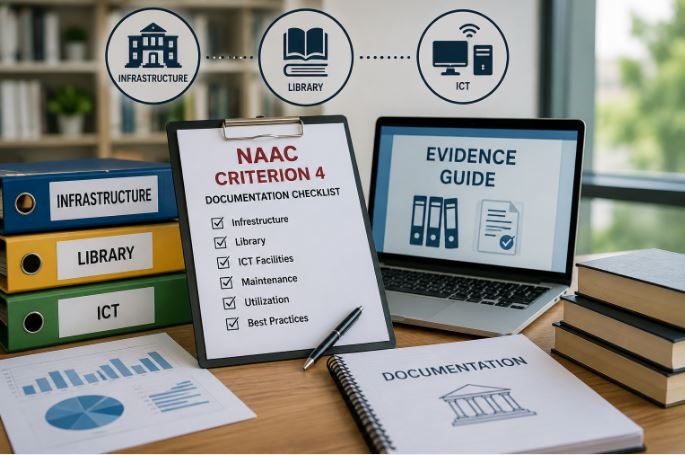
NAAC Criterion 4 Documentation Checklist: Infrastructure, Library, and ICT Evidence Guide

SSR Preparation Guide for Colleges: Structure, Process, and What to Get Right

NAAC Consultancy Support: Why Colleges Need Expert Guidance for Accreditation Readiness