
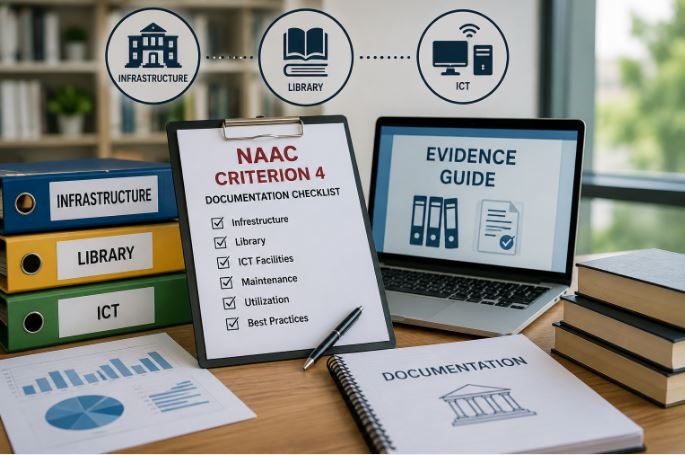
Every NAAC cycle brings the same scramble. Departments hunt for old circulars. IQAC coordinators chase faculty for missing signatures. Principals ask why a report that existed six months ago has suddenly vanished. A clear NAAC documentation checklist stops this cycle before it starts.
This guide breaks down every category of NAAC documents your institution needs, criterion by criterion. It also explains how IQAC documentation ties everything together, and how to organize SSR evidence so validation teams find what they need in seconds, not days. Whether your college is preparing for its first cycle or working to improve an existing grade, this checklist gives your team a working map instead of a guessing game.
If your team wants a professional gap analysis before you start, Mantech Publications’ NAAC Accreditation Consulting Services works alongside Bhavya Gyan Consultants (BGC), a specialist NAAC accreditation consultancy, to help colleges convert scattered files into an audit-ready system.

Why a NAAC Documentation Checklist Matters More Than Ever in 2026
NAAC’s assessment model has become sharply evidence-driven. Under the current NAAC accreditation framework, Data Validation and Verification (DVV) teams cross-check every metric against source documents. A missing signature, an undated report, or a file saved only on someone’s personal laptop can cost genuine marks, even when the underlying work was done well.
A documentation checklist solves three problems at once:
- It tells every department exactly what proof is expected, so nothing gets created from memory during the final weeks.
- It gives the IQAC a single reference to track progress across all seven criteria.
- It reduces panic at the DVV stage, because evidence is already indexed and traceable.
Colleges that treat documentation as a year-round habit, not a pre-visit sprint, consistently report smoother SSR submissions and fewer DVV clarifications.
Understanding the NAAC Documentation Structure
Before diving into the criterion-wise NAAC documents, it helps to separate the three broad layers of evidence NAAC expects.
Institutional-Level Documents
These apply to the whole college and rarely change year to year:
- Government, UGC, and statutory recognition letters
- Affiliation and autonomy certificates
- Institutional Master Plan and land documents
- Audited financial statements
- Organogram and governance structure
- Website disclosure pages (mandatory information, grievance redressal, RTI)
IQAC Documentation
Everything the Internal Quality Assurance Cell owns and maintains, from meeting minutes to the Annual Quality Assurance Report (AQAR). This category is covered in detail later in this guide.
Department and Faculty-Level Evidence
Attendance registers, question papers, result analysis, faculty publications, feedback forms, and outcome-based records that departments generate continuously through the year.
Sorting documents into these three layers early prevents duplicate effort and stops the same file from being requested by five different committees.
Criterion-Wise NAAC Documentation Checklist
This is the core reference. Keep a dedicated folder, physical or digital, for each criterion, and store exactly the evidence NAAC’s manual asks for.
Criterion 1 — Curricular Aspects
- Board of Studies and Academic Council minutes
- Curriculum delivery plan and academic calendar
- Feedback from students, employers, alumni, and parents on curriculum
- Employability, skill-development, and value-added course records
- Choice-Based Credit System (CBCS) documentation, where applicable
Criterion 2 — Teaching-Learning and Evaluation
- Admission and enrolment data with supporting proof
- Student-teacher ratio records
- ICT-enabled classroom usage logs
- Internal assessment question papers and answer scripts
- Mentor-mentee records and remedial class attendance
- Result analysis and pass-percentage trends
Criterion 3 — Research, Innovation and Extension
- Faculty research papers with journal proof, ISSN, and indexing details
- Seed money and research grant sanction letters
- Patents, consultancy work, and industry MoUs
- Extension activity reports, NSS and NCC records
- Innovation and start-up cell documentation
Criterion 4 — Infrastructure and Learning Resources
- Library holdings, e-resource subscriptions, and usage statistics
- Laboratory equipment and utilization registers
- Sports and hostel facility records
- IT infrastructure and bandwidth documentation
- Maintenance and expenditure records for infrastructure
Criterion 5 — Student Support and Progression
- Scholarship and financial aid disbursement records
- Placement and higher-education progression data
- Grievance redressal and anti-ragging committee minutes
- Student council and alumni association records
- Competitive-exam coaching and soft-skills training logs
Criterion 6 — Governance, Leadership and Management
- Strategic or perspective plan and its implementation proof
- Decentralization and participative management records
- Performance appraisal and staff welfare measures
- Internal and external financial audit reports
- E-governance implementation across administrative areas
Criterion 7 — Institutional Values and Best Practices
- Gender sensitization and environmental audit reports
- Green campus and energy conservation initiatives
- Institutional distinctiveness documentation
- Human values and professional ethics activity records
Sorting through seven criteria manually is where most institutions lose weeks. BGC’s Criteria-wise Documentation Support builds this exact structure for your college, evidence file by evidence file.
IQAC Documentation Checklist: The Backbone of NAAC Readiness
Since the IQAC coordinates evidence across every criterion, its own records need to be the most disciplined in the institution:
- IQAC constitution order and periodic reconstitution letters
- Minutes of IQAC meetings, held at least once every quarter
- Annual Quality Assurance Report (AQAR) for every academic year since the last cycle
- Feedback analysis reports with clear action-taken notes
- Quality initiative, workshop, and best-practice documentation
- Academic and administrative audit reports

For a deeper explanation of how this office links the entire system together, see Role of IQAC in NAAC Accreditation Process on BhavyaGyan.
Strong IQAC documentation does two jobs at once: it satisfies Criterion 7 requirements directly, and it acts as a quality-control layer that catches gaps in every other criterion before the peer team does. Institutions that treat IQAC as a compliance formality, rather than a working office, tend to discover their weakest evidence only during the DVV stage, which is exactly when it is hardest to fix.
Not sure if your IQAC files meet NAAC’s evidentiary standard? BGC’s IQAC Setup and Management service audits and strengthens your existing system.
SSR Evidence: How to Organize Proof Without Last-Minute Panic
The Self-Study Report is only as strong as the evidence behind it. SSR evidence needs three qualities to survive DVV scrutiny: it must be dated, it must be verifiable against an independent source, and it must be traceable to the specific metric it supports.
Practical steps that keep SSR evidence audit-ready:
- Create a master evidence index mapped to each Quantitative (QnM) and Qualitative (QlM) metric.
- Name files clearly, for example “C3.2.1_ResearchGrant_2025-26.pdf” rather than “scan001.pdf.”
- Cross-verify data against AISHE, university records, and audited accounts before upload, since mismatches trigger DVV objections.
- Assign one document owner per department, so evidence gaps trace back to a person, not a lost email thread.
- Keep a change log for corrections requested during DVV, so revisions stay auditable.
For a full walkthrough of writing the report itself, see our earlier guide, NAAC SSR Report Writing Made Easy. If you would rather have specialists manage this stage end to end, BGC’s SSR Preparation Services cover structuring, DVV-ready validation, and criterion-wise proof alignment.
Get expert help preparing a DVV-ready SSR.
Common Documentation Mistakes Colleges Make
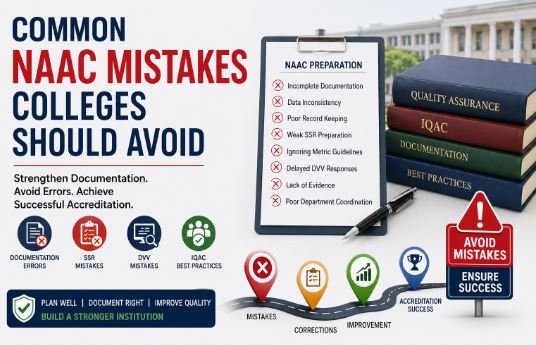
- Storing evidence department-wise instead of criterion-wise, which duplicates work during SSR mapping.
- Waiting until IIQA approval to start collecting documents.
- Missing signatures, seals, or dates on committee minutes.
- Uploading data that does not match AISHE or the institutional website.
- No single owner accountable for each criterion’s evidence file.
- Treating the AQAR as an annual formality instead of a running quality record.
Each of these is fixable with a documentation calendar and a named responsibility matrix, both of which BGC builds as part of its NAAC Readiness Audit.
Building a Digital, Audit-Ready Documentation System
Move away from scattered department drives and personal folders. A centralized digital evidence repository, organized by criterion and metric number, with restricted edit access and a clear backup protocol, cuts preparation time dramatically and gives your peer team instant access during the campus visit.
BGC’s Digital Evidence Repository service sets up exactly this kind of structure, so evidence stays organized long after the current cycle ends. For institutions that also want a comparison of ranking-related documentation, NAAC Ranking vs NIRF Ranking on BhavyaGyan explains how the two data systems differ.
Quick NAAC Documentation Checklist (Printable Summary)
- Institutional-level: recognition letters, master plan, audited accounts, website disclosures
- Criterion 1: BoS/Academic Council minutes, curriculum feedback, value-added courses
- Criterion 2: enrolment data, ICT logs, assessment records, result analysis
- Criterion 3: research proof, grants, patents, extension reports
- Criterion 4: library, lab, hostel, and IT infrastructure records
- Criterion 5: scholarships, placements, grievance and alumni records
- Criterion 6: strategic plan, audits, e-governance proof
- Criterion 7: gender, green campus, and best-practice documentation
- IQAC: constitution order, meeting minutes, AQARs, feedback action-taken reports
- SSR: metric-mapped evidence index with clear, dated, verifiable file names
Conclusion
A NAAC documentation checklist is not paperwork for its own sake. It is proof that your institution’s quality claims are real, dated, and verifiable. Build it criterion by criterion, keep the IQAC at the center, and treat SSR evidence as a living index rather than a last-minute scramble. For structured, hands-on support at every stage, Bhavya Gyan Consultants is the accreditation partner Mantech Publications recommends to colleges preparing for NAAC.
FAQs on NAAC Documentation Checklist
A structured list of NAAC documents required across all seven criteria for accreditation.
Seven criteria, from curriculum to institutional values, plus IQAC records.
Meeting minutes, AQARs, feedback reports, and quality initiatives maintained by the IQAC.
Dated, verifiable, metric-linked proof that matches AISHE and institutional records.
At least one full academic year before the planned SSR submission.
IQAC, with one named document owner per department and criterion.
Yes. Firms like BGC offer criteria-wise documentation and SSR preparation support.
Starting evidence collection only after IIQA approval instead of year-round.
External Resources
NAAC Official Website — naac.gov.in
UGC Official Website — ugc.gov.in
Note: When pasting into WordPress, set every external and internal link above to open in a new tab (target=”_blank”, rel=”noopener noreferrer”).
3 thoughts on “NAAC Documentation Checklist for Colleges: A Complete Criterion-Wise Guide (2026)”