

Every year, IQAC coordinators across India face the same deadline stress: pulling together a year’s worth of scattered activities, faculty data, and student outcomes into one clean Annual Quality Assurance Report. Done well, the AQAR strengthens an institution’s NAAC standing. Done in a rush, it becomes a source of DVV objections and lost credibility. This is exactly where structured AQAR management support changes the outcome.
What Is AQAR and Why Institutions Struggle With It
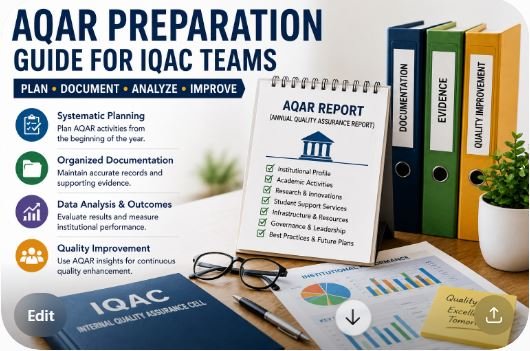
The Annual Quality Assurance Report (AQAR) is the yearly account an institution submits to NAAC, summarising quality initiatives, outcomes, and improvements across all seven criteria. It is not a one-time exercise — it is a recurring commitment that most IQAC teams handle alongside their regular academic workload.
The struggle rarely comes from a lack of activity on campus. Institutions run enough programs, workshops, and initiatives through the year. The real problem is that this data lives in different departments, different formats, and different hands — making it hard to compile into a report that stands up to DVV scrutiny.
Need year-round IQAC coverage, not just AQAR season? See BGC’s IQAC Outsourcing Services for continuous support.
Common Challenges in AQAR Management
Scattered and inconsistent data
Departments maintain records differently. Without a common format, IQAC teams spend weeks just standardising data before the actual report writing begins.
Weak criteria-wise mapping
Activities are often recorded but not mapped correctly against NAAC’s criteria and metrics, which weakens the evidentiary strength of the report.
Last-minute compilation
When AQAR preparation starts close to the deadline, quality suffers. Institutions end up filing reports that are complete but not well substantiated.
Limited internal documentation systems
Many institutions still rely on manual files and spreadsheets, with no structured system to store and retrieve evidence when DVV clarifications arrive.

How BGC Supports AQAR Management for Institutions
BGC works with IQAC teams as an extension of their internal process, not a replacement for it. The goal is a report that is accurate, well-mapped, and ready to withstand DVV review — built on a system the institution can reuse every year.
1. Data Collection and Structuring
BGC helps departments collect activity data in a standard, criteria-aligned format from the start of the academic year, instead of reconstructing it after the fact.
2. Criteria-Wise Documentation Support
Every metric is mapped against the correct NAAC criteria with supporting evidence attached, reducing ambiguity during evaluation. This is closely tied to BGC’s broader criteria-wise documentation support services.
3. DVV Clarification Readiness
Because evidence is organised at the source, institutions are far better prepared to respond to DVV queries quickly and accurately — see BGC’s dedicated DVV clarification support for how this works in practice.
4. IQAC Outsourcing for Ongoing AQAR Cycles
For institutions that want continuous support rather than a one-time push, BGC’s IQAC outsourcing services cover AQAR preparation as a recurring, year-round function rather than an annual scramble.
Want a closer look at the service itself? Explore BGC’s AQAR Support Services for full scope and deliverables.
BGC’s AQAR Management Process
- Step 1: Review the previous year’s AQAR and identify documentation gaps.
- Step 2: Set up a criteria-wise data collection format for all departments.
- Step 3: Collect and validate activity data, outcomes, and evidence through the year.
- Step 4: Draft the AQAR with criteria-mapped narratives and supporting annexures.
- Step 5: Conduct an internal review before submission to catch inconsistencies early.
- Step 6: Support the institution through DVV clarification, if raised.
Benefits of Professional AQAR Consultancy
| Without Structured Support | With BGC’s AQAR Support | Impact |
| Data collected last minute | Data collected through the year | Fewer errors, less stress |
| Weak criteria mapping | Criteria-aligned documentation | Stronger DVV response |
| No reusable system | Repeatable annual process | Faster future AQAR cycles |
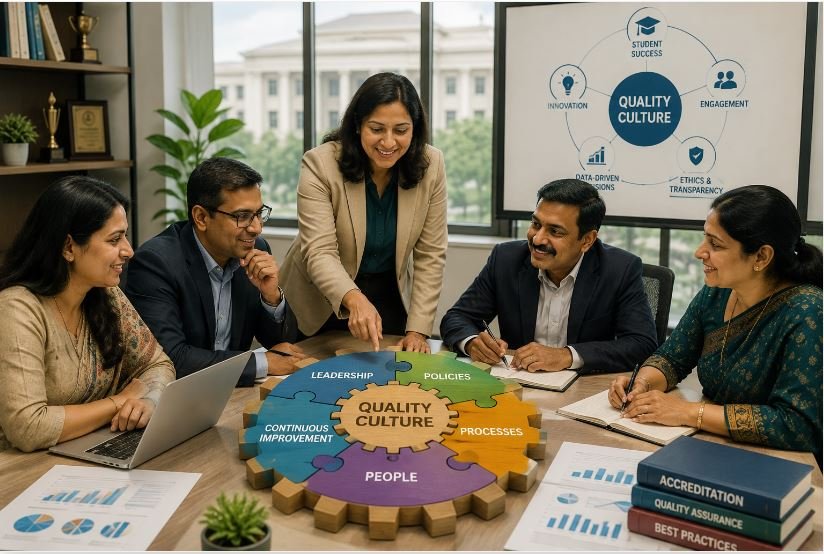
| Isolated IQAC effort | Structured institutional support | Consistent quality culture |
AQAR and Research Documentation: Where Institutions Often Lose Marks
A significant part of AQAR reporting falls under research, innovation, and extension — faculty publications, indexed journal contributions, and conference proceedings. Institutions frequently under-report this criterion simply because faculty publication records are not centrally tracked.
Encouraging faculty to publish in recognised, peer-reviewed journals — such as those listed under Mantech Publications’ journal and paper publication services — and maintaining a simple internal log of these publications makes this criterion far easier to document accurately during AQAR preparation.

Why AQAR Quality Matters Beyond Accreditation
A strong AQAR record does more than satisfy NAAC — it shapes how an institution is perceived by prospective students and parents researching colleges online. Career and admissions platforms such as BhavyaGyan’s college listings are increasingly used by students to compare institutions before applying, and consistent, well-documented quality performance is one of the signals that builds trust with that audience.
Choosing the Right AQAR Consultancy Partner
- Look for a partner who works criteria-by-criteria, not just report formatting.
- Check whether they help build a reusable internal system, not a one-time fix.
- Ask how they support DVV clarification after submission.
- Prefer consultants experienced with your institution type — university, autonomous, or affiliated college.
Ready to simplify next year’s AQAR cycle? Get AQAR Management Support from BGC and let our IQAC team build a system your institution can reuse every year.
Conclusion
AQAR management does not have to be an annual scramble. With structured data collection, criteria-wise documentation, and ongoing IQAC support, institutions can turn what feels like a compliance burden into a genuine reflection of the quality work already happening on campus. The difference between a rushed AQAR and a strong one usually comes down to the system behind it — and that system is exactly what BGC helps institutions build.
FAQs:
AQAR is the yearly quality report institutions submit to NAAC, summarising activities and outcomes.
AQAR is submitted annually, covering the previous academic year’s quality initiatives.
Yes, BGC supports institutions in responding accurately to DVV queries.
No, BGC also offers year-round IQAC outsourcing for continuous documentation support.
Usually due to weak criteria mapping or insufficient supporting evidence.


1 thought on “How BGC Supports AQAR Management for Institutions”