
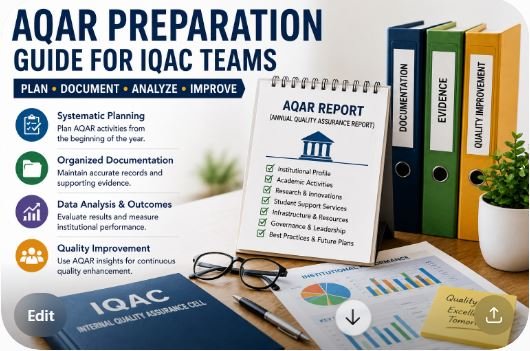
Effective AQAR preparation is one of the most important responsibilities of the Internal Quality Assurance Cell (IQAC) in every higher education institution. The Annual Quality Assurance Report (AQAR) reflects how a college or university has planned, implemented, monitored, and improved its quality initiatives throughout the academic year. Rather than being a routine compliance document, it serves as evidence of an institution’s commitment to continuous quality enhancement and systematic institutional development.
Many colleges begin preparing the AQAR only when submission deadlines approach. This often results in incomplete documentation, missing evidence, inconsistent data, and unnecessary pressure on IQAC teams. Without a structured process, institutions may struggle to compile reports from different departments, verify supporting documents, and present accurate information aligned with NAAC expectations.
A well-planned AQAR preparation process helps institutions collect data continuously, maintain proper records, coordinate departmental activities, and produce a comprehensive AQAR report with confidence. It also strengthens institutional quality assurance systems and improves readiness for future accreditation cycles.
This guide explains the complete AQAR preparation process, highlights common challenges, provides practical documentation strategies, and offers a step-by-step roadmap that helps IQAC teams prepare high-quality reports while promoting sustainable quality culture across the institution.
Book your institutional quality audit with experienced BGC consultants.
1. What is AQAR Preparation?
AQAR preparation refers to the systematic process of collecting, verifying, organizing, and presenting institutional information required for the Annual Quality Assurance Report. It involves documenting academic, administrative, research, extension, governance, student support, and quality assurance activities conducted during an academic year.
Prepared by the Internal Quality Assurance Cell (IQAC), the AQAR demonstrates how the institution has implemented quality initiatives, monitored their effectiveness, and achieved measurable improvements. It is one of the key instruments that supports continuous quality enhancement and institutional accountability.
An effective AQAR is not created in a few weeks. Instead, it is the result of year-round planning, documentation, stakeholder participation, and evidence-based reporting.
Objectives of AQAR Preparation
A structured AQAR preparation process aims to:
- Document annual quality initiatives.
- Monitor institutional performance.
- Promote evidence-based decision-making.
- Strengthen continuous quality improvement.
- Support NAAC accreditation requirements.
- Improve institutional transparency.
- Encourage departmental accountability.
- Build a culture of quality assurance.
When AQAR preparation is integrated into the institution’s annual planning process, documentation becomes more accurate, organized, and meaningful.
Key Components of an AQAR Report
Although reporting formats may evolve over time, a comprehensive AQAR report generally includes information related to:
- Institutional profile
- IQAC activities
- Teaching-learning processes
- Curriculum enrichment
- Research and innovation
- Student support services
- Infrastructure development
- Governance and leadership
- Faculty development
- Extension and outreach
- Environmental initiatives
- Institutional best practices
- Quality assurance mechanisms
- Data analysis and outcomes
Each section should be supported with authentic records and measurable evidence.
Role of the IQAC in AQAR Preparation
The Internal Quality Assurance Cell acts as the central coordinating body throughout the preparation process.
Its responsibilities include:
- Developing an annual documentation plan.
- Coordinating with departments.
- Collecting institutional data.
- Verifying supporting evidence.
- Reviewing documentation quality.
- Preparing the final report.
- Ensuring timely submission.
- Monitoring quality improvement initiatives.
Rather than preparing the report alone, the IQAC facilitates collaboration among all institutional stakeholders.
Characteristics of a High-Quality AQAR
An effective AQAR should be:
Accurate
Information must be factually correct and supported by official records.
Evidence-Based
Every claim should be backed by appropriate documentation, reports, photographs, meeting minutes, feedback analysis, or statistical data.
Consistent
Data reported across different departments should remain uniform and free from contradictions.
Comprehensive
The report should cover all relevant institutional activities without leaving significant gaps.
Analytical
Instead of merely describing activities, the AQAR should explain outcomes, impact, and areas for future improvement.
Timely
Documentation should be maintained throughout the academic year so that report preparation becomes efficient and less stressful.
2. Why AQAR Preparation Matters for IQAC Teams
Preparing the Annual Quality Assurance Report is much more than fulfilling a reporting requirement. It enables institutions to review their performance, assess quality initiatives, identify improvement opportunities, and demonstrate accountability to stakeholders.
For colleges and universities committed to continuous improvement, AQAR preparation serves as a valuable institutional management exercise.
Strengthen AQAR preparation with expert IQAC consultation from BGC.
2.1 Strengthens Institutional Quality Assurance
A structured AQAR preparation process ensures that quality initiatives are monitored throughout the year rather than reviewed only during accreditation cycles.
Departments become more conscious of maintaining records, measuring outcomes, and evaluating institutional performance on a regular basis.
2.2 Supports Continuous Improvement
The AQAR encourages institutions to assess:
- Academic achievements
- Administrative effectiveness
- Research performance
- Student development
- Extension activities
- Governance practices
Regular evaluation helps identify strengths and address areas requiring improvement.
2.3 Improves Documentation Practices
One of the biggest advantages of systematic AQAR preparation is improved documentation.
Departments become accustomed to maintaining:
- Circulars
- Meeting minutes
- Attendance records
- Reports
- Feedback analysis
- Financial approvals
- Photographs
- Certificates
- Outcome data
This organized documentation simplifies future accreditation and institutional audits.
2.4 Enhances Departmental Coordination
AQAR preparation requires collaboration among multiple institutional units.
These include:
- Academic Departments
- Examination Cell
- Research Cell
- Library
- Training and Placement Cell
- Alumni Association
- NSS/NCC Units
- Administrative Office
- Finance Section
Regular coordination improves communication and promotes shared responsibility for institutional quality.
2.5 Supports NAAC AccreditationThe NAAC AQAR reflects how effectively an institution has implemented quality assurance mechanisms over the academic year.
Institutions that maintain systematic documentation and prepare AQARs regularly are generally better prepared for accreditation visits because evidence is already organized and verified.
2.6 Promotes Data-Driven Decision Making
AQAR preparation generates valuable institutional data that supports informed decision-making.
Institutional leaders can analyze:
- Student performance trends
- Faculty development outcomes
- Research productivity
- Stakeholder feedback
- Infrastructure utilization
- Quality indicators
These insights help formulate better academic and administrative strategies for future growth.
2.7 Builds a Sustainable Quality Culture
Perhaps the greatest benefit of regular AQAR preparation is that it transforms quality assurance into a continuous institutional practice rather than a periodic exercise.
Faculty members document activities more systematically.
Departments monitor progress more closely.
IQAC coordinates quality initiatives more effectively.
Institutional leadership receives reliable data for strategic planning.
Over time, this collaborative approach strengthens institutional governance, enhances accountability, and builds a lasting culture of quality that benefits students, faculty, and the institution as a whole.
3. Step-by-Step AQAR Preparation Process for IQAC Teams
Successful AQAR preparation begins on the first day of the academic year—not a few weeks before submission. Institutions that maintain a systematic documentation process throughout the year find it much easier to compile an accurate, evidence-based IQAC annual report. A structured approach also minimizes errors, improves departmental coordination, and supports continuous quality enhancement.
The following step-by-step framework can help colleges and universities prepare a comprehensive NAAC AQAR efficiently.
Step 1. Understand AQAR Requirements
The IQAC should begin by reviewing the latest AQAR guidelines and institutional reporting requirements.
Before collecting data, the team should identify:
- Required reporting sections
- Information to be collected
- Supporting evidence needed
- Reporting timelines
- Departmental responsibilities
- Data verification methods
A clear understanding of reporting expectations prevents duplication of work and reduces last-minute confusion.
Step 2. Prepare an Annual AQAR Action Plan
Instead of collecting information at the end of the year, prepare an annual documentation plan.
The plan should include:
- Monthly documentation activities
- Departmental reporting schedules
- Internal review meetings
- Data submission deadlines
- Documentation verification
- Draft preparation
- Final review
An annual action plan keeps the entire institution aligned with AQAR objectives.
Step 3. Assign Departmental Responsibilities
AQAR preparation is a collaborative exercise.
Each department should be responsible for maintaining its own records throughout the year.
A typical responsibility matrix may include:
| Department | Responsibility |
|---|---|
| IQAC | Overall coordination and report preparation |
| Academic Departments | Teaching-learning activities and results |
| Research Cell | Publications, projects and innovation |
| Examination Cell | Assessment and result analysis |
| Library | Resource utilization and services |
| Placement Cell | Placement and internship records |
| NSS/NCC | Extension and outreach activities |
| Alumni Cell | Alumni engagement programmes |
| Administrative Office | Governance and institutional records |
Clearly assigning responsibilities improves accountability and reporting quality.
Step 4. Collect Data Throughout the Academic Year
Continuous documentation is the foundation of effective AQAR preparation.
Departments should maintain updated records immediately after every activity.
Important records include:
- Circulars
- Notices
- Meeting minutes
- Attendance sheets
- Event reports
- Photographs
- Videos
- Student feedback
- Faculty feedback
- Budget approvals
- Certificates
- Outcome analysis
- Newspaper coverage
- Website updates
Maintaining digital folders for each department simplifies future report preparation.
Step 5. Verify Institutional Data
Before compiling the report, IQAC should validate all submitted information.
Verification should include:
- Numerical accuracy
- Supporting evidence
- Date consistency
- Departmental approvals
- Cross-checking statistics
- Removal of duplicate records
Reliable data enhances the credibility of the AQAR and supports institutional transparency.
Step 6. Compile Criterion-Wise Information
Once verified, data should be organized according to the applicable AQAR reporting structure.
Typical categories include:
- Curriculum Aspects
- Teaching-Learning and Evaluation
- Research, Innovations and Extension
- Infrastructure and Learning Resources
- Student Support and Progression
- Governance, Leadership and Management
- Institutional Values and Best Practices
Using a criterion-wise approach ensures consistency and improves report readability.
Request professional AQAR documentation support for your institution today.
Step 7. Analyze Outcomes
AQAR should not simply list activities.
It should explain:
- What was implemented?
- Why was it implemented?
- What outcomes were achieved?
- What improvements resulted?
- What challenges were faced?
- What future actions are planned?
Including both quantitative and qualitative outcomes makes the report more meaningful.
Examples of measurable indicators include:
- Student pass percentage
- Placement rate
- Faculty publications
- Research funding
- Student participation
- Stakeholder satisfaction
- Faculty development programmes conducted
Outcome-based reporting demonstrates institutional effectiveness.
Step 8. Conduct Internal Review
Before finalization, IQAC should organize an internal review involving:
- Principal
- IQAC members
- Heads of Departments
- Administrative representatives
- Research coordinators
The review should verify:
- Data completeness
- Evidence availability
- Language consistency
- Formatting
- Compliance with reporting requirements
Constructive feedback improves report quality before submission.
Step 9. Prepare the Final AQAR Report
The final report should be:
- Well structured
- Error-free
- Professionally formatted
- Evidence-based
- Consistent across sections
The report should present institutional achievements honestly while identifying areas requiring further improvement.
Step 10. Preserve Documentation
After submission, institutions should archive all supporting documents.
Maintain digital repositories containing:
- Final AQAR
- Supporting evidence
- Department reports
- Feedback records
- Audit reports
- Meeting minutes
- Statistical data
- Certificates
Proper archiving simplifies future accreditation, audits, and institutional reviews.
4. Common Mistakes Institutions Should Avoid During AQAR Preparation
Many colleges conduct excellent academic and quality initiatives but face difficulties because of poor documentation and planning. Avoiding common mistakes can significantly improve the quality of the IQAC annual report.
Beginning AQAR Preparation Too Late
One of the most common mistakes is starting documentation only near the submission deadline.
This often leads to:
- Missing records
- Incomplete reports
- Increased workload
- Data inconsistencies
AQAR preparation should continue throughout the academic year.
Poor Coordination Among Departments
AQAR depends on information collected from multiple departments.
Without clear communication:
- Reports become inconsistent.
- Duplicate information appears.
- Important activities are omitted.
Regular coordination meetings help maintain consistency.
Inadequate Supporting Evidence
Claims without supporting evidence reduce the credibility of the report.
Every activity should be supported by documents such as:
- Circulars
- Attendance records
- Reports
- Photographs
- Feedback analysis
- Financial approvals
- Certificates
Evidence should be organized systematically for easy retrieval.
Reporting Activities Instead of Outcomes
Many reports describe what was conducted but fail to explain its impact.
Instead of writing:
“Five workshops were conducted.”
Explain:
- Number of participants
- Skills developed
- Feedback received
- Improvement observed
- Follow-up actions taken
Outcome-oriented reporting reflects genuine institutional quality improvement.
Copying Generic Content
Using copied descriptions from previous reports or other institutions reduces authenticity.
Every AQAR should reflect the institution’s unique achievements, challenges, and improvement initiatives.
Ignoring Data Verification
Errors in statistics can affect institutional credibility.
IQAC should cross-check:
- Student enrolment
- Examination results
- Faculty details
- Research publications
- Financial data
- Infrastructure information
Accurate reporting strengthens institutional confidence.
Weak Documentation Management
Many institutions store documents in multiple locations, making retrieval difficult.
A centralized digital repository managed by IQAC improves efficiency and supports future accreditation activities.
Lack of Continuous Monitoring
AQAR preparation should not end with report submission.
Institutions should use AQAR findings to:
Continuous monitoring transforms AQAR into a valuable quality management tool rather than a compliance document.
5. Best Practices for Effective AQAR Preparation
Successful AQAR preparation is not a one-time administrative exercise. It is an ongoing institutional process that reflects the effectiveness of quality assurance systems, departmental coordination, and evidence-based decision-making. Colleges that consistently follow structured documentation practices find AQAR submission more efficient and are better prepared for accreditation and quality audits.
The following best practices can help institutions develop a sustainable and reliable AQAR preparation system.
Develop an Annual AQAR Calendar
Instead of waiting until the reporting deadline, prepare an annual AQAR calendar that includes:
- Departmental reporting schedules
- IQAC meetings
- Documentation reviews
- Academic audits
- Stakeholder feedback collection
- Data verification timelines
- Draft preparation
- Final report review
A planned calendar ensures timely completion of every activity.
Develop accurate AQAR reports with experienced BGC consultants today.
Standardize Documentation Formats
All departments should use common templates for:
- Activity reports
- Meeting minutes
- Attendance records
- Feedback summaries
- Outcome analysis
- Event reports
- Best practice documentation
Uniform reporting simplifies data compilation and improves consistency across the institution.
Maintain a Centralized Digital Repository
IQAC should establish a secure digital repository for storing institutional records.
Recommended folders include:
- Academic activities
- Research and innovation
- Faculty development
- Student support
- Extension activities
- Governance records
- Financial documents
- Best practices
- Feedback reports
- AQAR drafts
Cloud-based storage or institutional ERP systems can improve accessibility and reduce the risk of data loss.
Conduct Regular Internal Reviews
Quarterly or semester-wise reviews help monitor institutional progress.
Review meetings should evaluate:
- Activity completion
- Documentation status
- Data accuracy
- Pending reports
- Evidence availability
- Departmental performance
Continuous monitoring reduces last-minute workload and improves report quality.
Encourage Departmental Ownership
AQAR preparation should not remain the sole responsibility of IQAC.
Departments should actively maintain:
- Academic records
- Faculty achievements
- Student activities
- Research outputs
- Extension programmes
- Committee reports
Shared responsibility strengthens institutional quality assurance.
Focus on Outcomes Rather Than Activities
An effective AQAR highlights measurable improvements instead of simply listing events.
Examples include:
- Increase in student success rates
- Growth in research publications
- Improved placement performance
- Enhanced stakeholder satisfaction
- Better faculty participation in development programmes
Outcome-oriented reporting demonstrates institutional effectiveness and continuous improvement.
Use AQAR Findings for Institutional Planning
The AQAR should serve as a planning document for future quality initiatives.
Institutions should use AQAR oservations to:
- Improve academic planning
- Revise quality objectives
- Allocate resources
- Design faculty development programmes
- Strengthen governance
- Enhance student support services
Using AQAR as a strategic planning tool maximizes its institutional value.
AQAR Preparation Checklist for IQAC Teams
| Checklist Item | Status |
|---|---|
| Annual AQAR action plan prepared | □ |
| Department coordinators assigned | □ |
| Documentation templates standardized | □ |
| Data collected throughout the year | □ |
| Supporting evidence verified | □ |
| Criterion-wise information organized | □ |
| Outcomes analyzed | □ |
| Internal review completed | □ |
| Final AQAR approved by IQAC | □ |
| Digital records archived | □ |
Institutions that complete this checklist regularly can improve reporting accuracy and strengthen their quality assurance systems.
6. How Bhavya Gyan Consultants (BGC) Can Help
Preparing a comprehensive AQAR requires careful planning, systematic documentation, and a thorough understanding of quality assurance expectations. Many institutions face challenges such as fragmented records, inconsistent reporting, delayed documentation, and limited coordination among departments.
Bhavya Gyan Consultants (BGC) supports colleges and universities in building structured IQAC systems that simplify AQAR preparation and improve institutional readiness for accreditation.
BGC Services Include
- AQAR planning and documentation support
- IQAC system development
- NAAC Criterion-wise documentation guidance
- Academic and administrative audit support
- Documentation review and gap analysis
- Faculty training on AQAR reporting
- Evidence management systems
- Institutional quality planning
- Internal quality audits
- NAAC readiness consultation
BGC works collaboratively with institutional leadership, IQAC coordinators, faculty members, and administrative teams to develop sustainable documentation practices that promote continuous quality improvement.
Official External Links
Conclusion
Effective AQAR preparation is fundamental to maintaining a strong quality assurance framework in higher education institutions. A well-prepared AQAR report reflects an institution’s commitment to academic excellence, transparent governance, continuous improvement, and evidence-based decision-making.
Rather than viewing AQAR as an annual compliance requirement, institutions should integrate documentation into their routine academic and administrative processes. Continuous record-keeping, regular departmental coordination, outcome-based reporting, and systematic reviews make AQAR preparation more efficient while strengthening institutional quality.
By investing in structured planning and robust documentation systems, colleges and universities can improve accreditation readiness, enhance institutional performance, and build a sustainable culture of quality assurance.
FAQs:
AQAR preparation is the process of collecting, verifying, organizing, and presenting institutional data and quality initiatives for the Annual Quality Assurance Report prepared by the IQAC.
The Internal Quality Assurance Cell (IQAC) coordinates AQAR preparation with support from academic departments, administrative offices, research cells, examination branches, and other institutional committees.
Documentation should be maintained continuously throughout the academic year, with periodic reviews to ensure that records remain accurate and complete.
Typical documents include meeting minutes, circulars, attendance records, activity reports, feedback analysis, photographs, financial records, research data, and evidence supporting institutional initiatives.
Continuous documentation reduces last-minute workload, improves data accuracy, strengthens institutional transparency, and ensures better preparedness for NAAC accreditation and quality audits.