
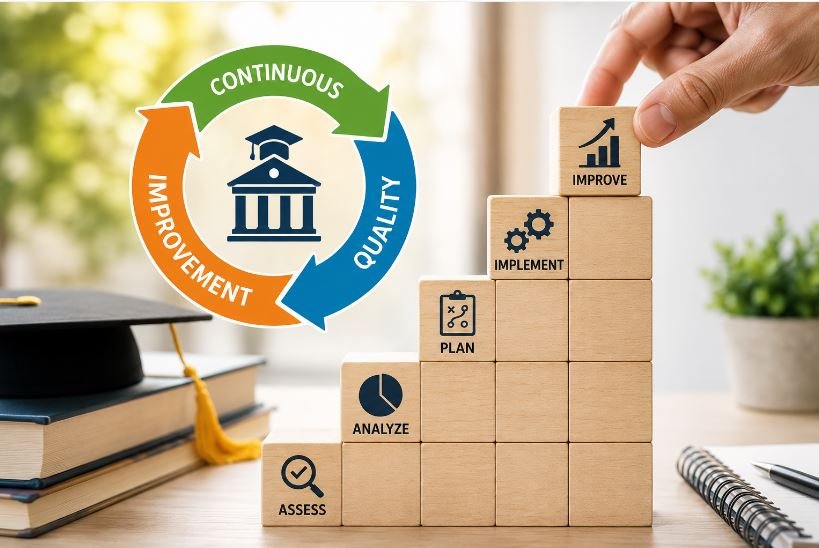
Most colleges have some version of a quality process: an audit before accreditation, a feedback form collected once a semester, a committee that meets when something goes wrong. Few have continuous quality improvement in the true sense, a system where asking “how are we doing, and can we do better” happens constantly, not periodically. This guide covers how to build that system. Our earlier guide on the internal academic audit process covers one important mechanism within this larger picture; this post focuses on the broader culture and systems that make improvement genuinely continuous.
Why Most Colleges Stay Stuck in Event-Based Quality Reviews
Event-based review is easier to schedule, easier to staff, and easier to point to as evidence of effort. An annual audit has a clear start and end date, a defined committee, and a report at the finish line. Continuous improvement has none of that structure by default, which is exactly why most institutions default to the event model even when they know, in principle, that ongoing improvement would serve them better.
The cost of this default shows up predictably: problems identified in one year’s audit reappear in the next, because nothing changed in between the two review dates. Continuous quality improvement exists specifically to close that gap, by making the review-and-respond cycle short enough that problems get fixed while they are still small.
🚀 Ready to build a genuine continuous improvement culture at your institution?
What Continuous Quality Improvement Actually Means for Colleges
Continuous Quality Improvement, often shortened to CQI, is a philosophy as much as a process. Rather than treating quality review as a scheduled event, CQI treats it as an ongoing habit built into how the institution operates day to day. The core discipline is simple to state and hard to sustain: continuously ask what is working, what is not, and act on the answer, rather than waiting for a fixed review date to ask the question at all.
- It focuses on improving processes, not assigning blame to individuals when something falls short
- It relies on data and evidence rather than assumption or anecdote to identify where improvement is needed
- It treats improvement as incremental and ongoing, not a single large overhaul completed once and left alone
- It depends on genuine participation across the institution, not just directives from senior leadership

The PDSA Cycle: A Practical Framework for CQI in Higher Education
The Plan-Do-Study-Act (PDSA) cycle, widely used across healthcare and education quality management, offers colleges a practical, repeatable structure for continuous improvement.
- Plan: Identify a specific, measurable area for improvement, such as first-year student attrition or assignment feedback turnaround time.
- Do: Implement a small, well-scoped change targeting that specific area, rather than a sweeping institution-wide overhaul.
- Study: Review the data after implementation to see whether the change actually produced the intended effect.
- Act: Adopt the change more broadly if it worked, adjust it if it partly worked, or abandon it if it did not, then begin the cycle again.
The strength of this cycle is its size. Small, testable changes move faster and carry less institutional risk than large reforms, and they generate faster feedback about what actually works in your specific context.
A Worked Example
Suppose a department notices that assignment feedback regularly takes three weeks to reach students, well past the point where it can still influence their next submission. A PDSA cycle applied here might plan a change limiting feedback turnaround to one week for a single course, implement it for one semester, study whether the shorter turnaround actually improved subsequent assignment quality, and then act by rolling the change out department-wide if the data supports it. The entire cycle can run in a single semester, producing a real, evidence-backed decision rather than a policy change made on instinct alone.
🔄 Want help applying a structured improvement cycle to your institution’s quality processes?
IQAC’s Role in Driving Continuous Improvement
For IQAC improvement efforts to genuinely drive CQI, the cell needs to function as an active improvement engine, not just a documentation body that compiles evidence before an accreditation visit. This shift in role, from evaluator to enabler, is often the single biggest change that separates institutions with real CQI culture from those with an IQAC that exists mainly on paper.
- Run feedback collection every semester, not once a year, so issues surface while they can still be addressed within the same academic cycle
- Track a small set of institutional quality indicators continuously, rather than compiling them for the first time during SSR drafting
- Give departments a direct channel to propose and test small improvements, rather than positioning IQAC purely as an evaluator
- Report back to departments on what changed as a result of their feedback, closing the loop visibly rather than letting input disappear into a report no one sees again
Building a Genuine Quality Culture, Not Just a Quality Process
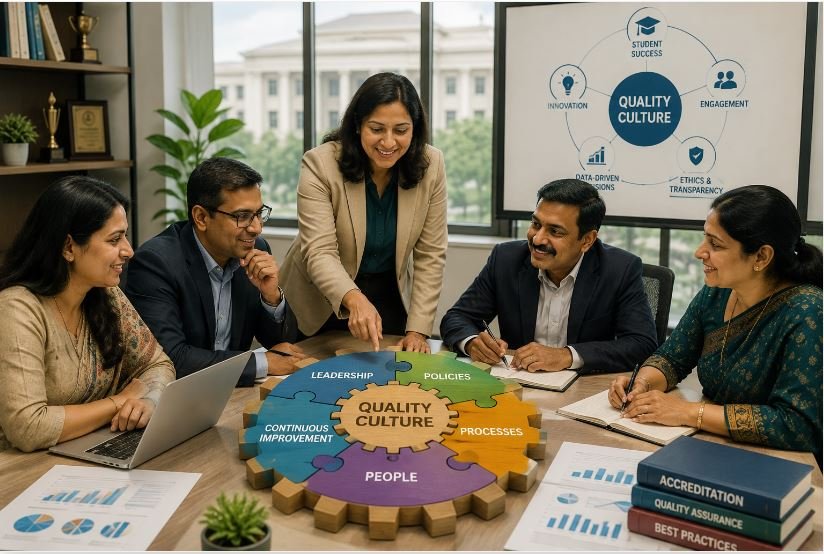
Processes alone do not sustain CQI. A genuine quality culture is what keeps the process alive once the initial enthusiasm of a new initiative fades, usually within the first year if culture is not deliberately built alongside the process.
- Leadership visibly participates in and responds to quality data, rather than delegating it entirely to IQAC and forgetting about it
- Faculty and staff can raise problems without fear of blame, since a punitive culture quietly trains people to hide issues instead of surfacing them
- Ownership of quality sits with every department, not just a central quality cell that everyone else treats as someone else’s job
- Small wins are recognised and shared, reinforcing that participating in improvement efforts is worth the effort
🌱 Want to assess whether your institution has a genuine quality culture or just a quality process?
Practical Ways to Embed CQI Into Daily Institutional Life
Turning the principles above into daily habit takes a handful of concrete practices, none of which require large new budgets or a dedicated software system to start.
- Build short feedback checkpoints into every course, not just end-of-semester surveys, so issues surface while a course is still running
- Use your internal academic audit as one structured input into the broader CQI cycle, not as the only quality activity all year
- Set a small number of institutional quality goals each year, tracked visibly, rather than trying to improve everything at once
- Create a simple, low-friction way for any staff member to flag an improvement idea, and actually review those suggestions on a regular schedule

How CQI Strengthens NAAC and NBA Outcomes
Institutions with a genuine CQI culture consistently find accreditation preparation easier, since the evidence NAAC and NBA expect, consistent data, documented action on feedback, visible improvement over time, already exists as a byproduct of how the institution operates. Our guides on how to start NAAC preparation in a college and the SSR Preparation Guide for Colleges both assume this kind of ongoing evidence base; CQI is what actually builds it.
🚀 Ready to turn your quality culture into a genuine accreditation advantage?
Conclusion
Continuous quality improvement is not another item to add to an already long accreditation checklist. It is a shift in how an institution relates to its own weaknesses, from something to hide before a visit to something to notice and fix year-round. Build small, testable improvement cycles, give IQAC a genuine improvement mandate rather than just a documentation role, and protect a culture where raising a problem is safe. Institutions that do this consistently find that accreditation stops being a special event and becomes a confirmation of what they already know about themselves, gathered through a year of honest, ongoing attention rather than assembled under deadline pressure.
Once your CQI culture is genuinely running, our guide on the internal academic audit process shows how to structure the periodic review that fits inside it.
FAQs:
An ongoing culture of reviewing and improving processes, not a periodic event.
Plan-Do-Study-Act, a repeatable framework for testing small improvements.
By running continuous feedback and improvement cycles, not just annual documentation.
Culture sustains participation and honesty even without active enforcement.
No, the audit is one structured input within a broader continuous system.
External Resources
Related posts:

What Is DVV in NAAC Accreditation? A Complete Guide for Indian Institutions

Graduation Outcomes NIRF Ranking: How Institutions Can Improve Performance
NAAC Criterion 6 and 7 Documentation Guide: Governance, Best Practices and Institutional Values
2 thoughts on “How to Build Continuous Quality Improvement in Colleges”