
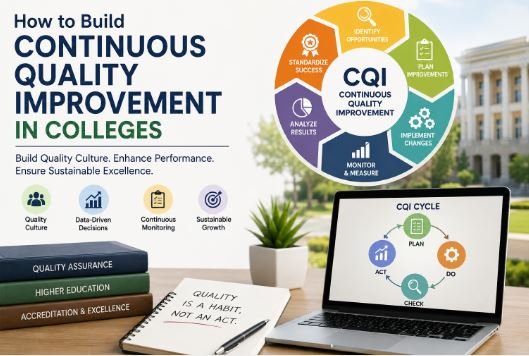
Continuous quality improvement has become an essential strategy for colleges and universities aiming to achieve long-term institutional excellence. In today’s higher education landscape, quality is no longer measured only during accreditation cycles. Instead, regulatory bodies and stakeholders increasingly expect institutions to demonstrate an ongoing commitment to improving academic processes, governance, student outcomes, research, in NIRF data collection structure, and administrative efficiency.
Many higher education institutions perform well when preparing for accreditation but struggle to maintain consistent quality practices once the assessment is complete. This often results in fragmented documentation, irregular reviews, delayed corrective actions, and limited stakeholder participation. Such challenges affect institutional performance, accreditation readiness, rankings, and overall educational outcomes.
A well-designed Continuous Quality Improvement (CQI) system transforms quality from a one-time project into an institutional culture. Rather than reacting to external evaluations, colleges proactively monitor performance, identify improvement opportunities, implement corrective measures, and review outcomes regularly. This approach strengthens governance, supports evidence-based decision-making, and encourages accountability across departments.
For Principals, Directors, IQAC Coordinators, Department Heads, and faculty members, establishing a structured CQI framework ensures that improvement becomes part of everyday institutional operations. This guide explains the concept of Continuous Quality Improvement, its significance for Indian higher education institutions, and the practical steps required to build a sustainable quality culture.
Request Your Continuous Quality Improvement Consultation Today
1. What is Continuous Quality Improvement?
Continuous Quality Improvement (CQI) is a systematic and ongoing approach to improving institutional performance through regular assessment, data analysis, planning, implementation, monitoring, and review. Rather than viewing quality as an activity performed only during accreditation, CQI encourages institutions to evaluate every academic and administrative process continuously.
In higher education, CQI is not limited to teaching and learning. It extends to governance, curriculum development, student support services, research activities, infrastructure management, examination systems, community engagement, faculty development, and institutional planning.
The philosophy behind CQI is simple: every process can be improved through systematic evaluation and informed decision-making. Instead of waiting for problems to become significant, institutions identify minor issues early, implement corrective measures, monitor progress, and refine processes over time.
Unlike one-time quality initiatives, Continuous Quality Improvement creates a cycle of learning and enhancement. Each review generates valuable insights that inform future planning, making institutional growth more structured and sustainable.
Understanding CQI in the Context of Indian Higher Education
For Indian colleges and universities, quality assurance has gained greater importance due to evolving expectations from accreditation agencies, regulatory bodies, students, employers, and society. Institutions are expected to demonstrate measurable improvements in teaching quality, student outcomes, governance, research productivity, innovation, and community engagement.
A college implementing CQI regularly collects performance data, analyses strengths and weaknesses, prepares action plans, assigns responsibilities, tracks implementation, and evaluates outcomes. These activities become part of routine institutional management rather than isolated accreditation exercises.
This systematic approach helps institutions build confidence among stakeholders while improving operational efficiency.
Core Principles of Continuous Quality Improvement
A successful CQI framework is built upon several interconnected principles.
Focus on Students
Every improvement initiative should ultimately enhance student learning, employability, satisfaction, and overall educational experience. Decisions regarding curriculum, infrastructure, technology, assessment, and support services should consider student needs as a primary factor.
Evidence-Based Decision Making
Quality improvements should rely on measurable evidence rather than assumptions. Institutions should regularly analyse data related to admissions, examination performance, placement, research output, faculty development, attendance, student feedback, alumni engagement, and administrative performance.
Reliable data enables leadership teams to prioritise improvement initiatives effectively.
Continuous Monitoring
CQI is not an annual activity.
Institutions should establish regular review mechanisms such as:
- Monthly departmental meetings
- Quarterly IQAC reviews
- Semester academic audits
- Annual institutional performance reviews
- Stakeholder feedback analysis
Regular monitoring ensures that corrective actions remain timely and effective.
Collaborative Participation
Quality improvement cannot be achieved by the IQAC alone.
Successful institutions involve:
- Management
- Principal
- IQAC
- Department Heads
- Faculty
- Administrative Staff
- Students
- Alumni
- Employers
- Industry Experts
Shared responsibility creates stronger ownership and encourages innovation throughout the institution.
Incremental Improvement
CQI promotes gradual, sustainable improvements rather than dramatic organisational changes.
Small improvements in attendance monitoring, examination processes, faculty mentoring, documentation, student counselling, laboratory utilisation, or digital services collectively produce significant institutional transformation over time.
Transparency and Accountability
Every improvement initiative should clearly define:
- Objectives
- Responsible individuals
- Timelines
- Resources
- Expected outcomes
- Review mechanisms
Transparent processes improve accountability while making institutional progress easier to evaluate.
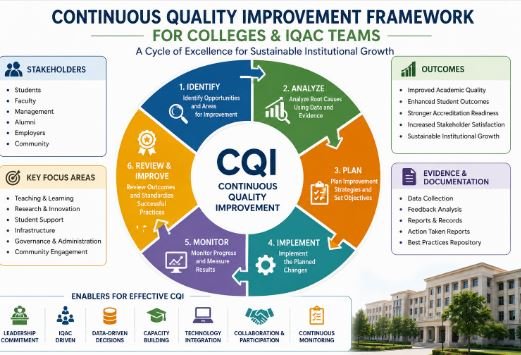
The Continuous Quality Improvement Cycle
Although institutions may adopt different quality models, most CQI systems follow a similar improvement cycle.
Step 1: Identify Areas for Improvement
The institution collects information through:
- Student feedback
- Faculty feedback
- Academic audit reports
- Department reviews
- Placement statistics
- Examination analysis
- Alumni feedback
- Employer feedback
- Research performance
- Infrastructure assessment
The objective is to identify performance gaps.
Step 2: Analyse the Root Cause
Instead of treating symptoms, institutions investigate why problems occur.
For example:
Low placement rates may result from:
- Outdated curriculum
- Limited industry interaction
- Poor communication skills
- Insufficient internship opportunities
- Weak career guidance
Understanding root causes helps institutions implement meaningful solutions.
Step 3: Develop Improvement Plans
Each identified issue should have:
- Defined objectives
- Improvement strategy
- Responsible department
- Timeline
- Required resources
- Performance indicators
Planning converts observations into actionable initiatives.
Step 4: Implement Corrective Actions
Departments execute the planned improvements.
Examples include:
- Faculty development programmes
- Curriculum revisions
- Student mentoring initiatives
- Laboratory upgrades
- Digital learning tools
- Research support programmes
- Industry collaborations
Implementation should be documented carefully for future review.
Download the College Continuous Quality Improvement Checklist Now
Step 5: Measure Results
After implementation, institutions evaluate whether improvements achieved the intended outcomes.
Performance indicators may include:
- Student success rates
- Placement statistics
- Research publications
- Faculty participation
- Student satisfaction
- Graduation rates
- Examination performance
- Accreditation readiness
Step 6: Standardise Successful Practices
Effective improvements should become institutional policies or standard operating procedures.
This ensures consistency across departments while preventing recurring issues.
Characteristics of a College with Strong Continuous Quality Improvement
Institutions with mature CQI systems generally demonstrate several common characteristics.
Strong Leadership Commitment
Institutional leadership actively promotes quality initiatives, allocates resources, reviews progress, and encourages innovation.
Quality becomes a strategic priority rather than an administrative requirement.
Active IQAC
The Internal Quality Assurance Cell functions throughout the year by:
- Monitoring quality indicators
- Coordinating departmental reviews
- Conducting audits
- Analysing institutional performance
- Supporting documentation
- Recommending improvements
Rather than merely preparing reports, the IQAC becomes the driving force behind institutional development.
Data-Driven Governance
Decisions regarding academics, infrastructure, faculty recruitment, budgeting, and student services rely on institutional evidence instead of assumptions.
Regular dashboards and performance reports support informed planning.
Departmental Ownership
Every academic department maintains its own improvement plans aligned with institutional objectives.
Department Heads regularly review:
- Course outcomes
- Programme outcomes
- Student progression
- Faculty development
- Research performance
- Industry engagement
This decentralised approach strengthens overall institutional quality.
Continuous Documentation
Documentation becomes an ongoing activity rather than a last-minute accreditation exercise.
Records typically include:
- Meeting minutes
- Action Taken Reports
- Academic audit reports
- Faculty development activities
- Student achievements
- Extension activities
- Research documentation
- Feedback analysis
- Improvement initiatives
Consistent documentation significantly reduces accreditation preparation time.
2. Why Continuous Quality Improvement Matters for Colleges, Universities and IQAC Teams
Higher education institutions today operate in an increasingly competitive environment. Students seek quality education, employers expect industry-ready graduates, accreditation agencies demand evidence-based practices, and regulatory authorities encourage accountability. Under these circumstances, maintaining quality cannot depend solely on periodic inspections or accreditation visits. Continuous Quality Improvement enables institutions to remain responsive, adaptable, and focused on long-term excellence.
For colleges, CQI is more than a quality assurance tool—it is a management philosophy that integrates planning, execution, review, and improvement into everyday institutional functioning. By embedding quality into routine academic and administrative processes, institutions become better equipped to meet changing educational expectations and sustain performance over time.
Builds a Sustainable Quality Culture
One of the greatest advantages of Continuous Quality Improvement is that it helps create a genuine quality culture across the institution.
Instead of viewing quality as the responsibility of only the IQAC or senior management, CQI encourages every stakeholder to participate in institutional improvement. Faculty members review teaching practices, departments monitor academic performance, administrators improve service delivery, and students contribute through structured feedback.
As this collaborative approach becomes routine, quality shifts from being an event to becoming a shared institutional value.
Strengthens IQAC Functioning
An effective Internal Quality Assurance Cell is central to institutional development. However, many IQACs become highly active only during accreditation preparation. Continuous Quality Improvement changes this approach by giving the IQAC an ongoing role in monitoring quality indicators, coordinating departmental reviews, analysing institutional data, tracking Action Taken Reports, and facilitating evidence-based improvements throughout the academic year.
This sustained engagement enables the IQAC to move beyond documentation and become a strategic driver of institutional excellence.
3. Step-by-Step Framework to Build Continuous Quality Improvement in Colleges
Developing a successful continuous quality improvement system requires more than drafting policies or conducting periodic meetings. Institutions need a structured framework that integrates planning, implementation, monitoring, evaluation, and corrective action into daily operations. When every department understands its role in quality enhancement, improvement becomes sustainable rather than event-driven.
The following framework can help colleges and universities establish an effective CQI system aligned with institutional goals and accreditation expectations.
Step 1: Define a Clear Quality Vision
Every quality journey begins with institutional commitment.
The management, Principal, and senior leadership should establish a clear vision explaining what quality means for the institution. This vision should align with the college’s mission, strategic plan, and long-term development goals.
An effective quality vision answers questions such as:
- What kind of graduates does the institution aim to produce?
- What standards should academic and administrative departments achieve?
- How will institutional performance be measured?
- What values should guide continuous improvement?
Once developed, the vision should be communicated across departments so that every stakeholder understands the institution’s quality objectives.
Step 2: Strengthen the Role of IQAC
The Internal Quality Assurance Cell should function as the central coordination body for institutional quality initiatives.
Instead of becoming active only before accreditation, the IQAC should operate throughout the academic year by:
- Coordinating departmental quality initiatives
- Reviewing institutional performance indicators
- Monitoring Action Taken Reports quality in higher education
- Conducting internal quality reviews
- Organising faculty development programmes
- Promoting innovation and best practices
- Maintaining quality documentation
- Preparing periodic quality reports
A proactive IQAC encourages departments to view improvement as an ongoing responsibility rather than an occasional exercise.
Step 3: Establish Measurable Quality Objectives
Broad goals such as “improve education quality” are difficult to monitor.
Instead, institutions should define measurable objectives.
Examples include:
| Area | Sample Objective |
|---|---|
| Student Success | Increase pass percentage by 5% |
| Research | Improve publications in indexed journals |
| Faculty Development | Every faculty member attends two FDPs annually |
| Student Support | Increase mentoring sessions each semester |
| Placement | Improve placement percentage through industry collaborations |
| Digital Learning | Expand LMS adoption across departments |
Each objective should include:
- Performance indicators
- Timeline
- Responsible department
- Required resources
- Review frequency
Clear objectives make institutional progress measurable.
Step 4: Identify Quality Indicators
Quality indicators allow institutions to measure progress objectively.
Common indicators include:
Academic Indicators
- Student pass percentage
- Course completion rate
- Programme outcome attainment
- Student progression
- Examination results
- Graduate employability
Faculty Indicators
- Faculty qualifications
- Research publications
- FDP participation
- Consultancy projects
- Patents
- Research grants
Administrative Indicators
- Student grievance resolution
- Digital services
- Library utilisation
- Infrastructure maintenance
- Financial transparency
Student Experience Indicators
- Student satisfaction
- Feedback scores
- Placement statistics
- Internship participation
- Extracurricular involvement
Selecting appropriate indicators ensures regular monitoring.
Step 5: Build a Data Collection System
Continuous improvement depends on reliable data.
Institutions should collect information systematically through:
- Student feedback
- Faculty feedback
- Alumni surveys
- Employer feedback
- Academic audits
- Department reports
- Examination analysis
- Placement records
- Research databases
- Infrastructure utilisation reports
Digital data management systems improve accuracy while reducing manual effort.
Step 6: Conduct Regular Academic and Administrative Reviews
Quality cannot improve without periodic review.
Suggested review schedule:
| Review Activity | Frequency |
| Department Meetings | Monthly |
| IQAC Meetings | Quarterly |
| Academic Audit | Semester-wise |
| Administrative Review | Quarterly |
| Feedback Analysis | Every Semester |
| Institutional Review | Annual |
Each review should conclude with:
- Observations
- Improvement recommendations
- Responsible officers
- Deadlines
- Action Taken Reports
Step 7: Prepare Action Plans
Every identified issue should lead to a structured improvement plan.
A practical action plan should include:
| Component | Description |
| Issue Identified | Low placement percentage |
| Root Cause | Limited industry interaction |
| Improvement Activity | Industry partnerships and internships |
| Responsibility | Placement Cell |
| Timeline | Six months |
| Success Indicator | Increased campus recruitment |
Action plans convert analysis into measurable institutional progress.
Step 8: Monitor Progress Continuously
Implementation alone does not guarantee improvement.
Departments should monitor:
- Activity completion
- Budget utilisation
- Timeline adherence
- Performance indicators
- Stakeholder feedback
- Challenges encountered
Monitoring helps identify delays before they affect institutional performance.
Step 9: Review Outcomes
After implementation, institutions should evaluate whether objectives were achieved.
Typical evaluation questions include:
- Did student performance improve?
- Were faculty development goals achieved?
- Has research productivity increased?
- Did stakeholder satisfaction improve?
- Were planned activities completed?
- Which initiatives produced the best results?
Evaluation supports evidence-based planning for future improvements.
Step 10: Standardise Successful Practices
Successful initiatives should become institutional policies.
Examples include:
- Student mentoring systems
- Feedback mechanisms
- Department review formats
- Academic audit schedules
- Digital documentation procedures
- Research monitoring systems
Standardisation ensures consistency across departments.
Practical Continuous Quality Improvement Checklist
Institutions can use the following checklist to evaluate their readiness.
| Checklist Item | Status |
| Quality policy documented | □ |
| Annual quality objectives prepared | □ |
| IQAC meetings conducted regularly | □ |
| Department quality plans available | □ |
| Academic audits completed | □ |
| Administrative audits conducted | □ |
| Student feedback analysed | □ |
| Alumni feedback collected | □ |
| Employer feedback incorporated | □ |
| Action Taken Reports maintained | □ |
| Faculty development monitored | □ |
| Research performance reviewed | □ |
| Best practices documented | □ |
| Institutional dashboard updated | □ |
| Annual quality review completed | □ |
Roles and Responsibilities in Continuous Quality Improvement
CQI succeeds only when responsibilities are clearly defined. Every stakeholder contributes to institutional quality in a unique way.
Principal / Director
The institutional head provides strategic direction and leadership for quality initiatives. Their responsibilities include:
- Establishing quality goals
- Approving institutional policies
- Allocating resources
- Reviewing quality reports
- Encouraging innovation
- Monitoring implementation
Strong leadership ensures quality remains an institutional priority.
IQAC Coordinator
The IQAC Coordinator serves as the central facilitator of continuous improvement.
Key responsibilities include:
- Coordinating quality initiatives
- Monitoring institutional indicators
- Organising quality meetings
- Supporting departments
- Preparing Action Taken Reports
- Maintaining quality documentation
- Facilitating academic audits
- Promoting best practices
The effectiveness of the IQAC often determines the success of the CQI framework.
Heads of Departments (HODs)
Department Heads translate institutional quality objectives into departmental action.
Their responsibilities include:
- Monitoring academic performance
- Reviewing programme outcomes
- Supporting faculty development
- Encouraging research
- Maintaining departmental records
- Conducting departmental meetings
- Implementing improvement plans
Department-level ownership is essential for institution-wide success.
Faculty Members
Faculty members play a direct role in improving teaching and learning quality.
They contribute through:
- Outcome-based teaching
- Innovative pedagogical practices
- Student mentoring
- Research activities
- Curriculum improvement
- Continuous assessment
- Feedback implementation
Faculty participation ensures that quality improvement reaches the classroom.
Administrative Staff
Administrative departments significantly influence student experience and institutional efficiency.
Their responsibilities include:
- Maintaining accurate records
- Improving service delivery
- Supporting digital transformation
- Managing documentation
- Ensuring timely communication
- Assisting quality reviews
Administrative excellence strengthens institutional governance.
Students
Students are valuable partners in quality enhancement.
They contribute by:
- Providing constructive feedback
- Participating in committees
- Engaging in institutional activities
- Reporting challenges
- Supporting quality initiatives
Student participation helps institutions identify practical improvement opportunities.
Creating a Culture of Evidence-Based Decision Making
One of the defining characteristics of mature CQI systems is the use of evidence rather than assumptions.
Instead of relying on perceptions, institutional leaders analyse data before making decisions.
Examples include:
- Using examination analysis to improve teaching strategies.
- Reviewing placement trends before updating skill development programmes.
- Analysing student feedback before revising curriculum delivery.
- Monitoring research productivity before planning faculty development.
- Studying infrastructure utilisation before making investment decisions.
Evidence-based governance improves transparency, accountability, and institutional effectiveness.

Benefits Institutions Experience After Implementing CQI
Colleges that consistently implement a structured CQI framework often experience measurable improvements over time, including:
- Better academic planning and execution.
- Stronger departmental coordination.
- Improved documentation and record management.
- Enhanced student satisfaction and engagement.
- Increased faculty participation in research and development.
- More effective decision-making through institutional data.
- Stronger preparedness for accreditation and quality assessments.
- Sustainable institutional growth driven by continuous learning and improvement.
Rather than treating quality as a destination, these institutions embrace it as an ongoing journey, creating resilient systems capable of adapting to changing educational needs and stakeholder expectations.
4. Common Mistakes Colleges Should Avoid While Implementing Continuous Quality Improvement
Even institutions with dedicated leadership and active IQAC teams may struggle to establish an effective continuous quality improvement system if common implementation mistakes are not addressed. Recognising these challenges early helps colleges build a more sustainable quality framework.
4.1 Treating CQI as an Accreditation Activity
One of the most common misconceptions is that quality improvement is only necessary before accreditation visits. As a result, institutions become highly active during NAAC or NBA preparation and then discontinue many quality initiatives afterward.
Best Practice: Integrate CQI into the annual academic calendar with regular reviews, departmental meetings, and improvement plans throughout the year.
4.2 Depending Entirely on the IQAC
Quality cannot be achieved by the IQAC alone. When departments view quality assurance as someone else’s responsibility, institutional progress slows.
Best Practice: Clearly define quality responsibilities for Principals, HODs, faculty members, administrative staff, and committees.
4.3 Poor Documentation Practices
Many colleges perform excellent activities but fail to maintain evidence. Missing records, incomplete reports, and inconsistent documentation create significant challenges during audits and accreditation.
Best Practice: Maintain digital and physical records continuously, including meeting minutes, attendance, feedback analysis, Action Taken Reports (ATRs), academic audit reports, and photographs of activities.
4.4 Ignoring Stakeholder Feedback
Student, alumni, employer, faculty, and parent feedback provide valuable insights for improvement. Collecting feedback without analysing or acting upon it reduces its value.
Best Practice: Review feedback periodically, identify recurring issues, implement corrective measures, and communicate improvements to stakeholders.
4.5 Lack of Measurable Objectives
General goals such as “improve quality” or “enhance teaching” make it difficult to evaluate progress.
Best Practice: Set SMART objectives (Specific, Measurable, Achievable, Relevant, and Time-bound) with defined performance indicators.
4.6 Weak Follow-Up Mechanisms
Many improvement initiatives begin enthusiastically but lose momentum because progress is not monitored.
Best Practice: Track every action item using timelines, responsible persons, review dates, and completion status.
4.7 Limited Faculty Participation
Faculty members are central to teaching, learning, research, and student mentoring. Excluding them from quality initiatives limits institutional impact.
Best Practice: Encourage faculty ownership through departmental quality plans, professional development programmes, research incentives, and collaborative decision-making.
5. Best Practices for Building a Sustainable Quality Culture
A strong quality culture develops gradually through consistent leadership, collaboration, and evidence-based practices. The following strategies help institutions sustain Continuous Quality Improvement over the long term.
Develop a Long-Term Quality Strategy
Quality initiatives should align with the institution’s strategic plan rather than individual accreditation cycles. Annual objectives should contribute to long-term institutional goals.
Integrate Quality into Everyday Operations
CQI should become part of routine academic and administrative processes, including:
- Department meetings
- Faculty appraisal
- Curriculum review
- Student mentoring
- Examination analysis
- Budget planning
- Research monitoring
Encourage Innovation
Faculty, staff, and students should be encouraged to propose innovative teaching methods, administrative improvements, digital initiatives, research collaborations, and community engagement projects.
Build Capacity Through Training
Regular workshops on topics such as Outcome-Based Education (OBE), academic auditing, documentation, research methodology, digital learning, and institutional planning strengthen staff capabilities.
Use Technology for Quality Management
Digital tools can simplify quality monitoring by supporting:
- Online feedback collection
- Learning Management Systems (LMS)
- Document repositories
- Performance dashboards
- Academic management systems
- Data analytics
Technology improves efficiency while reducing manual errors.
Celebrate Best Practices
Recognising departments and individuals who contribute significantly to quality enhancement motivates others and reinforces institutional commitment to continuous improvement.
Benchmark Institutional Performance
Colleges should compare their practices with national quality standards and peer institutions to identify opportunities for improvement while maintaining their unique institutional vision.
Suggested Roadmap for Continuous Quality Improvement
| Timeline | Recommended Activities |
|---|---|
| Monthly | Department meetings, review of action plans, student mentoring, documentation updates |
| Quarterly | IQAC meetings, KPI monitoring, stakeholder feedback analysis, administrative review |
| Semester-wise | Academic audit, curriculum review, faculty performance evaluation, programme outcome analysis |
| Annual | Institutional quality review, strategic planning, best practice documentation, quality objectives for the next academic year |
This structured roadmap helps institutions move from reactive quality management to proactive institutional development.
6. How Bhavya Gyan Consultants (BGC) Can Help
Building a successful continuous quality improvement framework requires expertise, structured planning, and sustained institutional engagement. Bhavya Gyan Consultants (BGC) partners with colleges and universities across India to strengthen quality systems and support long-term institutional excellence.
Our consultative approach focuses on helping institutions create practical, evidence-based quality processes that continue well beyond accreditation cycles.
BGC Services for Continuous Quality Improvement
BGC can assist your institution with:
- IQAC strengthening and operational support
- Quality policy development
- Academic and administrative audit support
- Department-wise quality planning
- Documentation and evidence management
- NAAC accreditation readiness
- NBA and Outcome-Based Education (OBE) supportNIRF data management and ranking support
- Strategic institutional planning
- Faculty development programmes
- Website structuring for accreditation compliance
- Continuous monitoring and quality review mechanisms
Whether your institution is preparing for accreditation or aiming to build a sustainable quality culture, BGC provides practical guidance tailored to your institutional goals.
Official External Link:
Use only official sources where appropriate:
Conclusion
Building continuous quality improvement is not a one-time initiative but an ongoing institutional commitment. Colleges that embrace CQI develop stronger governance systems, more effective academic processes, better documentation, improved stakeholder satisfaction, and greater readiness for accreditation and ranking exercises.
A successful CQI framework empowers every stakeholder—from institutional leadership and IQAC teams to faculty members, administrative staff, and students—to contribute toward a shared vision of excellence. Through regular planning, monitoring, evaluation, and corrective action, institutions create a resilient quality culture capable of adapting to changing educational expectations.
Rather than focusing solely on compliance, colleges should view Continuous Quality Improvement as a strategic investment in institutional growth, student success, and long-term sustainability.
Strengthen Your Continuous Quality Improvement System
A well-functioning IQAC is the foundation of sustainable institutional excellence. If your college is planning to enhance its quality systems, improve documentation, conduct academic audits, or prepare for accreditation, Bhavya Gyan Consultants can provide practical guidance tailored to your institutional needs.
FAQs:
Continuous Quality Improvement (CQI) is an ongoing process of planning, implementing, monitoring, evaluating, and improving academic and administrative activities to enhance institutional performance and student outcomes.
Quality assurance focuses on maintaining predefined standards, while Continuous Quality Improvement goes a step further by continuously identifying opportunities to enhance institutional processes and performance.
CQI enables the IQAC to monitor institutional performance throughout the year, coordinate improvement initiatives, maintain documentation, and support evidence-based decision-making rather than working only during accreditation preparation.
Most institutions benefit from monthly departmental reviews, quarterly IQAC meetings, semester-wise academic audits, and annual institutional quality reviews.
Common indicators include student performance, programme outcomes, faculty development, research output, placement statistics, stakeholder feedback, infrastructure utilisation, and administrative efficiency.