
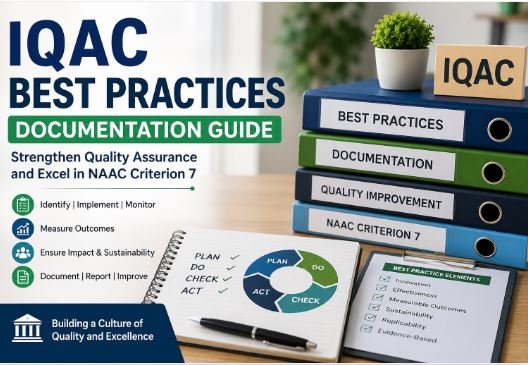
Quality assurance has become one of the most important priorities for higher education institutions in India. Whether a college is preparing for NAAC accreditation, strengthening its Internal Quality Assurance Cell (IQAC), or aiming to improve institutional performance, documenting and presenting meaningful initiatives is no longer optional. Institutions are now expected to demonstrate how they continuously improve teaching, learning, governance, student development, and community engagement through well-planned quality practices.
One of the most significant components of this process is the documentation of IQAC best practices. Well-documented best practices not only support compliance with accreditation requirements but also showcase an institution’s commitment to innovation, accountability, and continuous improvement. During NAAC assessment, reviewers look beyond policy documents and expect evidence of practices that have positively impacted the institution and can be sustained over time.
Unfortunately, many colleges face challenges in identifying what qualifies as a best practice, collecting evidence, organizing documentation, and presenting it in the format expected under NAAC Criterion 7. Some institutions have excellent initiatives but fail to document them effectively, while others confuse routine administrative activities with genuine best practices.
This guide explains everything institutions need to know about documenting IQAC best practices. It covers the meaning of best practices, their importance for accreditation, common documentation challenges, and practical guidance for creating impactful records that strengthen institutional quality assurance systems.
Strengthen IQAC systems with expert documentation support today.
1. Understanding IQAC Best Practices
The term IQAC best practices refers to innovative, effective, and sustainable institutional initiatives that significantly improve academic quality, governance, student development, research, extension activities, environmental responsibility, or administrative efficiency. These practices demonstrate how an institution continuously enhances its performance through planned interventions rather than isolated activities.
A best practice is not simply an event conducted once or a mandatory academic procedure. Instead, it represents a systematic approach that has been implemented consistently, evaluated regularly, and shown measurable positive outcomes. Such practices often emerge from the institution’s commitment to solving specific challenges while promoting excellence across different functional areas.
For example, a college may establish a structured faculty mentoring system that improves student retention, implement a digital academic monitoring platform that enhances transparency, or develop an industry collaboration framework that significantly increases internship opportunities. When these initiatives are planned carefully, monitored continuously, supported by evidence, and replicated successfully over time, they become institutional best practices.
Within the framework of quality assurance, IQAC plays the central role in identifying, nurturing, monitoring, documenting, and disseminating these practices across departments. Rather than working only during accreditation cycles, the IQAC should continuously encourage departments to innovate, assess outcomes, and maintain documentation throughout the academic year.
Effective best practices generally address institutional objectives while creating measurable benefits for stakeholders such as students, faculty members, administrators, employers, and the community. They should also align with the institution’s vision and mission, making quality enhancement an ongoing institutional culture instead of a temporary accreditation exercise.

Characteristics of Effective IQAC Best Practices
A genuine institutional best practice usually possesses several important characteristics.
Clearly Defined Objectives
Every best practice begins with a clearly identified institutional need or challenge. Institutions should explain what problem they intended to solve and why the initiative was necessary.
For instance:
- Improving student attendance
- Enhancing employability
- Promoting research culture
- Strengthening alumni engagement
- Increasing digital learning adoption
- Supporting slow learners
- Improving governance transparency
Without a clearly defined objective, it becomes difficult to demonstrate the significance of the practice.
Innovation
Innovation does not always require sophisticated technology or expensive infrastructure. Instead, it involves introducing improved methods, processes, or systems that generate better outcomes than conventional approaches.
Examples include:
- Digital mentoring systems
- Outcome-based academic reviews
- Student-led quality circles
- Community knowledge exchange programs
- Faculty innovation grants
- Paperless academic administration
Innovation should solve a real institutional problem while being practical and sustainable.
Measurable Outcomes
One of the strongest indicators of an effective best practice is the ability to demonstrate measurable improvement.
Evidence may include:
- Improved examination results
- Higher student participation
- Better placement statistics
- Increased research publications
- Enhanced stakeholder satisfaction
- Reduced dropout rates
- Improved attendance
- Greater faculty participation in FDPs
Quantifiable outcomes make documentation stronger and more convincing during accreditation.
Sustainability
A successful practice should continue over multiple academic sessions rather than being implemented only once.
Sustainability demonstrates institutional commitment, resource allocation, leadership support, and long-term planning.
Reviewers generally appreciate practices that have become an integral part of institutional functioning rather than temporary projects introduced solely for accreditation.
Replicability
One important quality of a best practice is that it can be adopted by other departments or institutions.
When documentation clearly explains implementation methods, resources, responsibilities, and outcomes, other institutions can learn from and adapt the model.
Replicable practices contribute to institutional reputation and knowledge sharing within higher education.
Evidence-Based Documentation
Perhaps the most important requirement is comprehensive documentation.
Supporting evidence may include:
- Policy documents
- Circulars
- Meeting minutes
- Attendance records
- Photographs
- Reports
- Feedback analysis
- Outcome data
- Survey results
- Certificates
- Newspaper coverage
- Website screenshots
Well-organized evidence adds credibility and simplifies the accreditation process.
2. Why IQAC Best Practices Matter for Colleges and Universities
Higher education institutions today are evaluated not only on academic performance but also on how effectively they foster innovation, inclusiveness, sustainability, governance, and continuous improvement. Documenting institutional best practices enables colleges to demonstrate that quality enhancement is embedded in their day-to-day functioning rather than treated as a periodic accreditation requirement.
For institutions preparing for NAAC assessment, IQAC best practices play a particularly important role because they reflect an institution’s ability to identify challenges, implement creative solutions, evaluate outcomes, and institutionalize successful initiatives. They provide tangible evidence that quality assurance mechanisms are active, effective, and aligned with the institution’s mission.
1. Strengthens NAAC Criterion 7 Documentation
One of the primary reasons best practice documentation is important is its direct relevance to NAAC Criterion 7, which focuses on Institutional Values and Best Practices. Assessors expect institutions to present authentic examples of initiatives that have created measurable improvements and contributed to institutional excellence.
Strong documentation under this criterion demonstrates that quality enhancement is integrated into institutional culture rather than being limited to compliance activities.
2. Demonstrates Continuous Quality Improvement
Continuous improvement is a core principle of IQAC. Institutions that regularly identify challenges, implement corrective actions, monitor results, and refine processes are better positioned to maintain high academic standards.
Documented best practices serve as evidence that quality enhancement is an ongoing institutional process supported by data, stakeholder participation, and periodic review.
3. Encourages Innovation Across Departments
When departments see successful initiatives being documented and recognized, they are encouraged to design their own innovative academic and administrative practices. This creates a healthy culture of experimentation, collaboration, and knowledge sharing within the institution.
Over time, these initiatives contribute to improved teaching methods, stronger student support systems, better governance, and enhanced community engagement.
4. Builds Institutional Credibility
Well-documented best practices help present the institution as a quality-conscious and forward-looking organization. They showcase achievements to accreditation agencies, regulatory bodies, prospective students, faculty members, funding organizations, and industry partners.
Institutions with a repository of successful practices often find it easier to communicate their strengths during inspections, audits, and ranking exercises.
5. Supports Evidence-Based Decision Making
Best practice documentation provides valuable insights into what works well within the institution. By reviewing implementation strategies and outcomes, institutional leaders can make informed decisions about scaling successful initiatives, allocating resources, and planning future quality enhancement activities.
This evidence-based approach reduces reliance on assumptions and supports more effective governance.
6. Enhances Stakeholder Confidence
Students, parents, faculty, alumni, employers, and governing bodies are more likely to trust institutions that demonstrate a commitment to transparency and continuous improvement. Documented best practices provide clear examples of how the institution addresses challenges, adopts innovative solutions, and measures success.
Such transparency strengthens stakeholder engagement and reinforces the institution’s reputation for quality and accountability.
H2 3. Step-by-Step Process for Preparing Best Practice Documentation
Creating effective best practice documentation is not just about writing reports before a NAAC visit. It is a systematic process that begins with identifying meaningful initiatives, collecting evidence throughout the academic year, evaluating outcomes, and presenting the information in a structured format. Institutions that document activities consistently find the accreditation process much easier and more accurate.
The following framework can help colleges and universities develop high-quality documentation that aligns with institutional quality assurance goals and supports NAAC Criterion 7.
Step 1. Identify Institutional Practices Worth Documenting
Not every activity conducted by a college qualifies as a best practice. Routine administrative tasks, statutory meetings, or annual events generally do not meet the criteria unless they demonstrate innovation, measurable impact, and long-term sustainability.
The IQAC should work with departments to identify initiatives that have:
- Solved a significant institutional challenge
- Improved academic or administrative quality
- Benefited students, faculty, or society
- Produced measurable outcomes
- Continued successfully for multiple years
- Become part of institutional culture
Examples include:
- Structured faculty mentoring programmes
- Student leadership development initiatives
- Green campus campaigns
- Digital attendance and academic monitoring systems
- Research incentive policies
- Community outreach programmes
- Industry-integrated learning models
- Outcome-based academic review mechanisms
Instead of documenting numerous small activities, institutions should focus on a few impactful practices supported by strong evidence.
Step 2. Define the Objective Clearly
Every documented practice should begin by explaining why it was introduced.
Questions to answer include:
- What institutional problem existed?
- Why was intervention necessary?
- Which stakeholders were affected?
- What goals were expected?
For example:
Instead of writing:
“The college introduced faculty mentoring.”
A stronger statement would be:
“To reduce first-year student dropout rates and improve academic engagement, the institution introduced a structured faculty mentoring system under the guidance of IQAC.”
A clearly defined objective helps reviewers understand the purpose of the initiative and its institutional relevance.
Step 3. Describe the Context and Need
NAAC reviewers appreciate documentation that explains the background rather than simply listing activities.
Include information such as:
- Institutional challenges
- Student demographics
- Academic issues
- Community needs
- Regulatory expectations
- Previous performance gaps
For example, if a college implemented a digital grievance system, explain whether there were delays in complaint resolution, communication challenges, or transparency concerns before introducing the system.
Providing context demonstrates that the initiative emerged from genuine institutional needs.
Step 4. Explain the Planning Process
One of the most overlooked aspects of documentation is describing how the initiative was planned.
Include details such as:
- IQAC discussions
- Departmental meetings
- Stakeholder consultations
- Approval by governing bodies
- Resource planning
- Timeline preparation
- Budget allocation
- Roles and responsibilities
This information shows that the initiative was systematic rather than spontaneous.
A flowchart illustrating the planning process can also strengthen documentation.
Step 5. Document the Implementation Process
This section should explain exactly how the practice was executed.
Include information such as:
- Launch date
- Implementation stages
- Departments involved
- Faculty responsibilities
- Student participation
- Technology used
- Monitoring mechanisms
- Review meetings
Instead of writing general statements, explain the process chronologically.
Example:
- Need identified during Academic Audit
- Proposal discussed in IQAC meeting
- Governing Body approval obtained
- Faculty orientation conducted
- Student participation initiated
- Monthly monitoring introduced
- Semester-wise review completed
- Improvements incorporated
Such structured documentation reflects effective institutional planning.
Request your institutional IQAC documentation audit from BGC now.
Step 6. Collect Supporting Evidence Throughout the Year
One of the biggest mistakes institutions make is collecting evidence only a few weeks before accreditation.
Evidence should be maintained continuously.
Useful supporting documents include:
| Document Type | Purpose |
|---|---|
| IQAC Meeting Minutes | Decision-making evidence |
| Circulars | Official communication |
| Attendance Sheets | Participation records |
| Photographs | Visual evidence |
| Reports | Activity summaries |
| Student Feedback | Stakeholder response |
| Faculty Feedback | Improvement assessment |
| Outcome Reports | Performance analysis |
| Newspaper Coverage | Public recognition |
| Website Screenshots | Online dissemination |
| Financial Records | Resource utilization |
| Certificates | External validation |
Maintaining digital folders for every initiative simplifies future reporting.
Step 7. Measure Outcomes
A best practice without measurable outcomes becomes difficult to justify.
Institutions should compare data before and after implementation.
Possible indicators include:
Academic Indicators
- Pass percentage
- Result improvement
- Student attendance
- Course completion rates
Research Indicators
- Publications
- Patents
- Projects
- Research funding
Student Development
- Placement rate
- Internship participation
- Skill certifications
- Entrepreneurship initiatives
Administrative Indicators
- Processing time reduction
- Digital service adoption
- Stakeholder satisfaction
- Grievance resolution time
Whenever possible, include numerical data, charts, or comparison tables.
Step 8. Evaluate Impact
Impact should extend beyond statistics.
Explain how the initiative benefited different stakeholders.
Possible impacts include:
Students
- Better academic performance
- Increased confidence
- Improved employability
- Enhanced participation
Faculty
- Better teaching practices
- Professional development
- Research collaboration
- Improved communication
Institution
- Stronger quality culture
- Better governance
- Improved documentation
- Increased stakeholder trust
Society
- Community engagement
- Environmental awareness
- Local development
- Social responsibility
Impact analysis helps reviewers understand the broader significance of the initiative.
Step 9. Mention Challenges and Improvements
No institutional initiative is perfect.
Acknowledging challenges demonstrates transparency.
Common challenges include:
- Limited funding
- Faculty workload
- Technology adoption
- Student participation
- Infrastructure limitations
Also explain how the institution addressed these issues.
For example:
- Conducted additional awareness programmes
- Increased stakeholder involvement
- Improved training sessions
- Revised implementation timelines
- Allocated additional resources
Continuous refinement reflects mature quality assurance practices.
Step 10. Prepare the Final Documentation
A well-structured report improves readability and evaluation.
A recommended format includes:
- Title of Best Practice
- Objective
- Institutional Context
- Problem Identified
- Practice Description
- Planning Process
- Implementation
- Evidence
- Outcomes
- Impact
- Challenges
- Future Plans
- Supporting Documents
- Contact Information (if applicable)
Consistency in formatting across departments enhances institutional professionalism.
H2 4. Common Mistakes Institutions Should Avoid
Many colleges implement excellent initiatives but lose valuable opportunities because of weak documentation. Understanding these common mistakes can help institutions prepare stronger records for accreditation and internal quality assurance.
Treating Routine Activities as Best Practices
One of the most frequent errors is presenting mandatory or routine institutional activities as best practices. Annual functions, examinations, regular meetings, and statutory processes are important but generally do not qualify unless they include innovative approaches and measurable improvements.
Instead, institutions should highlight initiatives that demonstrate creativity, problem-solving, and sustained impact.
Lack of Measurable Outcomes
Documentation often describes activities in detail but fails to explain the results achieved.
For example:
Instead of writing:
“A faculty development programme was conducted successfully.”
Provide measurable outcomes such as:
- Number of faculty trained
- Improvement in teaching methods
- Student feedback results
- Increase in digital learning adoption
- Research publications after training
Evidence-based reporting significantly strengthens documentation.
Poor Evidence Management
Many institutions struggle to locate photographs, reports, attendance records, and approvals during accreditation preparation because documentation was not maintained systematically.
A practical solution is to create centralized digital repositories managed by IQAC, where departments upload supporting documents immediately after each activity.
Copying Documentation from Other Institutions
Every institution has unique strengths and challenges. Using copied or generic content reduces credibility and may not reflect actual practices.
Documentation should always represent authentic institutional experiences supported by genuine evidence.
Inconsistent Departmental Reporting
Different departments often use different formats, making institutional documentation difficult to compile.
IQAC should provide standardized templates covering:
- Objectives
- ActivitiesOutcomes
- Evidence
- Photographs
- Supporting documents
Uniform reporting improves consistency across the institution.
Weak Stakeholder Participation
Successful best practices usually involve multiple stakeholders.
Documentation should indicate participation from:
- Students
- Faculty
- Alumni
- Employers
- Parents
- Community organizations
- Industry partners
Collaborative initiatives often demonstrate greater institutional impact.
Ignoring Sustainability
Some institutions document initiatives conducted only once.
Reviewers generally value practices that have:
- Continued over several years
- Been reviewed regularly
- Improved continuously
- Become institutional policies
Long-term implementation reflects genuine quality enhancement.
Build stronger NAAC documentation with experienced accreditation consultants.
Inadequate Presentation
Even good documentation may appear weak if reports are poorly organized.
Recommended practices include:
- Consistent formatting
- Clear headings
- Tables for data presentation
- Infographics where appropriate
- High-quality photographs
- Numbered annexures
- Cross-referencing evidence
Professional presentation improves readability and reviewer confidence.

5. Best Practices Roadmap for Sustainable IQAC Documentation
Building a strong repository of IQAC best practices requires a structured approach that integrates documentation into the institution’s routine quality assurance processes. Rather than preparing reports only when accreditation is approaching, colleges should establish a year-round documentation system that captures evidence, evaluates outcomes, and encourages innovation across departments.
The following roadmap can help institutions create sustainable documentation practices that support continuous quality improvement and strengthen compliance with NAAC Criterion 7.
Phase 1. Establish Institutional Documentation Policies
The IQAC should develop clear guidelines that define:
- What qualifies as a best practice
- Documentation standards
- Reporting formats
- Evidence collection procedures
- Departmental responsibilities
- Review timelines
Standardization ensures consistency and makes it easier to compile institutional reports during accreditation cycles.
Phase 2. Build Departmental Capacity
Documentation quality depends on the awareness and participation of faculty members. Organize orientation sessions to help departments understand:
- NAAC expectations
- Evidence requirements
- Writing effective reports
- Measuring outcomes
- Maintaining digital records
Regular training reduces reporting errors and promotes a quality-focused culture.
Phase 3. Maintain a Central Digital Repository
A centralized documentation system helps preserve records and simplifies retrieval during audits or assessments.
The repository may include:
- Meeting minutes
- Circulars
- Activity reports
- Attendance records
- Feedback forms
- Photographs
- Videos
- Outcome analysis
- Policy documents
- Annual reports
- Media coverage
Cloud-based storage with department-wise folders ensures secure and organized access.
Phase 4. Review and Validate Documentation
Before reports are finalized, IQAC should review documentation to verify:
- Accuracy
- Completeness
- Data consistency
- Supporting evidence
- Alignment with institutional objectives
- Formatting standards
Internal validation improves the quality and credibility of documentation.
Phase 5. Share and Institutionalize Best Practices
Successful initiatives should not remain limited to one department. Institutions should encourage knowledge sharing through:
- Faculty development programmes
- IQAC meetings
- Academic council discussions
- Department presentations
- Annual quality reports
- Institutional newsletters
Sharing successful practices encourages continuous improvement across the institution.
Institutional Checklist for IQAC Best Practices Documentation
Use the following checklist to evaluate your institution’s readiness.
| Checklist Item | Status |
|---|---|
| Best practice identified based on institutional need | □ |
| Objectives clearly defined | □ |
| Planning process documented | □ |
| Stakeholder participation recorded | □ |
| Implementation timeline prepared | □ |
| Evidence collected systematically | □ |
| Quantitative outcomes measured | □ |
| Qualitative impact explained | □ |
| Challenges documented | □ |
| Improvements incorporated | □ |
| Sustainability demonstrated | □ |
| Supporting documents organized | □ |
| Digital repository updated | □ |
| Final report reviewed by IQAC | □ |
Institutions that complete this checklist throughout the academic year are generally better prepared for accreditation visits and internal quality reviews.
6. How Bhavya Gyan Consultants (BGC) Can Help Strengthen IQAC Systems
Developing authentic and impactful documentation requires planning, consistency, and a clear understanding of accreditation expectations. Many institutions have innovative initiatives but need support in organizing evidence, preparing reports, and aligning documentation with NAAC requirements.
Bhavya Gyan Consultants (BGC) works with colleges and universities to strengthen institutional quality assurance systems through practical, institution-specific guidance. Instead of offering generic templates, BGC focuses on helping institutions develop documentation that accurately reflects their strengths and quality initiatives.
BGC Support Includes
- IQAC documentation planning
- Best practice identification and reporting
- NAAC Criterion-wise documentation support
- Institutional quality audits
- Academic and administrative audit assistance
- Departmental documentation standardization
- Evidence management systems
- Annual Quality Assurance Report (AQAR) guidance
- Strategic preparation for NAAC accreditation
- Capacity-building workshops for faculty and IQAC teams
With structured processes and consultative support, institutions can improve documentation quality, streamline accreditation preparation, and foster a culture of continuous quality enhancement.
Book your IQAC readiness consultation with BGC experts today.
Conclusion
Effective IQAC best practices are more than well-written reports—they reflect an institution’s commitment to innovation, accountability, and continuous improvement. By identifying meaningful initiatives, maintaining evidence throughout the year, measuring outcomes, and presenting information in a structured manner, colleges can build a strong foundation for accreditation and long-term institutional excellence.
Documentation should not be viewed as a last-minute activity before NAAC assessment. Instead, it should become an integral part of everyday institutional functioning. A systematic documentation process not only supports NAAC Criterion 7 but also improves decision-making, promotes transparency, encourages innovation, and strengthens stakeholder confidence.
Institutions that invest in robust best practice documentation are better equipped to demonstrate their achievements, showcase their quality culture, and continuously improve academic and administrative performance.
Official External Link:
FAQs:
IQAC best practices are innovative, sustainable, and evidence-based institutional initiatives that improve academic quality, governance, student development, research, community engagement, or administrative efficiency. They should demonstrate measurable outcomes and align with the institution’s quality objectives.
While NAAC requirements may vary over time, institutions should focus on documenting a few high-impact, well-evidenced practices rather than preparing a large number of routine activities. Quality and authenticity are more important than quantity.
Routine activities generally do not qualify as best practices unless they include innovative approaches, address institutional challenges, demonstrate measurable improvements, and are sustained over time.
Routine activities generally do not qualify as best practices unless they include innovative approaches, address institutional challenges, demonstrate measurable improvements, and are sustained over time.
Documentation should be updated continuously throughout the academic year. Regular evidence collection and periodic reviews make accreditation preparation more efficient and ensure that records remain accurate and complete.