The National Assessment and Accreditation Council (NAAC) has continuously evolved its accreditation framework to improve transparency, accountability, and quality assurance in higher education institutions. One of the most important aspects of this evolving framework is the Data Validation and Verification (DVV) process. Over time, NAAC has strengthened its validation systems to ensure that institutions submit accurate, authentic, and evidence-based information during accreditation.
For many colleges and universities, the NAAC data validation process can appear highly technical, documentation-heavy, and time-consuming. Institutions often struggle with understanding what data is required, how evidence should be presented, how discrepancies are identified, and how responses should be managed during validation stages.
The newer NAAC data validation framework emphasizes digital verification, structured documentation, transparency, and evidence-based evaluation. Institutions are now expected to maintain organized data systems throughout the academic cycle rather than preparing documents only during accreditation periods.
Understanding the new NAAC data validation process in a simplified way can help institutions reduce errors, improve compliance, strengthen accreditation scores, and build a more efficient quality assurance system.
Understanding the NAAC Data Validation and Verification (DVV) Process
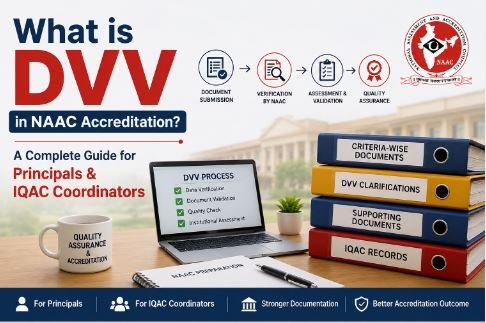
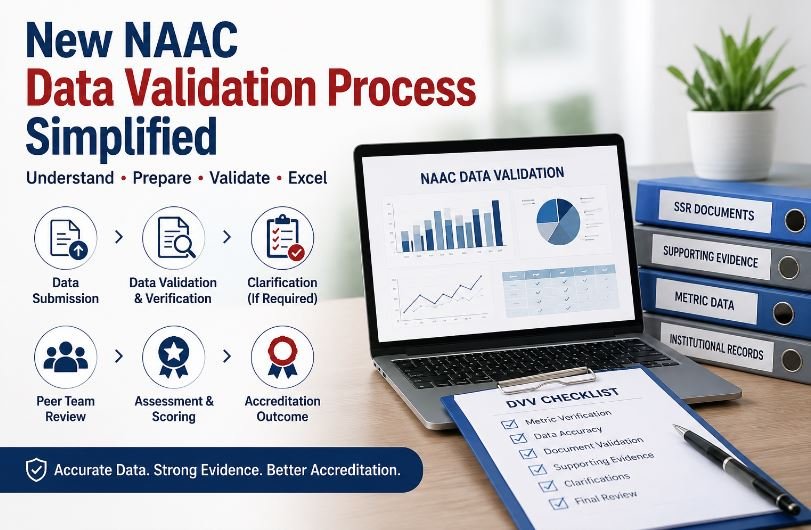
The Data Validation and Verification (DVV) process is a critical stage in NAAC accreditation where the quantitative data submitted by institutions is carefully reviewed and verified by external experts appointed by NAAC.
The purpose of DVV is to ensure that:
- Submitted data is authentic
- Metrics are properly calculated
- Claims are supported with evidence
- Institutional records are accurate
- Data aligns with NAAC guidelines
DVV improves the reliability and credibility of accreditation assessments.
Why NAAC Strengthened the Data Validation Process
NAAC introduced stronger validation mechanisms to address challenges such as:
- Inconsistent institutional reporting
- Inflated claims
- Incomplete documentation
- Lack of evidence-based submissions
- Variations in interpretation of metrics
The revised process ensures greater transparency and standardization across institutions.
Key Objectives of the New DVV Process
The new NAAC validation framework focuses on:
- Data accuracy
- Digital evidence verification
- Standardized evaluation
- Reduction of subjective claims
- Transparent institutional reporting
This approach supports fair and objective accreditation outcomes.
Overview of the NAAC Accreditation Process
To understand DVV properly, it helps to see where it fits within the full accreditation process.
The general accreditation stages include:
- Institutional Information Submission
- Self-Study Report (SSR) submission
- Data Validation and Verification (DVV)
- Student Satisfaction Survey (SSS)
- Peer Team Visit
- Final Assessment and Grading
DVV primarily examines quantitative metrics submitted in the SSR.
What Type of Data Is Validated During DVV
NAAC validates quantitative data under various criteria such as:
- Teaching-learning processes
- Faculty details
- Research output
- Student progression
- Infrastructure
- Financial management
- Governance practices
Each metric requires supporting documents and verifiable evidence.
Major Changes in the New NAAC DVV Process
Increased Focus on Digital Documentation
Institutions are now expected to maintain:
- Scanned records
- Digital repositories
- Organized evidence folders
- Online accessibility of documents
Paper-based dependency is gradually reducing.
More Structured Metric Evaluation
NAAC has standardized metric interpretations to reduce ambiguity.
Institutions must follow:
- Prescribed templates
- Defined calculation methods
- Specific evidence requirements
Greater Scrutiny of Quantitative Metrics
Quantitative data now undergoes deeper verification.
Claims without evidence may:
- Be rejected
- Receive reduced scores
- Require clarification
Stronger Evidence-Based Assessment
Institutions must provide:
- Official documents
- Financial records
- Attendance records
- Appointment letters
- Research proofs
- Academic reports
General statements without proof are insufficient.
Time-Bound Clarification Responses
Institutions must respond to DVV clarification queries within specific timelines.
Delayed or incomplete responses can affect scoring.
Understanding Quantitative Metrics (QnM)
Quantitative Metrics are measurable institutional indicators.
Examples include:
- Student-teacher ratio
- Research publications
- Placement statistics
- Faculty qualifications
- Financial expenditure
These metrics contribute significantly to accreditation scores.
Common Areas Where Institutions Face DVV Challenges
Faculty Data Discrepancies
Common issues include:
- Incorrect faculty count
- Missing appointment letters
- Incomplete qualification records
- Mismatch in experience details
Research Publication Errors
Institutions often struggle with:
- Incorrect indexing claims
- Duplicate publications
- Missing DOI details
- Unverified citations
Student Data Inconsistency
Problems arise due to:
- Incorrect enrollment data
- Missing attendance records
- Improper progression statistics
Financial Documentation Issues
Common errors include:
- Inconsistent expenditure reporting
- Missing audited statements
- Incorrect categorization of expenses
Infrastructure Evidence Gaps
Institutions sometimes fail to provide:
- Facility photographs
- Maintenance records
- Usage logs
- Equipment details
Importance of Proper Documentation
Documentation is the backbone of successful NAAC validation.
Institutions should maintain:
- Organized files
- Digital records
- Date-wise documentation
- Department-wise repositories
Strong documentation improves credibility and response efficiency.
Creating an Effective Documentation System
Centralized Digital Repository
Institutions should create a centralized system for storing:
- Academic records
- Administrative documents
- Financial statements
- Research data
Department-Level Documentation Teams
Each department should maintain its own verified records aligned with NAAC requirements.
Standardized Templates
Uniform templates reduce confusion and improve consistency.
Year-Round Documentation
Documentation should be continuous rather than last-minute.
Role of IQAC in the DVV Process
The Internal Quality Assurance Cell (IQAC) plays a central role in NAAC preparation.
Coordination and Monitoring
IQAC coordinates data collection across departments.
Data Verification
IQAC cross-checks:
- Accuracy
- Consistency
- Supporting evidence
Documentation Management
IQAC helps maintain institutional repositories and evidence systems.
Training and Awareness
IQAC conducts workshops for faculty and staff regarding NAAC metrics and compliance.
Best Practices for Successful DVV Preparation
Understand Metric Requirements Clearly
Institutions must carefully study:
- NAAC manuals
- Metric guidelines
- SOPs for documentation
Avoid Inflated Claims
Only submit data that can be fully verified.
Conduct Internal Audits
Regular audits help identify gaps before submission.
Maintain Evidence Mapping
Every metric should have clearly linked supporting evidence.
Train Faculty and Staff
Awareness reduces errors and improves preparedness.
Respond to Clarifications Promptly
Timely responses improve evaluation outcomes.
Importance of Data Accuracy in DVV
Even small inconsistencies can create major problems during validation.
Accurate data improves:
- Institutional credibility
- Evaluation fairness
- Accreditation outcomes
Technology and the Future of NAAC Validation
Technology is transforming accreditation processes significantly.
Cloud-Based Documentation Systems
Cloud storage improves accessibility and organization.
ERP Integration
ERP systems help automate:
- Attendance
- Faculty management
- Student records
- Financial tracking
AI-Based Data Analysis
Future systems may use artificial intelligence for:
- Error detection
- Pattern analysis
- Automated validation
Real-Time Data Monitoring
Continuous institutional tracking may eventually replace isolated accreditation cycles.
Common Mistakes Institutions Should Avoid
Last-Minute Data Collection
Rushed preparation increases errors.
Poor File Naming and Organization
Disorganized files delay responses during DVV clarification stages.
Inconsistent Reporting Formats
Different departments should follow standardized formats.
Missing Supporting Documents
Every claim must be supported by proper evidence.
Overdependence on Manual Systems
Manual processes increase the risk of inaccuracies.
Get personalized support for NAAC accreditation preparation processes
Simplifying NAAC Preparation Through Institutional Planning
Institutions can simplify accreditation by:
- Building year-round quality systems
- Digitizing records
- Training staff continuously
- Conducting regular reviews
Proactive planning reduces stress significantly.
Importance of Transparency in NAAC Submissions
Transparency is a major focus of modern accreditation systems.
Transparent institutions demonstrate:
- Ethical governance
- Accountability
- Academic integrity
This strengthens institutional reputation.
Benefits of a Strong DVV Process
A strong validation process helps institutions:
- Improve data management
- Strengthen governance
- Enhance quality assurance
- Build credibility
- Achieve better accreditation outcomes
Future Trends in NAAC Data Validation
Future accreditation systems are expected to include:
- Automated evidence verification
- Continuous monitoring systems
- Digital institutional dashboards
- AI-assisted validation tools
Institutions must prepare for increasingly technology-driven quality assessment frameworks.
Building a Quality Culture Beyond Accreditation
NAAC preparation should not be viewed only as a compliance exercise.
Institutions should use the process to improve:
- Academic quality
- Governance systems
- Student outcomes
- Institutional transparency
A strong quality culture leads to sustainable excellence.
Role of Leadership in Successful Validation
Institutional leadership must actively support:
- Digital transformation
- Documentation systems
- Faculty engagement
- Resource allocation
Leadership commitment strengthens overall accreditation readiness.
Conclusion
The new NAAC Data Validation and Verification process reflects a broader shift toward transparency, accountability, and evidence-based quality assurance in higher education. While the process may initially seem complex, institutions can manage it effectively through organized documentation, digital systems, continuous monitoring, and strong internal coordination.
The key to successful DVV preparation lies in maintaining accurate records throughout the year rather than treating accreditation as a temporary activity. Institutions that build strong quality cultures, centralized data systems, and proactive IQAC frameworks will find the validation process far more manageable and efficient.
Ultimately, the NAAC validation process is not just about securing grades. It is about building reliable institutional systems that support academic excellence, governance quality, and long-term educational credibility.
FAQs:
DVV stands for Data Validation and Verification, where NAAC verifies institutional quantitative data and supporting evidence.
It improves transparency, accuracy, accountability, and fairness in accreditation assessments.
Institutions may need faculty records, financial statements, research evidence, attendance data, and infrastructure documentation.
By maintaining digital documentation, centralized repositories, standardized formats, and continuous data management systems.
IQAC coordinates data collection, verification, documentation management, and institutional quality monitoring.
Related posts:

NAAC Consultancy Support: Why Colleges Need Expert Guidance for Accreditation Readiness
NAAC Readiness Audit for Colleges: A Complete Guide to NAAC Readiness Audit

Department File Checklist for Colleges: A Complete Documentation Guide