

Every college wants strong quality records. Few colleges check them often. Then a NAAC, NBA or NIRF deadline arrives, and the gaps show up all at once.
An academic and administrative audit fixes this problem early. It gives you a clear view of what works and what does not. This guide shares a simple, ready-to-use academic administrative audit checklist that your IQAC can use this semester. It also fits well with our NAAC accreditation 2026 roadmap.
You will learn what the audit covers, how to run it, and which gaps to fix first. The language is simple. The steps are practical. You can start today.
What Is an Academic and Administrative Audit (AAA)?
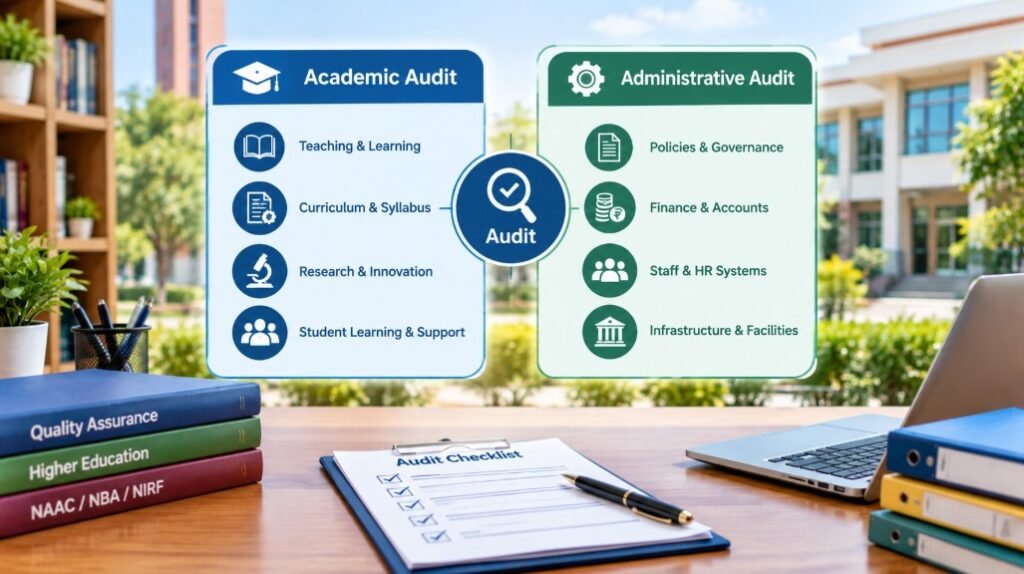
An academic and administrative audit, or AAA audit, is a planned review of how your institution runs. It checks two areas.
- Academic audit: reviews teaching, curriculum, assessment, research and student learning.
- Administrative audit: reviews policies, records, finance, staff systems and support services.
NAAC expects accredited institutions to carry out academic and administrative audits on a regular basis. The goal is not to punish anyone. The goal is to find weak spots and improve them.
Internal Audit vs Institutional Audit
An internal audit is done by your own team. The IQAC usually leads it. Faculty from other departments often serve as reviewers. An institutional audit is wider. It may cover the whole campus and may include outside experts.
Most colleges should start with an internal audit every year. Then they can add an external review before a major accreditation cycle.
Why an AAA Audit Matters for NAAC, NBA and NIRF
Quality bodies ask for proof. They do not accept claims without records. An audit helps you build that proof step by step.
- It shows gaps before the peer team or DVV team finds them.
- It keeps files, data and reports consistent across departments.
- It supports the Self Study Report. Read our guide on NAAC SSR report writing to see how data flows into the SSR.
- It improves teaching quality and student support.
- It builds a habit of continuous improvement.
The new Binary and MBGL system makes this even more important. If you are new to it, start with our explainer on the NAAC Binary accreditation and MBGL levels.
How the AAA Audit Links to NAAC Criteria

A good audit follows the same structure that assessors use. That makes your evidence easy to reuse later. Map each audit area to a NAAC criterion like this:
- Curricular aspects: curriculum design, feedback and value-added courses.
- Teaching-learning and evaluation: classroom methods, assessment and results.
- Research, innovations and extension: publications, projects and outreach.
- Infrastructure and learning resources: labs, library and IT systems.
- Student support and progression: scholarships, placements and higher studies.
- Governance, leadership and management: policies, finance and IQAC.
- Institutional values and best practices: gender equity, green campus and distinctiveness.
The framework is now moving toward ten key attributes. Our guide to the new 10 NAAC attributes shows how the older criteria connect to them. Use it to keep your audit format future-ready.
Not sure where your college stands?
Get a free institutional consultation and a clear view of your audit and accreditation readiness.
The Academic and Administrative Audit Checklist

Use the checklist below department by department. Mark each item as Done, Partly Done or Missing. Attach evidence for every item marked Done.
1. Curriculum and Academic Planning
- Approved academic calendar for the year.
- Syllabus copies and curriculum revision records.
- Course outcomes for every subject.
- Certificate and value-added course records.
- Feedback from students, alumni, employers and teachers.
Good curriculum files are the base of your accreditation data. See the NAAC Criterion 1 documentation checklist from Bhavya Gyan Consultants for a metric-wise view.
2. Teaching, Learning and Evaluation
- Lesson plans and teaching diaries.
- Use of ICT tools and digital content.
- Mentoring and remedial class records.
- Internal assessment schedules and marks.
- Question paper moderation and result analysis.
- Grievance handling in examinations.
3. Research, Innovation and Extension
- Research policy and ethics guidelines.
- Faculty publications and patents.
- Funded project records.
- Workshops, seminars and conferences held.
- Community outreach and extension activity reports.
Research records also feed ranking data. Our partner guide on the NIRF data collection checklist shows how to organise them.
4. Student Support and Progression
- Scholarship and fee concession records.
- Career guidance and placement cell reports.
- Student council and committee minutes.
- Anti-ragging, internal complaints and grievance committee files.
- Alumni association activities.
5. Infrastructure and Learning Resources
- Classroom, lab and library stock registers.
- Equipment maintenance logs.
- Library usage and e-resource subscription proof.
- IT infrastructure and Wi-Fi details.
- Safety, fire and sanitation records.
Journal and database access is a common gap. Colleges can explore academic journal subscription support from Mantech Publications to close it.
6. Governance, Leadership and Policies
- Vision, mission and institutional plan.
- Governing body and IQAC meeting minutes.
- Approved policies and SOPs for each function.
- Action Taken Reports on past decisions.
- Organisation chart with clear roles.
7. Finance and Resource Management
- Annual budget and audited statements.
- Purchase and tender records.
- Fee collection and refund registers.
- Fund use reports for grants.
- Internal financial audit observations.
8. Human Resources and Records
- Appointment letters and service books.
- Faculty qualification and UGC norm compliance.
- Faculty development programme records.
- Performance appraisal files.
- Statutory approvals, such as UGC and AICTE recognition.
9. IQAC, Documentation and Data
- IQAC composition and meeting schedule.
- AQAR filed on time.
- Central digital repository with file naming rules.
- Data matched with AISHE and NIRF submissions.
- Website pages updated for transparency.
Need a ready department-wise audit format?
Bhavya Gyan Consultants can share structured documentation and audit support for your IQAC.
How to Conduct an Internal Audit: Step by Step

Step 1: Form the Audit Committee
Pick five to seven members. Include senior faculty, one administrative head and an IQAC member. Avoid auditing your own department.
Step 2: Fix Scope and Calendar
List departments, offices and cells to audit. Set dates that do not clash with exams. Share the schedule at least two weeks ahead.
Step 3: Share the Checklist Early
Send the checklist to every department. Ask them to arrange files in advance. This turns the audit into a learning exercise, not a surprise.
Step 4: Visit, Sample and Verify
Check a sample of records, not every page. Talk to teachers, staff and students. Note both good practices and gaps.
Step 5: Write the Audit Report
Give each department a short report. Include findings, evidence gaps, risk level and suggested actions. Keep the tone helpful.
Step 6: Track Corrective Actions
Set owners and deadlines. Review progress every month. Close each point with proof before the next audit cycle.
Want an expert review before NAAC?
Get a gap analysis, risk flags and an action plan from specialists who work with colleges every day.
A Simple Scoring Method for Your Audit
Scores help you compare departments fairly. Keep the method simple so that everyone understands it.
- Score 3: Process exists, is followed and has full evidence.
- Score 2: Process exists and is followed, but evidence is incomplete.
- Score 1: Process exists on paper but is rarely followed.
- Score 0: No process and no evidence.
Add a colour code. Green means healthy. Amber means fix within the semester. Red means fix at once. Share the summary with the principal and the IQAC. Repeat the same scoring next year so that progress is easy to see.
The Role of IQAC in Audit Success
The IQAC is the engine of quality in every college. It plans the audit, trains reviewers and follows up on actions. It should also publish an annual audit summary for internal use.
If your IQAC needs a stronger base, revisit the steps in our guide on how to get NAAC accreditation. It explains how a well-run IQAC supports every stage of the process.
A Yearly Audit Calendar You Can Copy

Spread the work across the year. This keeps stress low and records fresh.
- June to July: Update policies, formats and the audit checklist.
- August to September: Audit curriculum, teaching plans and student support files.
- October to November: Audit research, finance and infrastructure records.
- December to January: Audit HR, governance and IQAC files.
- February: Prepare the audit report and share it with departments.
- March to May: Close corrective actions and prepare AQAR data.
Academic Audit vs Administrative Audit: Key Differences
Both audits matter, but they ask different questions. Knowing the difference helps you pick the right reviewers.
- Focus: The academic audit looks at learning quality. The administrative audit looks at systems and compliance.
- Evidence: Academic files include lesson plans, results and research proof. Administrative files include minutes, registers and financial records.
- Reviewers: Subject experts suit academic audits. Office heads and finance staff suit administrative audits.
- Outcome: Academic findings improve teaching. Administrative findings improve speed, transparency and control.
Run both together when possible. A strong classroom needs strong support behind it.
Best Practices for Audit Documentation
Even a good audit fails if records are messy. Follow a few simple habits.
- Use one file naming rule, such as Year_Criterion_Metric_Department.
- Scan documents in clear, readable quality.
- Store every file in a central digital repository with backups.
- Give each file an owner who checks it every quarter.
- Keep approvals, circulars and reports together for each activity.
- Match numbers in reports, the website and portal data.
These habits also reduce DVV queries later. They save hours during the peer team visit.
Common Gaps Found During an Institutional Audit
- Event reports without attendance sheets, photos or feedback.
- Policies that exist on paper but are not followed.
- Data in the website that differs from the data in reports.
- Missing minutes of IQAC and committee meetings.
- No action taken report on student feedback.
- Poor quality scanned files that are hard to read.
- Different departments using different formats.
Most of these gaps are easy to fix. They only need a system. For a full method, read our criteria-wise NAAC documentation guide. It explains templates, file naming and repository setup.
Tips to Make Your Audit Work Better
- Run the audit every year, not only before NAAC.
- Use one standard format for all departments.
- Keep a digital folder for each checklist area.
- Train faculty on documentation basics, and use Bhavya Gyan Academy learning programmes to build staff and student skills.
- Review findings in an IQAC meeting and record decisions.
- Check eligibility and readiness early. This NAAC eligibility guide helps you plan.
Engineering and technical institutions should also study program-level needs. See how the NBA accreditation process differs from NAAC.
Students and early-career teachers can also learn quality basics through the career guidance on Bhavya Gyan and the coaching and skill programmes at Bhavya Gyan Academy.
When to Take Expert Help
Many colleges have strong teams but very little time. Audits need planning, neutral eyes and good templates. An expert partner can save months.
Bhavya Gyan Consultants offers internal academic audit, documentation audit and compliance audit support. It also helps with policies, SOPs and evidence repositories. You can read about its NAAC consultancy services to see the full range.
Ready to make your institution audit-ready?
Talk to the BGC team about internal audits, SOPs and evidence systems built for Indian colleges.
Conclusion
An academic and administrative audit is not a burden. It is a habit that keeps your institution ready all year. Use the checklist above, assign owners, and close every gap with proof. Start small, stay regular, and improve each cycle.
FAQs:
A planned review of teaching, curriculum, records, finance and governance to find gaps and improve institutional quality.
Once every year is ideal. Add an extra review before NAAC, NBA or NIRF submissions.
The IQAC usually leads it, with senior faculty and administrative heads as reviewers from other departments.
NAAC expects accredited institutions to run regular academic and administrative audits as part of quality assurance.
Internal audit uses your own team. Institutional audit is wider and may include external experts.
Yes. Use a simple checklist, a small committee and clear deadlines. Seek expert help if time is short.
External Resources
- NAAC – National Assessment and Accreditation Council
- UGC – University Grants Commission
- NIRF – National Institutional Ranking Framework
- NBA – National Board of Accreditation
- Ministry of Education, Government of India