
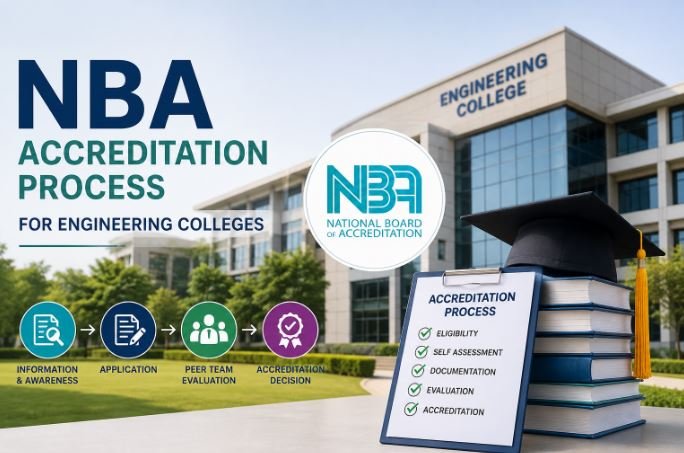
Engineering colleges often confuse NBA with NAAC, or assume the two processes overlap more than they actually do. Understanding the NBA accreditation process on its own terms, separately from NAAC, is the first step toward preparing for it properly. This guide walks through the complete process, from eligibility through final accreditation outcome. If you are already at the documentation stage, our SAR Preparation Guide for NBA Accreditation covers that specific step in far more depth; this post gives you the full journey around it.
With AICTE having pushed engineering and management institutions toward NBA accreditation as a quality benchmark in recent years, more departments are approaching this process for the first time without a clear sense of how the pieces fit together. This guide is meant to close that gap before your department opens the application portal.
🚀 Ready to map out your program’s NBA accreditation timeline? Talk to a BGC Accreditation Consultant today.
What Is NBA Accreditation and How It Differs From NAAC
The National Board of Accreditation, or NBA accreditation, was established in 1994 under the AICTE Act to assess the quality of engineering, management, pharmacy, and related technical programs. It became fully independent of AICTE in 2013, and since 2014 has been a permanent signatory member of the Washington Accord, an international agreement that gives NBA-accredited engineering programs recognition across member countries.
- NBA accredits individual programs, such as a specific engineering branch, not the institution as a whole
- NAAC accredits the institution as a whole, evaluating governance, infrastructure, and academics together across all departments
- A college can hold NBA accreditation for some programs and not others, depending on which departments have applied and qualified
- Many engineering colleges pursue both NBA and NAAC in parallel, since they serve different purposes and audiences
This program-versus-institution distinction is worth internalising early, since it shapes almost every decision that follows. A strong NAAC grade does not automatically mean a specific engineering branch is ready for NBA, and departments sometimes discover this gap only after starting the application process.

Who Is Eligible for NBA Accreditation
Before applying, confirm your program actually qualifies for engineering college accreditation under NBA’s eligibility rules.
- The program must have graduated a minimum number of batches before applying, with management programs typically requiring additional batches beyond engineering programs
- Only full-time programs are eligible; part-time programs do not qualify for NBA accreditation
- Postgraduate engineering programs generally require the corresponding undergraduate program to already hold accreditation
- The institution must fall under either Tier I or Tier II classification, which determines the specific accreditation pathway
📋 Not sure whether your program currently meets NBA’s eligibility criteria? Talk to a BGC Accreditation Consultant.
Common Misconceptions About NBA Accreditation
A few misunderstandings recur often enough among first-time applicant departments to be worth addressing directly.
- “NBA and NAAC accreditation are basically the same process.” They evaluate different things at different levels and require separate applications and evidence sets
- “Once a program is accredited, the whole institution is accredited.” NBA status applies strictly to the specific accredited program
- “NBA accreditation is optional and mostly symbolic.” Recruiters, university partners, and some scholarship or exchange programs increasingly check for it directly
- “Any engineering program can apply the moment it exists.” Programs need a minimum number of graduated batches before they become eligible at all
Tier I vs Tier II: What’s the Real Difference
NBA classifies applicant institutions into two tiers, and the distinction affects both the accreditation pathway and the international recognition your program receives. Confirming which tier your institution falls under early avoids confusion later, since the evaluation approach and expectations differ between the two.
- Tier I: IITs, NITs, autonomous colleges, and private universities. Programs accredited under Tier I gain recognition under the Washington Accord.
- Tier II: Affiliated, non-autonomous colleges. These institutions follow a distinct evaluation pathway and do not carry Washington Accord recognition.
This distinction matters most for students planning to study or work abroad, since Washington Accord recognition specifically applies to Tier I accredited programs, not NBA accreditation generally.

The NBA Accreditation Process, Step by Step
With eligibility and tier classification confirmed, the actual accreditation journey follows a consistent sequence, regardless of which engineering discipline is applying.
- Confirm eligibility and register the program with NBA through the official process
- Prepare and submit the Self-Assessment Report (SAR), the core evaluation document for the program
- Undergo review by the NBA evaluation team, including a peer team visit to the institution
- Receive the grading decision, which determines whether the program is accredited and for what duration
- Maintain ongoing records and evidence throughout the accreditation period, ready for the next renewal cycle
SAR preparation is the most demanding step in this process, and our SAR Preparation Guide for NBA Accreditation covers exactly how to approach it criterion by criterion. Once accredited, maintaining consistent records matters just as much; our guide on how to maintain records for accreditation covers the evidence management discipline needed to stay ready for renewal.
📝 Ready to start preparing your program’s SAR? Read our SAR Preparation Guide.
How Long NBA Accreditation Lasts
NBA typically grants provisional accreditation for a shorter period, often around three years, for newer or first-cycle programs, and full accreditation for a longer period, often around six years, once a program has demonstrated sustained quality across a complete cycle. Exact durations can vary by program type and evaluation outcome, so confirm current terms against your accreditation letter rather than assuming a fixed figure.
- Provisional accreditation typically applies to programs early in their accreditation journey
- Full accreditation reflects a longer track record of consistent, evidence-backed quality
- Institutions should begin renewal preparation well before the current accreditation period ends, not after receiving a renewal notice
🔄 Preparing for an NBA renewal cycle rather than a first-time application? See our guide on maintaining accreditation records.
Why NBA Accreditation Matters for Engineering Colleges
Beyond the process itself, it helps to keep the actual payoff in view, since SAR preparation and evidence collection can feel like pure administrative overhead without it.
- Signals to students and recruiters that a specific program meets rigorous, outcome-based quality standards
- Improves student mobility and international recognition, particularly for Tier I programs under the Washington Accord
- Often correlates with stronger placement outcomes, since recruiters increasingly filter by accreditation status
- Supports eligibility for autonomous status and certain grants tied to demonstrated program quality
- Drives continuous improvement internally, since the outcome-based evaluation model pushes departments to track and act on learning outcomes year-round
Library and learning resource quality feed directly into this evaluation as well. Our partner guide on designing a modern library for engineering colleges under NBA and NAAC norms covers this specific piece of the evaluation in depth.
Conclusion
The NBA accreditation process rewards programs that treat outcome-based education as an ongoing practice, not a one-time submission exercise. Confirm your program’s eligibility, understand which tier you fall under, and build your SAR on evidence collected consistently over the accreditation cycle rather than assembled at the last minute. Programs that approach the process this way consistently face fewer difficult questions during peer team visits and renew more smoothly when the time comes, since their evidence trail already reflects genuine, sustained practice rather than a documentation sprint.
Once you understand this full process, our detailed guide on SAR preparation for NBA accreditation is the natural next step for your department’s documentation work.
FAQs:
What does NBA accreditation actually evaluate?
Individual academic programs, not the institution as a whole.
How is NBA different from NAAC?
NBA accredits specific programs; NAAC accredits the entire institution.
What is the difference between Tier I and Tier II?
Tier I includes autonomous institutions with Washington Accord recognition; Tier II does not.
How long does NBA accreditation last?
Typically around three years provisional, or six years for full accreditation.
Can a college have some programs accredited and others not?
Yes, accreditation applies program by program, not institution-wide.
What is the most demanding step in the NBA process?
Preparing the Self-Assessment Report (SAR) with complete, verifiable evidence.




1 thought on “NBA Accreditation Process for Engineering Colleges: A Complete Guide”