
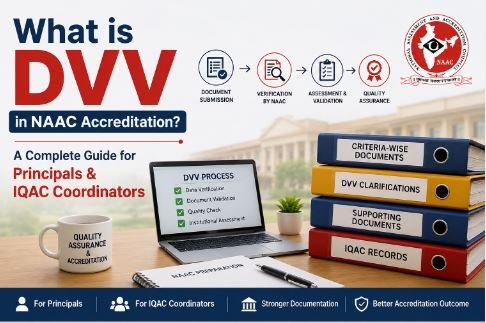
If your institution has submitted or is preparing to submit a Self Study Report (SSR) for NAAC accreditation, you will encounter one process that can either protect your score or quietly destroy it — DVV, or Data Validation and Verification. Yet despite DVV being one of the most consequential stages in the entire NAAC assessment journey, it remains one of the least understood. Most institutions only discover what DVV really means after they receive their first set of DVV queries — often weeks after SSR submission, with limited time to respond.
This guide is written specifically for Principals, IQAC Coordinators, and administrative teams who need a clear, practical understanding of DVV in NAAC — what it is, how it works, what triggers DVV mismatches, and what your institution needs to do to come out of the DVV stage with your score intact.
Mantech Publications — a trusted academic publishing and consulting organization with over 12 years of institutional support experience — has noted in its detailed analysis of why colleges fail NAAC that DVV mismatches are among the top causes of grade loss, even for institutions with genuinely strong academic records. Understanding DVV is not optional — it is foundational.
Part 1: Understanding DVV — What It Is and Why NAAC Uses It
What Does DVV Stand For in NAAC?
DVV stands for Data Validation and Verification. In the context of NAAC accreditation, DVV is the formal process through which NAAC independently verifies the quantitative data your institution has submitted in the SSR. It is not a peer review of your academic quality — it is a systematic audit of the numbers, figures, and evidence you have submitted to support your claims across all seven criteria.
Think of it this way: when your IQAC Coordinator writes in the SSR that your institution conducted 24 faculty development programmes over five years, the DVV process asks a very specific question: can you prove it? Every number in your SSR — enrolment figures, research publications, placement data, infrastructure expenditure, faculty qualifications — is subject to DVV scrutiny.

Why Did NAAC Introduce DVV?
DVV was introduced as part of NAAC’s Revised Accreditation Framework (RAF) to address a critical problem: the reliability gap between what institutions claimed in their SSRs and what they could actually demonstrate during Peer Team visits. Before DVV was formalized, institutions had significant latitude to present data in ways that appeared stronger than the underlying evidence supported.
DVV brought three structural changes to how NAAC assesses quantitative data:
- A software-based system that flags discrepancies between submitted data and uploaded supporting evidence
- An independent DVV Partner — a NAAC-empanelled organization — that reviews your quantitative metrics before the Peer Team visit
- A formal DVV clarification stage where institutions must respond to specific queries raised by the DVV Partner within a stipulated timeframe
The result is a far more transparent and verifiable assessment. Under the current system, an institution cannot simply claim strong outcomes — it must demonstrate them through timestamped, authenticated, and consistently formatted evidence.
⚠ Important: Under NAAC's evolving Binary Accreditation and MBGL framework (announced February 2025, portal launch pending as of June 2026), DVV-style data verification is expected to become even more technology-driven and AI-assisted. Institutions preparing today under the RAF must treat DVV readiness as the foundation of their binary framework preparedness.
What Exactly Does DVV Cover?
DVV covers the Quantitative Metrics (QnM) in your SSR — the metrics that have numerical values, counts, percentages, and ratios. These are different from Qualitative Metrics (QlM), which are narrative write-ups assessed during the Peer Team visit. For DVV purposes, the data submitted through NAAC’s official data templates for each QnM is verified against the supporting documents you upload to the NAAC HEI portal.
The types of data DVV examines include:
- Student enrolment data — category-wise, year-wise, programme-wise
- Faculty data — qualifications, experience, research output, awards
- Research and publications — journal indexing, citations, funded projects
- Infrastructure — library holdings, lab equipment, ICT infrastructure valuation
- Student support — scholarships, placements, progression rates
- Financial expenditure — welfare, research, maintenance as a percentage of total budget
- Teaching-learning activities — add-on courses, value-added programmes, participations
For a complete understanding of which specific metrics fall under DVV for each criterion, BGC Global’s DVV Checklist for NAAC provides a metric-wise breakdown aligned to the current SSR framework.
📋 Download BGC’s Free DVV Checklist
Before you submit your SSR, know exactly which metrics will be audited. BGC Global’s metric-wise DVV checklist helps IQAC teams prepare DVV-ready evidence for all seven NAAC criteria — before the DVV Partner sends the first query.
Part 2: How the DVV Process Works — Stage by Stage
Understanding the mechanics of DVV — who does it, when it happens, and what the timelines look like — is critical for IQAC Coordinators to plan their evidence preparation effectively.
Stage 1: SSR Submission and QnM Template Upload
DVV begins not when NAAC appoints a DVV Partner, but at the moment you submit your SSR. Every quantitative metric in your SSR must be accompanied by filled data templates (usually in Excel format, provided by NAAC) and supporting documents uploaded to the NAAC HEI portal. These are the inputs the DVV Partner will work from.
Critical submission rules that directly affect DVV outcome:
- Each metric allows a maximum of 5 MB of data on the NAAC portal. If your supporting evidence exceeds this limit, you must host the additional documents on your institution’s website and provide a direct, working hyperlink — not a Google Drive, OneDrive, or third-party hosted link
- Once submitted, no modifications to uploaded documents are permitted. Any changes detected will be treated as data misappropriation and can lead to disqualification from the accreditation process
- All documents must be signed by the Head of the Institution to be considered valid
- Documents in regional languages must be accompanied by an English translation
- Links provided must point directly to the specific document, not to a general landing page or homepage
This is why institutions that prepare their documentation in parallel with SSR writing — rather than assembling evidence after the SSR is drafted — consistently perform better in DVV.
Stage 2: DVV Partner Assignment
After SSR submission and NAAC’s preliminary review, NAAC appoints an empanelled DVV Partner organization to audit your quantitative metrics. The DVV Partner is independent of both your institution and the Peer Team — their role is purely data verification.
The DVV Partner reviews your submitted data templates and supporting documents metric by metric. Where they find discrepancies, missing evidence, inconsistent figures, or unverifiable claims, they raise DVV Clarification Queries.
Stage 3: DVV Clarification Queries — The Critical Window
DVV clarification queries are the formal questions NAAC raises against specific metrics in your SSR. This is where the DVV process becomes high-stakes for institutions. Each query requires a structured response with fresh or additional supporting evidence, submitted within the timeframe NAAC specifies.
The nature of DVV queries typically falls into one of four categories:
- Missing evidence: A metric has been claimed but no supporting document has been uploaded, or the uploaded document does not directly substantiate the claim
- Numerical mismatch: The figure in your SSR data template differs from what the supporting document shows
- Format non-compliance: Your data template has been modified from NAAC’s prescribed format, or documents are in an unreadable or non-standard format
- Broken or inaccessible links: The URL you provided for documents hosted on your website is either broken, leads to the wrong page, or is not directly accessible
⚠ Failure to respond to DVV queries within the stipulated timeframe gives NAAC the right to finalize the score based on available evidence — which typically means a significantly reduced metric score or a zero for that metric.
BGC Global’s DVV Clarification Support Service is specifically designed to manage this stage. BGC assigns dedicated metric-wise response teams that prepare structured, evidence-backed clarification responses within the required timeframe — protecting your score even after queries are raised.

Stage 4: DVV Score Finalisation and Impact on Overall Grade
Once the DVV clarification stage closes, the DVV Partner finalises a verified score for each quantitative metric. This score feeds directly into your NAAC CGPA calculation. The impact is significant: QnM metrics carry substantial weightage across all seven criteria, and DVV-verified scores are treated as authoritative — they are not revisited during the Peer Team visit unless a specific physical verification is required.
This means your DVV performance is largely locked in before the Peer Team ever sets foot on your campus. A college that performs poorly in DVV cannot recover those marks through an excellent Peer Team presentation — the numbers are already final.
Mantech Publications’ complete guide to NAAC accreditation 2026 explains how DVV fits into the full accreditation timeline from IIQA to Peer Team visit — useful background reading for institutions mapping their preparation schedule.
🛡 Don’t Wait for DVV Queries to Find Your Gaps
BGC Global sets up a dedicated pre-submission DVV audit — metric by metric, document by document — so your institution enters the DVV stage with zero mismatch risk. Institutions that work with BGC before submission consistently face fewer DVV queries.
Part 3: DVV Mismatches — What Causes Them and How to Prevent Them
DVV mismatches are the specific discrepancies that trigger DVV queries and cause metric scores to be reduced or zeroed. In our work with institutions across India, BGC Global has identified seven recurring patterns that cause the vast majority of DVV problems. Each one is preventable with proper data governance — but only if you know what to look for.
1. Data Inconsistency Across Documents
This is the most common DVV mismatch. It occurs when the same data point — say, the number of students enrolled in a programme — appears with different values in different documents. Your SSR template says 420, your AQAR for the same year says 412, and the affiliation letter shows 415. The DVV Partner flags all three and downgrades the metric.
The root cause is almost always fragmented data ownership — different offices maintaining different registers without a unified institutional data standard. BGC Global’s Accreditation Data Management Services address this directly by creating a single, verified data repository that all NAAC documents draw from.
2. Uploading Summary Documents Instead of Source Records
Many institutions upload a compiled summary table as proof for a metric — for example, a single table listing all research publications — without uploading the source records (actual journal front pages, indexing certificates, or DOI proof). The DVV Partner requires primary source evidence, not internally prepared summaries. Summaries without source links are almost always flagged.
3. Missing Institutional Attestation
NAAC requires all supporting documents to be signed and stamped by the Head of the Institution. Many IQAC teams upload unsigned scans — particularly for older records — which the DVV Partner cannot authenticate. This is a procedural failure that costs marks for data that may otherwise be perfectly valid.
4. Broken or Redirecting Website Links
When supporting documents are hosted on your institutional website (due to the 5 MB portal limit), the URL you submit must remain live and accessible throughout the DVV process. Website restructuring, expired hosting, or changed URL slugs mid-process can make your evidence inaccessible — and NAAC will take the final call on an inaccessible link, which is almost always a score reduction.
BGC Global’s NAAC Website Compliance Services include a dedicated link integrity audit that verifies every URL submitted to the NAAC portal remains stable and accessible throughout the accreditation window.
5. Template Modifications
NAAC provides specific data templates for each quantitative metric. Any modification to these templates — changing column headers, adding or removing rows, reformatting cells — renders the template non-compliant. DVV Partners reject modified templates, requiring the institution to resubmit in the original format with limited time available.
6. Historical Data Gaps in Trend Metrics
Several NAAC metrics require five-year trend data — not just the current year’s figure. Institutions that began systematic data collection only in the year before their NAAC application find themselves unable to provide credible data for 2 to 4 prior years. The DVV Partner cannot verify data that does not exist, and the metric is scored pro-rata for the years for which evidence is available.
This is precisely why IQAC data management must begin years before accreditation, not weeks before SSR submission. Mantech Publications’ SSR report writing guide explains how institutions should structure five-year data trails for trend-based metrics — a critical read for first-time applicants.
7. Data Hosted on Third-Party Platforms
NAAC explicitly prohibits institutions from hosting their supporting documents on Google Drive, OneDrive, Amazon S3, or any third-party cloud service. Data must be hosted on your institution’s own domain. Many institutions — particularly those with limited IT infrastructure — unknowingly violate this rule, rendering their evidence invalid for DVV purposes.
BGC Global’s Digital Evidence Repository Service sets up a dedicated, institution-owned document repository on your website that is structured, NAAC-compliant, and fully verifiable by the DVV Partner.
📂 Is Your Evidence Repository DVV-Proof?
BGC Global audits your documentation structure, link integrity, template compliance, and data consistency — all seven mismatch categories, criterion by criterion — before your SSR reaches the DVV Partner.
What Should Your Institution Do Right Now?
Whether your NAAC assessment is six months away or two years away, there are three things every institution should be doing today to build DVV readiness:
- Appoint a Data Custodian: Designate one individual — typically within the IQAC — as the sole owner of institutional data. This person maintains the master data register from which all NAAC documents draw. No AQAR, IIQA, or SSR figure should come from any other source.
- Build a DVV-Ready Evidence Repository: For every quantitative metric in the SSR, build a corresponding evidence folder on your institutional website — properly named, dated, signed, and structured in the format NAAC prescribes. Start this process now, not at SSR submission time.
- Run a Pre-Submission DVV Mock Audit: Before your SSR is submitted, have every quantitative metric independently verified against its supporting documents by someone who was not involved in preparing it. BGC Global’s specialist team does exactly this — bringing the perspective of a DVV Partner to your data before NAAC’s DVV Partner does.
BGC Global — Bhavya Gyan Consultants — specializes exclusively in NAAC accreditation consultancy. Our complete NAAC accreditation consultancy services cover every stage from IQAC establishment and AQAR management to SSR preparation, DVV clarification, and Peer Team visit readiness — with a dedicated DVV team that has helped institutions eliminate mismatch risks before they become grade-threatening queries.
🎯 Ready to Make DVV Your Competitive Advantage?
Most institutions fear DVV. BGC Global’s clients use DVV preparation as the moment their accreditation strategy becomes unassailable. A 30-minute consultation with our NAAC specialists will show you exactly where your DVV vulnerabilities are — and how to eliminate every one of them.
FAQs:
Q1. What is DVV in NAAC accreditation?
DVV stands for Data Validation and Verification. It is the process through which NAAC independently audits the quantitative data submitted by an institution in its Self Study Report (SSR).
Q2. When does the DVV process happen in NAAC accreditation?
DVV occurs after your institution submits the SSR on the NAAC portal. NAAC appoints a DVV Partner to begin the verification process. DVV queries are raised during this stage, and institutions must respond within a specified timeframe.
Q3. What is a DVV mismatch and how does it affect my NAAC score?
A DVV mismatch occurs when the data in your SSR template does not match the supporting documents you have uploaded, or when the supporting documents are missing, inaccessible.
Q4. What is a DVV Partner in NAAC?
A DVV Partner is a NAAC-empanelled organization assigned to verify the quantitative data in your SSR independently. The DVV Partner reviews your submitted data templates, cross-checks them against supporting documents.
Q5. Can we change or update documents after SSR submission during DVV?
Once your SSR is submitted and documents are uploaded to the NAAC portal, no modifications to the submitted documents are permitted.
External Resources:
- NAAC Official Portal — Assessment & Accreditation Framework Guidelines:
- UGC — Quality Mandates and Accreditation Requirements for HEIs:
- AISHE Portal — National Student and Faculty Data Reference (used in DVV cross-verification):
- NIRF India Rankings Portal — Institutional data reference aligned with NAAC metrics:
This blog is published by BGC Global — Bhavya Gyan Consultants. For institutional publishing support, research assistance, and NAAC/NBA consulting resources, visit Mantech Publications.
2 thoughts on “What is DVV in NAAC Accreditation? A Complete Guide for Principals & IQAC Coordinators”