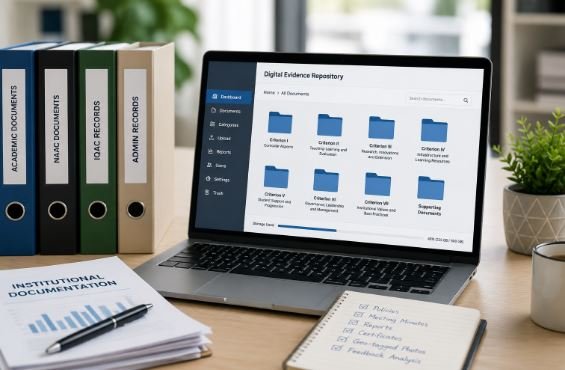
Creating a digital evidence repository has become a necessity for colleges and universities preparing for accreditation, ranking, audits, and quality assurance reviews. Many institutions struggle with scattered files, missing documents, duplicated records, and last-minute evidence collection during NAAC, NBA, or NIRF submissions.
When accreditation cycles approach, IQAC teams often spend weeks locating meeting minutes, faculty records, research data, student achievements, and committee reports stored across multiple computers and departments. This creates inefficiencies, delays, and compliance risks.
A well-structured digital evidence repository solves these challenges by centralizing institutional records, improving document management, and ensuring that evidence is readily available whenever required. This guide explains how institutions can build an effective repository, avoid common mistakes, and strengthen their accreditation readiness.
Request Documentation Audit for Better Accreditation Readiness
1. What is a Digital Evidence Repository?
A digital evidence repository is a centralized system used to collect, organize, store, retrieve, and manage institutional documents and supporting evidence in digital format.
The repository acts as a single source of truth for accreditation, ranking, compliance, and governance activities.
Typical documents stored include:
- NAAC criterion-wise evidence
- IQAC reports and minutes
- Academic calendars
- Faculty profiles
- Research publications
- Student achievement records
- Examination records
- Audit reports
- Extension activity reports
- Financial documents
- Committee proceedings
- Policy documents
Instead of maintaining files in different departments, all records are organized systematically and made accessible through a structured digital platform.
Key Objectives
- Improve document management efficiency
- Reduce duplication of records
- Enable quick evidence retrieval
- Support accreditation preparation
- Strengthen institutional governance
- Preserve institutional memory
2. Why a Digital Evidence Repository Matters for Colleges and Universities
Accreditation Readiness
Accreditation agencies require evidence-backed reporting. Institutions with a strong NAAC evidence repository can quickly produce supporting documents for Self-Study Reports (SSR), Data Validation and Verification (DVV), and peer team visits.
Improved IQAC Functioning
IQAC teams continuously monitor institutional quality initiatives. A centralized repository simplifies data collection and documentation throughout the academic year.
Better Compliance Management
Universities must maintain records for:
- UGC compliance
- AICTE requirements
- NAAC accreditation
- NBA accreditation
- NIRF submissions
- Internal and external audits
A digital repository ensures these records remain organized and accessible.
Reduced Dependency on Individuals
Many institutions face difficulties when key staff members retire or leave. A centralized repository ensures institutional knowledge remains available regardless of personnel changes.
Faster Report Generation
Data for AQAR, SSR, annual reports, strategic plans, and ranking submissions can be generated more efficiently when evidence is properly categorized.

3. Step-by-Step Process to Create a Digital Evidence Repository
Step 1: Define Repository Objectives
Begin by identifying why the repository is being created.
Common objectives include:
- NAAC preparation
- NBA accreditation support
- NIRF ranking documentation
- IQAC evidence management
- Institutional audits
- Regulatory compliance
Clearly defined goals help determine the repository structure.
Download Digital Documentation Checklist for Institutional Compliance
Step 2: Create a Document Classification Framework
Develop a hierarchical folder structure.
Example:
Institutional Documents
- Vision and Mission
- Strategic Plan
- Policies
Academic Documents
- Syllabi
- Lesson Plans
- Academic Calendar
Faculty Records
- Profiles
- Publications
- FDP Participation
Student Records
- Results
- Achievements
- Placement Data
IQAC Documents
- Meeting Minutes
- AQAR
- Action Taken Reports
Accreditation Records
- NAAC Evidence
- NBA Evidence
- DVV Documents
This classification framework becomes the foundation of effective document management.
Step 3: Map Documents to NAAC Criteria
For institutions preparing for accreditation, criterion-wise organization is essential.
Example:
| NAAC Criterion | Evidence Types |
|---|---|
| Criterion I | Curriculum Documents |
| Criterion II | Teaching-Learning Records |
| Criterion III | Research Evidence |
| Criterion IV | Infrastructure Documents |
| Criterion V | Student Spport Records |
| Criterion VI | Governance Documents |
| Criterion VII | Best Practices and Institutional Values |
This structure simplifies future accreditation exercises.
Step 4: Standardize File Naming
Poor file naming is one of the biggest causes of document retrieval issues.
Recommended format:
Department_DocumentType_Date_Version
Example:
IQAC_MeetingMinutes_2025-08-10_V1.pdf
Benefits include:
- Easy searching
- Version control
- Reduced duplication
Step 5: Digitize Existing Records
Many institutions still maintain paper-based records.
Digitization should include:
- Scanning historical documents
- Converting records into searchable PDFs
- Organizing files into appropriate folders
- Applying metadata and tags
Priority should be given to accreditation-related records.
Step 6: Establish Access Controls
Not every user requires access to every document.
Recommended access levels:
| User Role | Access Level |
|---|---|
| Principal | Full Access |
| IQAC Coordinator | Administrative Access |
| Department Heads | Department Access |
| Faculty | Limited Access |
| Auditors | Read-Only Access |
Proper permissions improve security and accountability.
Step 7: Implement Version Control
Without version control, institutions often store multiple conflicting copies of the same document.
Maintain:
- Draft versions
- Approved versions
- Archived versions
This ensures accuracy and traceability.
Step 8: Create Evidence Collection Workflows
Define responsibilities for document submission.
Example workflow:
Faculty → Department Coordinator → IQAC → Repository Administrator
This creates accountability and prevents missing evidence.
Book Repository Assessment with Accreditation Documentation Experts
Step 9: Conduct Periodic Reviews
Repositories should be reviewed at least quarterly.
Review areas:
- Missing documents
- Duplicate records
- Expired files
- Broken links
- Incorrect classifications
Regular audits improve repository quality.
4. Common Mistakes Institutions Should Avoid
1. Creating Repositories Only During Accreditation
Waiting until accreditation approaches creates unnecessary pressure and incomplete documentation.
2. No Ownership Structure
Without designated responsibility, repositories become outdated quickly.
3. Poor Folder Organization
Deeply nested or inconsistent folders make retrieval difficult.
4. Lack of Backup Systems
Critical evidence should always have backup copies.
5. Ignoring Version Management
Multiple versions create confusion and increase audit risks.
6. Storing Files Without Metadata
Documents should include relevant tags, dates, departments, and categories.
7. Failure to Train Staff
Technology alone cannot solve documentation challenges.
Users must understand repository processes and expectations.

5. Best Practices for Sustainable Evidence Management
Develop Documentation Policies
Create institutional guidelines covering:
- Document creation
- File naming conventions
- Approval procedures
- Archiving rules
- Retention schedules
Use Criterion-Wise Documentation
Organizing evidence according to accreditation criteria simplifies audits and submissions.
Maintain Regular Upload Cycles
Monthly uploads are more manageable than annual collection drives.
Integrate Repository Activities with IQAC
The IQAC should continuously monitor documentation practices across departments.
Conduct Internal Documentation Audits
Quarterly audits help identify gaps before external assessments.
Build a Culture of Documentation
Faculty and administrators should view documentation as an ongoing institutional process rather than a compliance exercise.
Use Cloud-Based Storage Solutions
Secure cloud systems provide:
- Better accessibility
- Automated backups
- Collaboration features
- Disaster recovery support
6. How Bhavya Gyan Consultants Can Help
Developing a robust digital evidence repository requires planning, structure, and alignment with accreditation requirements.
Bhavya Gyan Consultants (BGC) supports institutions through:
- Digital repository framework design
- NAAC evidence repository structuring
- IQAC documentation systems
- Accreditation evidence mapping
- Document management process development
- Academic and administrative audits
- Criterion-wise documentation support
- Evidence verification and gap analysis
Our team helps colleges and universities establish sustainable documentation systems that improve preparedness for accreditation, rankings, audits, and institutional quality initiatives.
Official External Resources
Conclusion
A structured digital evidence repository is no longer optional for higher education institutions aiming to strengthen accreditation readiness, compliance management, and quality assurance practices. By implementing proper document management processes, standardized workflows, criterion-wise evidence mapping, and regular audits, institutions can significantly reduce documentation challenges.
Rather than collecting evidence only during accreditation cycles, colleges and universities should establish a sustainable NAAC evidence repository that supports continuous improvement. With the right framework, technology, and governance practices, institutions can improve efficiency, transparency, and preparedness for future evaluations.
FAQs:
1. What is a digital evidence repository in higher education?
A digital evidence repository is a centralized system used to store, organize, manage, and retrieve institutional documents required for accreditation, audits, compliance, and quality assurance activities.
2. Why is a NAAC evidence repository important?
A NAAC evidence repository helps institutions maintain criterion-wise documentation, making SSR preparation, DVV verification, and peer team assessments more efficient.
3. Who should manage the repository?
Typically, the IQAC coordinator, documentation team, and designated repository administrators manage the system with support from department heads.
4. How often should documents be updated?
Institutions should update evidence monthly and conduct quarterly reviews to ensure records remain complete and accurate.
5. What documents should be included in the repository?
Important records include policies, meeting minutes, faculty data, student achievements, research outputs, financial reports, audit reports, and accreditation evidence.
6. Can a digital evidence repository support NBA and NIRF submissions?
Yes. A properly structured repository can support NAAC, NBA, NIRF, UGC compliance, internal audits, and other institutional reporting requirements.