
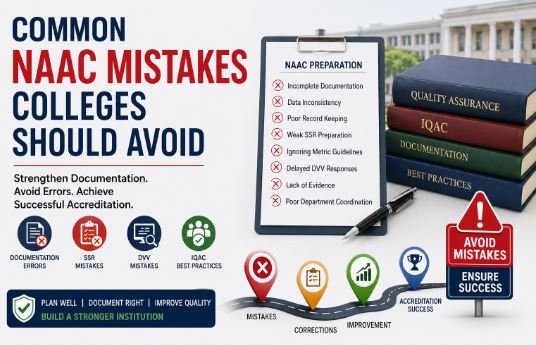
NAAC mistakes can significantly affect a college’s accreditation journey, regardless of how well the institution performs academically. Many higher education institutions invest considerable effort in preparing for assessment but lose valuable scores because of avoidable documentation gaps, incomplete evidence, inconsistent data, weak institutional planning, or poor coordination among departments. These issues often become apparent only during the Self Study Report (SSR) submission or the Data Validation and Verification (DVV) process.
Accreditation today is much more than preparing reports before an assessment. It requires a systematic approach to documentation, quality assurance, data management, stakeholder participation, and continuous institutional improvement. Even well-established colleges can encounter challenges if quality processes are not maintained consistently throughout the accreditation cycle.
For Principals, Directors, IQAC Coordinators, Department Heads, faculty members, and accreditation committees, understanding the most common NAAC mistakes is the first step toward building a stronger institutional quality framework. This guide explains the frequent errors observed during accreditation preparation, why they occur, and how colleges can proactively avoid them through better planning, documentation, and quality management.
Request Expert NAAC Consultation for Institutional Accreditation Success
1. Understanding NAAC Mistakes: What They Are and Why They Happen
Preparing for NAAC accreditation is one of the most comprehensive institutional exercises undertaken by colleges and universities in India. It requires coordinated efforts across academic departments, administrative offices, IQAC, governing bodies, faculty members, students, alumni, and other stakeholders.
Despite sincere efforts, many institutions lose valuable assessment scores because of avoidable operational mistakes rather than a lack of institutional achievements. These errors may occur during documentation, data compilation, evidence management, policy implementation, report preparation, or communication between departments.
In many cases, colleges perform excellent academic and extension activities but fail to present appropriate documentary evidence. Since NAAC assessments rely heavily on verifiable records, unsupported claims cannot contribute effectively during evaluation.
Understanding these challenges early allows institutions to establish better quality systems long before the accreditation process begins.What Are NAAC Mistakes?
NAAC mistakes are errors, omissions, inconsistencies, or weak institutional practices that negatively affect accreditation preparation and assessment outcomes.
These mistakes commonly include:
- Incomplete documentation
- Missing supporting evidence
- Incorrect statistical data
- Poor coordination among departments
- Weak IQAC functioning
- Inconsistent policy implementation
- Improper record maintenance
- Delayed preparation of SSR
- Weak DVV responses
- Lack of institutional planning
While some mistakes appear minor, they can collectively reduce institutional credibility during assessment.

Why Do Colleges Make NAAC Mistakes?
Most institutions do not intentionally ignore accreditation requirements.
Instead, these challenges usually arise because quality assurance activities are treated as temporary projects instead of continuous institutional processes.
Several common factors contribute to recurring accreditation problems.
Last-Minute Preparation
One of the biggest reasons behind accreditation challenges is beginning preparation only after deciding to apply for assessment.
Departments suddenly begin collecting documents, preparing reports, updating files, and compiling data from previous years. This often results in:
- Missing records
- Inconsistent information
- Duplicate documents
- Incomplete evidence
- Unverified statistics
Continuous documentation throughout the academic year significantly reduces these risks.
Lack of Awareness
Faculty members and administrative staff may not fully understand the documentation requirements associated with different NAAC criteria.
For example:
- Evidence required for student support
- Documentation for extension activities
- Research records
- Faculty development programmes
- Financial documentation
- Infrastructure utilisation
Without proper orientation, departments may unknowingly maintain incomplete records.
Weak Coordination
Successful accreditation requires collaboration among multiple stakeholders.
When communication is weak between:
- IQAC
- Departments
- Examination Cell
- Library
- Accounts
- AdministrationResearch Cell
- Placement Cell
important information often remains scattered across different offices.
This fragmentation creates delays during SSR preparation and DVV verification.
Poor Data Management
Accreditation requires accurate institutional data covering several academic years.
Many colleges face difficulties because:
- Data exists in multiple formats.
- Departments maintain separate records.
- Statistical reports differ across offices.
- Digital records are incomplete.
- Historical documents are unavailable.
Without structured data management systems, maintaining consistency becomes difficult.
Limited IQAC Engagement
Some institutions activate the IQAC primarily during accreditation cycles.
However, the IQAC should function throughout the year by:
- Monitoring quality indicators
- Conducting meetings
- Reviewing departmental activities
- Maintaining documentation
- Preparing Action Taken Reports
- Coordinating academic audits
Continuous IQAC involvement strengthens institutional readiness.
Major Areas Where NAAC Mistakes Commonly Occur
Although every institution is unique, accreditation challenges generally arise across similar operational areas.
Institutional Documentation
Documentation forms the foundation of accreditation.
Common issues include:
- Missing files
- Unsigned reports
- Incomplete meeting minutes
- Missing attendance records
- Unverified certificates
- Missing photographs
- Poor file organisation
Even high-quality institutional activities require proper documentary evidence.
Self Study Report (SSR)
The SSR is one of the most important documents submitted during accreditation.
Typical SSR mistakes include:
- Inaccurate data
- Unsupported claims
- Copy-paste descriptions
- Poor narrative writing
- Incorrect metric mapping
- Missing hyperlinks
- Weak institutional analysis
- A carefully prepared SSR presents institutional achievements clearly while remaining evidence-based.
Data Validation and Verification (DVV)
Many colleges underestimate the importance of the DVV process.
Common DVV mistakes include:
- Delayed responses
- Missing supporting documents
- Incorrect file naming
- Broken hyperlinks
- Unclear explanations
- Mismatch between SSR and evidence
Well-organised documentation enables faster and more accurate responses during verification.
Department-Level Documentation
Departments contribute significantly to institutional accreditation.
However, common NAAC documentation errors include:
- Missing course files
- Incomplete lesson plans
- Weak mentoring records
- Missing feedback analysis
- Poor programme outcome documentation
- Inconsistent attendance records
Departmental quality practices directly influence institutional performance.
Evidence Management
Every claim made during accreditation should be supported by authentic institutional evidence.
Essential evidence typically includes:
- Circulars
- Reports
- Attendance sheets
- Photographs
- Certificates
- Financial records
- Feedback reports
- Audit reports
- Meeting minutes
- Official approvals
Maintaining organised evidence repositories simplifies both SSR preparation and DVV verification.
Download Your Complete NAAC Documentation Preparation Checklist Today
Characteristics of Accreditation-Ready Institutions
Institutions that experience smoother accreditation journeys often demonstrate several common characteristics.
Strong Institutional Planning
Quality activities are planned well before accreditation.
Annual calendars include:
- IQAC meetings
- Academic audits
- Documentation reviews
- Faculty development programmes
- Feedback analysis
- Department reviews
Planning reduces last-minute workload.
Continuous Documentation
Documentation becomes part of routine institutional functioning.
Every event generates:
- Notice
- Attendance
- Photographs
- Report
- Outcome
- Supporting evidence
This systematic approach improves institutional credibility.
Data Consistency
Successful colleges ensure consistency across:
- AISHE reports
- Annual reports
- SSR
- Department records
- Examination statistics
- Financial statements
Consistency builds confidence during assessment.
Faculty Participation
Accreditation becomes more effective when faculty members actively contribute through:
- Teaching innovations
- Research
- Mentoring
- Documentation
- Committee participation
- Extension activities
Shared responsibility strengthens institutional quality culture.
2. Why Avoiding NAAC Mistakes Matters for Colleges and IQAC Teams
Avoiding NAAC mistakes is not merely about improving accreditation scores—it is about building a stronger institution. Colleges that address documentation gaps, improve coordination, and establish systematic quality practices are better prepared to demonstrate their achievements with confidence.
A proactive approach to accreditation strengthens governance, improves transparency, enhances stakeholder confidence, and supports long-term institutional development. Instead of treating accreditation as a one-time event, colleges that continuously monitor quality indicators are able to identify gaps early and implement timely corrective measures.
For IQAC teams, preventing SSR mistakes, DVV mistakes, and NAAC documentation errors reduces unnecessary pressure during accreditation cycles. When records are maintained consistently and evidence is readily available, the focus shifts from collecting documents at the last minute to showcasing genuine institutional excellence.
Moreover, avoiding common accreditation mistakes helps institutions improve internal quality systems, streamline administrative processes, strengthen departmental accountability, and create a culture of continuous improvement. These benefits extend well beyond accreditation and contribute to better academic outcomes, stronger stakeholder trust, and sustainable institutional growth.
3. Step-by-Step Checklist to Prevent NAAC Mistakes
Avoiding NAAC mistakes requires institutions to adopt a systematic and continuous approach rather than relying on last-minute preparations. Colleges that integrate quality assurance into their routine academic and administrative activities are better positioned to submit accurate documentation, respond confidently during the Data Validation and Verification (DVV) process, and demonstrate institutional excellence during assessment.
The following step-by-step framework provides a practical roadmap for Principals, IQAC Coordinators, Heads of Departments, faculty members, and administrative teams to minimise accreditation risks and strengthen institutional readiness.
Step 1: Start Accreditation Preparation Early
One of the biggest reasons colleges face accreditation challenges is delayed preparation. Many institutions begin compiling documents only after deciding to submit the Self Study Report (SSR), leaving little time for verification, corrections, and quality checks.
Instead, institutions should treat accreditation as a continuous process by:
- Preparing annual quality plans.
- Maintaining departmental records throughout the year.
- Conducting regular IQAC meetings.
- Monitoring institutional quality indicators.
- Reviewing documentation periodically.
Early preparation reduces stress and improves documentation quality.
Step 2: Strengthen the IQAC
The Internal Quality Assurance Cell (IQAC) should function throughout the academic year rather than only during accreditation.
An active IQAC should:
- Monitor quality initiatives.
- Conduct periodic reviews.
- Coordinate departmental documentation.
- Organise quality workshops.
- Review Action Taken Reports (ATRs).
- Maintain institutional evidence.
- Facilitate academic and administrative audits.
A proactive IQAC creates a culture of continuous improvement that significantly reduces accreditation-related errors.
Step 3: Develop a Documentation Framework
Documentation is one of the most critical components of NAAC accreditation. Every institutional activity should be supported by organised and verifiable records.
Essential documents include:
Academic Records
- Academic calendars
- Lesson plans
- Timetables
- Attendance registers
- Course files
- Programme outcomes
- Course outcomes
- Internal assessment records
Administrative Records
- Governing Body meeting minutes
- Finance Committee reports
- Purchase records
- HR policies
- Administrative circulars
- Service records
Student Support Records
- Scholarship records
- Placement reports
- Career guidance activities
- Student mentoring records
- Counselling reports
- Grievance redressal records
Research Documentation
- Research publications
- Patents
- Consultancy reports
- Sponsored projects
- Seminar reports
- FDP participation
Proper categorisation makes document retrieval easier during SSR preparation and DVV verification.
Step 4: Standardise Department-Level Documentation
Every department should maintain similar documentation formats.
Suggested departmental files include:
| Document | Frequency |
|---|---|
| Department Profile | Annual |
| Academic Calendar | Semester-wise |
| Faculty Profile | Updated regularly |
| Course Files | Every Semester |
| Lesson Plans | Every Semester |
| Student Feedback | Every Semester |
| Programme Outcome Reports | Annual |
| Research Activities | Continuous |
| Extension Activities | Continuous |
Standardisation ensures consistency across departments.
Step 5: Verify Institutional Data Before SSR Preparation
One of the most common SSR mistakes is inconsistent institutional data.
Before preparing the SSR, verify:
- Student enrolment
- Faculty strength
- Examination results
- Placement statistics
- Financial expenditure
- Research output
- Infrastructure details
- Scholarship beneficiaries
Cross-verification should be done using official institutional records.
Step 6: Create a Central Evidence Repository
Many institutions lose valuable time searching for documents during accreditation.
A central digital repository should include:
- Reports
- Circulars
- Photographs
- Attendance sheets
- Meeting minutes
- Audit reports
- Certificates
- Feedback reports
- Action Taken Reports
Folders should be organised according to NAAC criteria and metrics.
Cloud storage combined with institutional servers can improve accessibility and security.
Step 7: Conduct Internal Academic Audits
Regular academic audits help identify quality gaps before external assessment.
Academic audits should review:
- Curriculum delivery
- Lesson plan implementation
- Student attendance
- Examination practices
- Learning outcomes
- Research activities
- Mentoring systems
- Faculty development
Audit recommendations should be followed by corrective actions.
Step 8: Review Policies and Standard Operating Procedures
Institutions should periodically review policies relating to:
- Admission Examination
- Research
- Human resources
- Finance
- Student support
- Gender equity
- Environmental sustainability
- ICT implementation
Policies should be updated whenever institutional requirements or regulatory expectations change.
Step 9: Prepare for the DVV Process
Many colleges lose valuable marks because of avoidable DVV mistakes rather than weaknesses in institutional performance.
Common preparation strategies include:
- Maintaining evidence in advance.
- Naming files systematically.
- Verifying hyperlinks.
- Keeping scanned documents clear and readable.
- Cross-checking data with the SSR.
- Assigning dedicated DVV coordinators.
Prompt and accurate responses improve institutional credibility during verification.
Step 10: Conduct a Mock Accreditation Review
Before SSR submission, institutions should conduct an internal review similar to an external assessment.
The review team should evaluate:
- Documentation quality
- Evidence availability
- Department preparedness
- Data consistency
- Metric-wise compliance
- Institutional policies
- Best practices
- Governance mechanisms
Mock assessments help identify weaknesses before the actual accreditation process.
Comprehensive NAAC Preparation Checklist
The following checklist can help institutions monitor accreditation readiness.
| Checklist Item | Status |
| IQAC functional throughout the year | □ |
| Annual quality calendar prepared | □ |
| Department files updated | □ |
| Course files complete | □ |
| Student feedback analysed | □ |
| Alumni feedback collected | □ |
| Employer feedback available | □ |
| Academic audits completed | □ |
| Administrative audits completed | □ |
| Research records updated | □ |
| Infrastructure records maintained | □ |
| Financial documents verified | □ |
| SSR data validated | □ |
| DVV evidence organised | □ |
| Institutional policies reviewed | □ |
Department-Wise Responsibilities for Preventing NAAC Mistakes
Accreditation is a collective institutional responsibility. Each department should understand its role.
Principal
The Principal should:
- Provide strategic leadership.
- Monitor accreditation progress.
- Allocate required resources.
- Review quality reports.
- Encourage continuous improvement.
IQAC Coordinator
The IQAC Coordinator should:
- Coordinate accreditation activities.
- Monitor documentation.
- Review departmental records.
- Conduct quality meetings.
- Prepare Action Taken Reports.
- Support SSR preparation.
- Coordinate DVV responses.
Heads of Departments
Department Heads should:
- Maintain departmental files.
- Review teaching-learning processes.
- Monitor programme outcomes.
- Verify departmental statistics.
- Encourage faculty participation.
Faculty Members
Faculty responsibilities include:
- Preparing lesson plans.
- Maintaining course files.
- Recording student assessments.
- Participating in FDPs.
- Supporting research documentation.
- Maintaining mentoring records.
Administrative Staff
Administrative teams should maintain:
- Student records
- Financial documents
- HR records
- Purchase records
- Infrastructure files
- Committee records
Accurate administrative documentation supports institutional transparency.
How to Prevent Common SSR Mistakes
Preparing the Self Study Report requires careful planning and evidence-based writing.
To minimise SSR mistakes, institutions should:
- Use verified institutional data only.
- Avoid copying content from previous reports.
- Write criterion-wise narratives with supporting evidence.
- Maintain consistency between quantitative and qualitative metrics.
- Cross-check all hyperlinks before submission.
- Ensure statistical data matches official records.
- Conduct multiple internal reviews before final submission.
A well-prepared SSR accurately reflects institutional performance and simplifies the accreditation process.
Tips for Responding to DVV Queries
The Data Validation and Verification process requires timely, accurate, and evidence-backed responses.
Institutions should:
- Respond within the prescribed timeline.
- Provide only relevant supporting documents.
- Avoid submitting unnecessary files.
- Ensure documents are signed and authenticated where required.
- Maintain consistent file naming conventions.
- Cross-reference every response with the SSR.
- Review every submission before uploading.
An organised DVV response process improves efficiency and reduces the possibility of additional clarification requests.
Building a Quality-First Institutional Culture
The most successful institutions do not prepare for accreditation only during assessment cycles. Instead, they integrate quality assurance into everyday academic and administrative operations.
Regular documentation, structured reviews, evidence-based planning, faculty participation, and continuous monitoring create an institutional culture where accreditation becomes a reflection of ongoing excellence rather than a last-minute exercise.
By following this structured checklist, colleges can significantly reduce NAAC documentation errors, avoid common DVV mistakes, strengthen their Self Study Reports, and build sustainable quality systems that support long-term institutional growth.
4. Common NAAC Mistakes Colleges Should Avoid
While every institution has unique strengths and challenges, certain NAAC mistakes are repeatedly observed during accreditation preparation and assessment. Identifying these issues early allows colleges to improve their systems, strengthen documentation, and enhance overall accreditation readiness.
4.1 Beginning Preparation Too Late
One of the most common mistakes is treating accreditation as a short-term project. Many colleges begin preparing only after deciding to apply for NAAC accreditation, leaving little time to verify data, organise records, and improve quality processes.
How to Avoid It
- Maintain documentation throughout the academic year.
- Prepare annual quality plans.
- Conduct regular IQAC reviews.
- Update departmental files continuously.
4.2 Weak IQAC Functioning
The Internal Quality Assurance Cell (IQAC) should drive institutional quality throughout the year. However, some institutions activate the IQAC only during accreditation preparation.
How to Avoid It
- Conduct regular IQAC meetings.
- Monitor departmental quality indicators.
- Review Action Taken Reports (ATRs).
- Organise faculty development programmes.
- Track institutional improvements continuously.
4.3 Poor Documentation Practices
Many institutions perform excellent activities but fail to maintain proper evidence. Missing attendance sheets, unsigned reports, incomplete meeting minutes, or poorly organised files are among the most common NAAC documentation errors.
How to Avoid It
- Use standard documentation formats.
- Maintain digital and physical records.
- Verify all documents before filing.
- Organise files according to NAAC criteria.
4.4 Inconsistent Institutional Data
Data inconsistencies between the SSR, AISHE reports, annual reports, departmental records, and financial statements often create problems during assessment.
Examples include:
- Different student strength figures.
- Incorrect faculty data.
- Mismatched financial information.
- Inconsistent placement statistics.
How to Avoid It
Create a central institutional database and verify all data before submission.

4.5 Weak Self Study Report (SSR)
The Self Study Report is the institution’s most important accreditation document.
Common SSR mistakes include:
- Generic descriptions.
- Unsupported claims.
- Poor narrative writing.
- Missing evidence.
- Broken hyperlinks.
- Incorrect metric mapping.
How to Avoid It
- Write institution-specific content.
- Support every claim with evidence.
- Conduct multiple quality reviews.
- Validate all hyperlinks before submission.
4.6 Delayed or Weak DVV Responses
The Data Validation and Verification process requires prompt, accurate, and evidence-based responses.
Typical DVV mistakes include:
- Missing documents.
- Incorrect file names.
- Unclear explanations.
- Delayed submissions.
- Low-quality scanned documents.
How to Avoid It
Prepare a dedicated DVV response team and organise evidence before the verification process begins.
4.7 Lack of Departmental Ownership
Some departments assume accreditation is solely the responsibility of the IQAC.
This results in:
- Missing departmental files.
- Incomplete lesson plans.
- Poor mentoring records.
- Weak programme outcome documentation.
How to Avoid It
Assign clear accreditation responsibilities to every department.
4.8 Ignoring Stakeholder Feedback
Student, alumni, employer, and faculty feedback provide valuable evidence for institutional improvement.
Collecting feedback without analysing it or implementing corrective measures limits its usefulness.
How to Avoid It
- Analyse feedback every semester.
- Prepare Action Taken Reports.
- Communicate improvements to stakeholders.
4.9 Inadequate Internal Audits
Without regular academic and administrative audits, institutions may overlook quality gaps until external assessment.
How to Avoid It
Conduct:
- Departmental reviews
- Academic audits
- Administrative audits
- Documentation audits
- Infrastructure reviews
4.10 Copying Previous Accreditation Reports
Some institutions reuse content from previous SSRs without updating data or reflecting current practices.
This creates inconsistencies and weakens institutional credibility.
How to Avoid It
Prepare original, evidence-based narratives that accurately represent current institutional performance.
5. Best Practices for Successful NAAC Accreditation
Institutions that consistently perform well during accreditation typically follow structured quality management practices throughout the year.
Develop a Year-Round Accreditation Calendar
Instead of concentrating activities near submission deadlines, prepare an annual calendar that includes:
- IQAC meetings
- Documentation reviews
- Academic audits
- Feedback collection
- Departmental quality reviews
- Faculty development programmes
Build a Documentation Culture
Documentation should become part of routine institutional operations.
Every activity should generate:
- Notice
- Attendance
- Photographs
- Report
- Outcome
- Supporting evidence
Encourage Faculty Participation
Faculty members contribute significantly to accreditation through:
- Innovative teaching
- Research publications
- Consultancy
- Student mentoring
- Extension activities
- Documentation
Their active involvement strengthens institutional quality.
Use Technology for Documentation
Digital systems simplify accreditation preparation.
Useful tools include:
- Document Management Systems
- Learning Management Systems (LMS)
- Cloud Storage
- Digital Attendance
- Institutional Dashboards
- Feedback Portals
Technology improves accessibility and reduces documentation errors.
Conduct Mock NAAC Assessments
Internal mock assessments help institutions evaluate:
- Documentation quality
- Department preparedness
- Evidence availability
- Metric compliance
- Data consistency
Corrective actions can then be implemented before actual assessment.
Promote Continuous Quality Improvement
Accreditation should reflect an institution’s ongoing commitment to quality rather than temporary preparation efforts.
A strong quality culture includes:
- Continuous monitoring
- Regular reviews
- Evidence-based planning
- Stakeholder participation
- Institutional innovation
Recommended NAAC Readiness Roadmap
| Timeline | Activities |
|---|---|
| Monthly | Department meetings, documentation updates, mentoring review |
| Quarterly | IQAC meetings, KPI review, documentation audit |
| Semester-wise | Academic audit, feedback analysis, programme outcome review |
| Annual | Institutional review, strategic planning, SSR readiness assessment |
6. How Bhavya Gyan Consultants (BGC) Can Help
Preparing for accreditation requires structured planning, expert guidance, and consistent documentation. Bhavya Gyan Consultants (BGC) supports colleges and universities in building sustainable quality systems that extend beyond accreditation cycles.
Our consultancy services are designed to help institutions improve documentation, strengthen IQAC operations, enhance academic quality, and prepare confidently for NAAC assessment.
BGC Services Include
- NAAC Accreditation Consultancy
- IQAC Strengthening and Support
- SSR Preparation Guidance
- DVV Documentation Support
- Academic and Administrative Audit
- Documentation Management
- NBA & Outcome-Based Education (OBE) Support
- NIRF Ranking Support
- Website Structuring for Accreditation
- Faculty Development Programmes
- Institutional Strategic Planning
Whether your institution is preparing for its first accreditation or planning for re-accreditation, BGC provides practical, institution-specific support to improve quality systems and accreditation readiness.
Official External Links
Use official resources only:
Conclusion
Avoiding NAAC mistakes requires more than careful report writing—it demands a culture of continuous quality improvement, accurate documentation, effective institutional planning, and active participation from every department. Colleges that maintain organised records, strengthen IQAC operations, verify institutional data, and prepare systematically for SSR and DVV processes are better positioned to demonstrate their achievements during accreditation.
Rather than viewing accreditation as a one-time exercise, institutions should integrate quality assurance into their everyday academic and administrative practices. This approach not only reduces NAAC documentation errors, SSR mistakes, and DVV mistakes, but also supports long-term institutional excellence, improved governance, and better educational outcomes.
FAQs:
Common mistakes include incomplete documentation, inconsistent institutional data, weak SSR preparation, delayed DVV responses, poor IQAC functioning, and lack of continuous quality practices.
NAAC evaluates evidence-based institutional performance. Missing or incomplete documentation may prevent institutions from adequately supporting their claims.
Colleges should verify institutional data, prepare original criterion-wise narratives, maintain supporting evidence, and conduct internal quality reviews before submission.
The IQAC coordinates quality initiatives, monitors documentation, conducts reviews, prepares Action Taken Reports, and ensures continuous institutional improvement.
Institutions should organise documents in advance, verify hyperlinks, maintain clear file naming conventions, assign dedicated coordinators, and respond promptly with evidence-based documentation.