
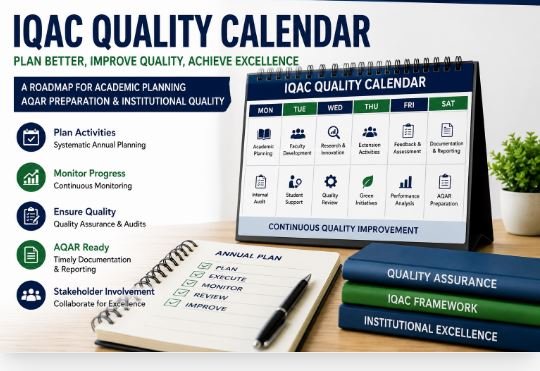
An effective IQAC quality calendar is the backbone of systematic quality assurance in higher education institutions. It enables colleges and universities to plan academic, administrative, research, extension, and quality enhancement activities throughout the academic year rather than rushing documentation before accreditation visits. Institutions with a structured quality calendar are better equipped to meet regulatory expectations, improve institutional performance, and maintain continuous quality improvement.
Despite recognizing the importance of planning, many colleges continue to rely on fragmented schedules maintained by different departments. As a result, important activities such as academic audits, stakeholder feedback, faculty development programmes, AQAR preparation, student support initiatives, and quality reviews often overlap or are delayed. This not only affects operational efficiency but also weakens documentation during accreditation and ranking exercises.
An annual IQAC quality calendar provides a centralized roadmap that aligns institutional objectives with academic planning, statutory requirements, and quality assurance activities. It helps IQAC coordinate departments, monitor progress, and ensure that quality initiatives are implemented consistently throughout the year.
This guide explains the purpose of an IQAC quality calendar, why it is essential for colleges and universities, and how institutions can use it as a practical management tool to strengthen academic planning, support the AQAR calendar, and promote sustainable institutional quality.
Strengthen your IQAC systems with expert planning support today.
1. What is an IQAC Quality Calendar?
An IQAC quality calendar is a structured annual schedule prepared by the Internal Quality Assurance Cell (IQAC) to plan, coordinate, monitor, and review institutional quality activities throughout the academic year. It serves as a comprehensive planning document that ensures every major academic and administrative activity is conducted within a defined timeline while supporting the institution’s long-term quality objectives.
Rather than functioning as a simple event calendar, the IQAC quality calendar integrates institutional goals with quality assurance processes. It brings together activities related to academics, research, governance, student development, extension, infrastructure, documentation, feedback collection, and statutory reporting into one coordinated framework.
The calendar enables departments to understand their responsibilities well in advance, reducing delays and improving collaboration. It also helps institutional leadership monitor progress and take corrective actions whenever necessary.
Objectives of an IQAC Quality Calendar
A well-designed quality calendar aims to:
- Promote systematic academic planning.
- Strengthen institutional quality assurance.
- Coordinate activities across departments.
- Improve documentation for accreditation.
- Support timely preparation of AQAR and other reports.
- Enhance stakeholder participation.
- Monitor implementation of quality initiatives.
- Encourage continuous institutional improvement.
When these objectives are achieved, institutions can shift from reactive management to proactive quality planning.
Key Components of an IQAC Quality Calendar
Although each institution has unique priorities, a comprehensive calendar generally includes:
- Academic session planning
- Admission activities
- Orientation programmes
- Faculty Development Programmes (FDPs)
- Curriculum planning and review
- Internal academic audits
- Student feedback collection
- Alumni engagement
- Employer feedback
- Research promotion activities
- Extension programmes
- Environmental initiatives
- Administrative reviews
- Examination schedules
- Departmental quality meetings
- AQAR preparation
- Annual report preparation
- NAAC documentation review
- NIRF and AISHE data collection
- Governance meetings
Integrating these activities into one annual schedule helps institutions maintain consistency and accountability.
Characteristics of an Effective IQAC Quality Calendar
A useful calendar should possess several important characteristics.
Strategic Alignment
Every planned activity should support the institution’s vision, mission, strategic plan, and quality objectives.
Realistic Timelines
Activities should be distributed evenly throughout the year to avoid excessive workload during accreditation periods.
Departmental Participation
The calendar should involve every academic and administrative department rather than remaining an IQAC-only document.
Measurable Milestones
Each activity should have:
- Responsible department
- Timeline
- Expected output
- Review mechanism
- Documentation requirements
Flexibility
While annual planning provides structure, institutions should retain flexibility to accommodate regulatory changes, new initiatives, or unforeseen circumstances.
2. Why Every College Needs an Annual IQAC Quality Calendar
Higher education institutions today are expected to demonstrate continuous quality improvement rather than isolated achievements. Accreditation agencies, regulatory bodies, students, employers, and governing authorities increasingly look for evidence of systematic planning and timely execution of institutional activities.
An annual IQAC quality calendar provides this structure by ensuring that quality initiatives are planned, implemented, monitored, and reviewed throughout the year.
2.1 Supports Continuous Quality Improvement
Quality assurance is an ongoing process rather than an activity limited to accreditation cycles. A quality calendar encourages departments to implement improvement initiatives consistently, monitor outcomes, and review progress at regular intervals.
Instead of reacting to deadlines, institutions become proactive in managing quality.
2.2 Improves Academic Planning
Effective academic planning depends on coordination among departments, faculty members, examination cells, administrative offices, and institutional leadership.
The IQAC calendar helps synchronize:
- Academic sessions
- Teaching plans
- Examination schedules
- Curriculum reviews
- Faculty training
- Student support activities
- Research initiatives
This coordinated approach minimizes scheduling conflicts and improves institutional efficiency.
2.3 Strengthens AQAR Preparation
Many institutions experience difficulties while preparing Annual Quality Assurance Reports because documentation is collected only at the end of the year.
An integrated AQAR calendar ensures that departments submit reports, evidence, feedback, and outcome data according to predefined timelines.
As a result:
- Documentation becomes more accurate.
- Evidence is readily available.
- Reporting workload decreases.
- Quality improves significantly.

2.4 Enhances Institutional Coordination
Without a common planning framework, departments often work independently, resulting in duplication of activities and inconsistent documentation.
The IQAC quality calendar promotes collaboration by providing one institutional roadmap for all stakeholders.
Departments understand:
- Their responsibilities
- Reporting deadlines
- Quality objectives
- Review schedules
- Documentation expectations
This improves communication and strengthens institutional governance.
2.5 Supports Accreditation Readiness
NAAC, NBA, NIRF, AISHE, and other quality initiatives require continuous documentation rather than last-minute preparation.
A structured quality calendar ensures timely completion of:
- Academic audits
- Student feedback
- Faculty appraisal
- Research reviews
- Extension activities
- Best practice documentation
- Institutional quality reviews
Consequently, institutions remain prepared for accreditation and quality assessments throughout the year rather than only during inspection periods.
2.6 Builds a Quality Culture
Perhaps the greatest advantage of an annual IQAC quality calendar is that it helps create a culture where quality becomes everyone’s responsibility.
Faculty members plan better.
Departments coordinate more effectively.
Students receive timely academic support.
Administrators monitor institutional performance using evidence.
IQAC functions as a facilitator of continuous improvement rather than merely a documentation office.
Over time, this culture of planned execution strengthens institutional quality, enhances stakeholder confidence, and contributes to sustainable academic excellence.
3. Step-by-Step Framework to Create an IQAC Quality Calendar
Preparing an effective IQAC quality calendar requires more than listing important dates. It involves aligning institutional objectives with academic planning, quality assurance activities, regulatory requirements, and continuous monitoring. A well-designed calendar serves as an operational roadmap that helps every department contribute toward institutional excellence.
The following framework can help colleges and universities design a practical annual quality calendar that supports academic excellence, strengthens the AQAR calendar, and improves institutional quality.
Step 1. Review the Previous Academic Year
Before preparing a new calendar, the IQAC should evaluate the performance of the previous year.
Review areas such as:
- Completion of planned activities
- Pending quality initiatives
- Academic audit findings
- Student feedback reports
- Faculty performance reviews
- AQAR observations
- NAAC recommendations
- NIRF and AISHE submissions
This review helps identify strengths, gaps, and improvement opportunities before planning the next academic session.
Step 2. Align the Calendar with Institutional Goals
The annual quality calendar should support the institution’s:
- Vision and mission
- Strategic development plan
- Quality policy
- Academic objectives
- Research goals
- Student development priorities
Every planned activity should contribute directly to institutional quality enhancement rather than functioning as an isolated event.
Request professional IQAC consultation for institutional quality improvement today.
Step 3. Identify Annual Quality Activities
Prepare a comprehensive list of activities to be completed during the academic year.
Typical IQAC activities include:
Academic Activities
- Academic calendar preparation
- Lesson plan review
- Curriculum enrichment
- Internal assessments
- Academic audits
- Result analysis
Faculty Development
- Faculty Development Programmes (FDPs)
- Research methodology workshops
- Outcome-Based Education training
- ICT-enabled teaching workshops
- Leadership development programmes
Student Development
- Student induction
- Mentoring sessions
- Career guidance
- Placement activities
- Skill development programmes
- Entrepreneurship initiatives
Research and Innovation
- Research proposal workshops
- Publication support
- Patent awareness programmes
- Consultancy initiatives
- Innovation competitions
Extension and Outreach
- Community engagement
- Environmental awareness campaigns
- NSS activities
- Social responsibility projects
- Village adoption programmes
Quality Assurance Activities
- IQAC meetings
- Internal quality reviews
- Department presentations
- Feedback collection
- Documentation review
- Best practice monitoring
- AQAR preparation
Step 4. Assign ResponsibilitiesEach activity should have clearly defined ownership.
The calendar should specify:
| Activity | Responsible Unit |
|---|---|
| Academic Audit | IQAC & Academic Committee |
| Student Feedback | IQAC |
| Faculty Development | HRDC / IQAC |
| Alumni Interaction | Alumni Cell |
| Placement Review | Training & Placement Cell |
| Research Review | Research Committee |
| AQAR Preparation | IQAC |
| Best Practice Documentation | Departments with IQAC |
Clearly assigning responsibilities improves accountability and prevents duplication of work.
Step 5. Develop a Month-wise Quality Calendar
Instead of scheduling everything at the end of the year, distribute activities evenly.
Example
June–July
- Admission planning
- Academic calendar approval
- Faculty orientation
- Department action plans
August
- Student induction
- Mentoring programme
- Academic monitoring
- IQAC meeting
September
- Internal academic audit
- Faculty Development Programme
- Student feedback
October
- Research review
- Extension activities
- Green campus initiatives
November
- Industry interaction
- Alumni engagement
- Placement preparation
December
- Mid-year quality review
- Documentation verification
January
- Curriculum enrichment review
- Skill development activities
February
- Best practice documentation
- Internal quality assessment
March
- Result analysis
- Stakeholder feedback
April
- AQAR data collection
- Department reports
May
- Annual quality review
- AQAR drafting
- Planning for the next academic year
A month-wise distribution ensures continuous monitoring and avoids last-minute pressure.
Step 6. Integrate Documentation Requirements
Every activity should specify the documents to be maintained.
Typical documentation includes:
- Circulars
- Attendance sheets
- Meeting minutes
- Activity reports
- Feedback forms
- Photographs
- News coverage
- Budget approvals
- Outcome reports
- Certificates
- Website updates
Maintaining documentation simultaneously with implementation significantly improves accreditation readiness.
Step 7. Review Progress Quarterly
Quarterly reviews help ensure that planned activities remain on schedule.
Review meetings should assess:
- Completed activities
- Delayed initiatives
- Documentation status
- Budget utilization
- Stakeholder participation
- Improvement actions
Periodic reviews allow institutions to make timely corrections instead of waiting until the end of the year.
4. Common MistakesInstitutions Should Avoid
Although many colleges prepare annual calendars, several recurring mistakes reduce their effectiveness. Understanding these issues helps institutions build a more practical and sustainable planning system.
Preparing the Calendar Only for Compliance
Some institutions create a quality calendar solely to satisfy accreditation requirements.
Instead, the calendar should function as a genuine management tool that guides institutional activities throughout the academic year.
Copying Generic Templates
Every institution has unique priorities, student demographics, academic programmes, and strategic objectives.
Using generic templates without customization often results in unrealistic planning and poor implementation.
The calendar should reflect the institution’s actual needs.
Ignoring Departmental Participation
An IQAC quality calendar should involve:
- Academic departments
- Examination Cell
- Library
- Research Cell
- Placement Cell
- Alumni Cell
- NSS/NCC
- Administrative offices
When departments actively contribute to planning, implementation becomes more effective.
Overloading Certain Months
Many colleges schedule multiple quality activities close to accreditation or AQAR deadlines.
This creates:
- Faculty workload
- Documentation delays
- Reduced activity quality
- Poor stakeholder participation
Balanced scheduling throughout the year improves execution.
Lack of Monitoring
Planning alone is insufficient.
Without regular review meetings, many scheduled activities remain incomplete.
IQAC should monitor implementation through:
- Monthly reviews
- Quarterly reports
- Department presentations
- Progress dashboards
Monitoring transforms planning into measurable outcomes.
Book your institutional quality audit with BGC experts today.
Weak Documentation
Institutions often conduct excellent activities but fail to preserve supporting evidence.
Maintain documentation immediately after each activity rather than collecting it retrospectively.
No Outcome Measurement
Instead of reporting only completed activities, institutions should evaluate:
- Participation levels
- Student satisfaction
- Faculty engagement
- Academic improvement
- Research output
- Community impact
Outcome-based reporting strengthens institutional quality assurance.

5. Best Practices for Maintaining an Effective IQAC Quality Calendar
An annual IQAC quality calendar becomes truly valuable when it is regularly monitored, updated, and integrated into the institution’s daily functioning. Successful colleges treat the quality calendar as a strategic management tool rather than a static document prepared only for accreditation purposes.
The following best practices can help institutions maximize the effectiveness of their quality calendar and strengthen institutional quality throughout the academic year.
Develop the Calendar Collaboratively
The IQAC should prepare the calendar in consultation with:
- Principal/Director
- Heads of Departments
- Examination Cell
- Research Cell
- Training and Placement Cell
- Library Committee
- Alumni Cell
- NSS/NCC Coordinators
- Administrative Office
Collaborative planning ensures realistic timelines, better ownership, and smooth execution across departments.
Integrate the Calendar with the Academic Calendar
The IQAC quality calendar should complement the institution’s academic calendar rather than function independently.
Synchronizing teaching schedules, examinations, faculty development programmes, research activities, student support services, and extension programmes prevents scheduling conflicts and improves institutional efficiency.
Use Digital Planning and Monitoring Tools
Maintaining the calendar digitally improves accessibility and accountability.
Institutions can use:
- Shared institutional calendars
- Google Workspace or Microsoft 365
- Learning Management Systems (LMS)
- Project management software
- Institutional ERP systems
- Document management platforms
Digital tracking also simplifies documentation for AQAR, NAAC, and internal reviews.
Conduct Monthly IQAC Review Meetings
Regular review meetings help monitor the progress of planned activities.
Monthly discussions may include:
- Completed activities
- Pending tasks
- Documentation status
- Challenges faced
- Corrective actions
- Upcoming events
This proactive approach keeps departments aligned with institutional quality objectives.
Maintain a Documentation Repository
Every activity should have a dedicated digital folder containing:
- Circulars
- Attendance records
- Photographs
- Reports
- Feedback forms
- Meeting minutes
- Outcome analysis
- Certificates
- Media coverage
Organized documentation significantly reduces the workload during accreditation preparation.
Review and Revise the Calendar Annually
Institutional priorities evolve over time due to new regulations, technological advancements, stakeholder expectations, and strategic goals.
At the end of each academic year, IQAC should evaluate:
- Activities completed successfully
- Delayed initiatives
- Feedback from departments
- Achievement of quality objectives
- Areas requiring improvement
The findings should be incorporated into the next annual quality calendar.
Institutional Checklist for an IQAC Quality Calendar
Use the following checklist to assess whether your institution has an effective annual quality calendar.
| Checklist Item | Status |
|---|---|
| Annual quality objectives defined | □ |
| Academic and quality activities integrated | □ |
| Department responsibilities assigned | □ |
| Month-wise schedule prepared | □ |
| AQAR activities included | □ |
| Documentation requirements identified | □ |
| Internal audit schedule planned | □ |
| Feedback collection timelines defined | □ |
| Quarterly review meetings scheduled | □ |
| Digital documentation repository maintained | □ |
| Calendar reviewed by IQAC | □ |
| Principal approved the annual calendar | □ |
Completing this checklist helps institutions improve planning, monitoring, and overall quality management.
6. How Bhavya Gyan Consultants (BGC) Can Help
Preparing and implementing a comprehensive IQAC quality calendar requires careful planning, institutional coordination, and continuous monitoring. Many colleges have quality initiatives in place but need expert guidance to align their academic planning with accreditation expectations and long-term quality goals.
Bhavya Gyan Consultants (BGC) provides specialized consultancy services to colleges and universities seeking to strengthen their Internal Quality Assurance Cell and institutional planning processes.
Our Services Include
- Annual IQAC quality calendar preparation
- Institutional quality planning
- NAAC documentation support
- AQAR preparation guidance
- Academic and administrative audit support
- IQAC policy development
- Department-wise documentation systems
- Faculty orientation and quality workshops
- Evidence management and documentation review
- Strategic NAAC readiness planning
By working closely with institutional leadership, IQAC teams, and academic departments, BGC helps develop practical quality systems that support continuous improvement rather than short-term compliance.
Build stronger institutional quality using BGC’s expert support today.
Conclusion
An effective IQAC quality calendar is much more than an annual schedule—it is a strategic framework that drives continuous improvement across every aspect of institutional functioning. By integrating academic planning, the AQAR calendar, documentation activities, faculty development, research initiatives, and quality reviews into a single roadmap, institutions can improve coordination, strengthen accountability, and build a sustainable culture of excellence.
Instead of preparing for accreditation only when inspections are announced, colleges should use the IQAC quality calendar to monitor progress throughout the year, identify areas for improvement, and ensure that evidence is consistently documented.
Institutions that adopt a structured quality calendar are better prepared for accreditation, improve operational efficiency, enhance stakeholder confidence, and foster long-term institutional quality.
Official External Links
FAQs:
An IQAC quality calendar is an annual planning document that schedules academic, administrative, research, documentation, and quality assurance activities throughout the academic year.
It helps institutions improve academic planning, coordinate quality initiatives, strengthen documentation, support AQAR preparation, and remain ready for accreditation and quality assessments.
The Internal Quality Assurance Cell prepares the calendar in consultation with the Principal, Heads of Departments, academic committees, administrative units, and other institutional stakeholders.
Institutions should monitor the calendar monthly, conduct quarterly reviews, and revise it annually based on institutional performance and quality objectives.
Yes. A well-maintained IQAC quality calendar supports systematic documentation, continuous quality improvement, and evidence collection, making institutions better prepared for NAAC accreditation and AQAR submission.
Internal Link Suggestions (BGC Website)
| Anchor Text | Suggested Page |
| NAAC Accreditation Consultancy | NAAC Accreditation Consultancy |
| IQAC Services | IQAC Services |
| Documentation Support | Documentation Support |
| Academic Audit Services | Academic Audit Services |
| NIRF Ranking Support | NIRF Ranking Support |
| NBA & OBE Consultancy | NBA & OBE Support |
| Contact Bhavya Gyan Consultants | Contact Us |
1 thought on “Annual IQAC Quality Calendar: A Complete Planning Guide for Colleges and Universities”