
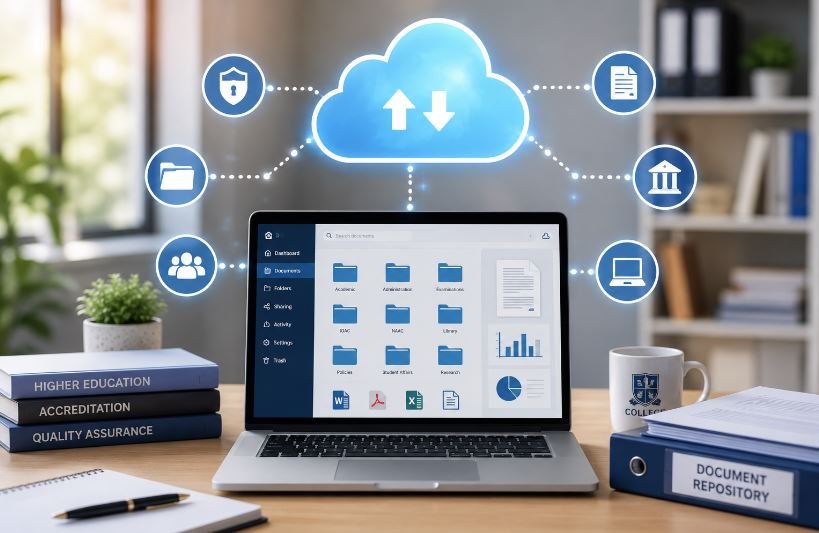
Ask any IQAC coordinator where last year’s evidence files are, and you’ll often get a pause before the answer — somewhere across three laptops, a shared drive, and one department’s personal email. A cloud documentation system fixes exactly this problem, giving every department one place to store, find, and update accreditation files, all year round. It sounds like a small operational fix, but it quietly changes how much stress every submission cycle carries.
This guide covers what makes a good digital repository for higher education, how to move away from scattered document management, and a practical rollout plan that doesn’t overwhelm your team in the first month.
Why Colleges Are Moving to Cloud Documentation Systems
Most institutions still manage accreditation files through a patchwork of spreadsheets, shared folders, and individual laptops. It works, barely, until someone leaves, a laptop crashes, or two departments submit conflicting versions of the same data. Our earlier guide on how to maintain AQAR records throughout the year covers the documentation habits that matter — a cloud system is simply the infrastructure that makes those habits sustainable at scale, across dozens of staff and multiple accreditation cycles.
The shift also reflects a broader reality: NAAC, NBA, and NIRF all now expect digital, verifiable evidence, not physical files produced under deadline pressure. A centralized repository makes that expectation far easier to meet consistently, cycle after cycle, without rebuilding the system from scratch each time.
Still managing accreditation evidence across scattered folders and laptops?
What Makes a Good Cloud Documentation System for Higher Education
Centralized Digital Repository
Every department’s evidence should live in one searchable system, not scattered across individual drives. A true digital repository lets anyone with the right access find a document by criterion, year, or department in seconds, not hours spent messaging five different coordinators.
Role-Based Access and Version Control
Not everyone needs to edit everything. Role-based access keeps data secure while still allowing collaboration, and version control ensures nobody accidentally overwrites a final, submitted document with an early draft — a mistake that’s far more common than institutions like to admit.

Criterion-Wise Folder Structure
Structuring folders around NAAC criteria, NBA program outcomes, or NIRF parameters — rather than by department alone — makes it dramatically faster to assemble evidence during submission season. Our breakdown of direct and indirect assessment in OBE is a good example of the kind of evidence that benefits most from this structure, since CO-PO mapping data needs to be traceable by course and outcome, not just by folder date.
Backup and Data Security
Automatic backups and encryption aren’t optional extras for institutional data — they’re baseline requirements, especially once student records and personal data are involved. A single unbacked-up laptop shouldn’t ever be the only copy of years of accreditation evidence.
Document Management Best Practices Before You Even Choose a Tool
A cloud system amplifies whatever habits you already have — good or bad. Migrating disorganised, inconsistent files into a shiny new platform just gives you disorganised files in a new location. Before choosing any tool, get basic document management practices right: consistent file naming, one designated owner per data type, and an agreed folder taxonomy every department follows the same way.
This groundwork usually takes a few weeks, but it determines whether your eventual system actually works or slowly turns into another dumping ground nobody trusts.
How a Digital Repository Simplifies Accreditation Files
Accreditation files rarely serve just one purpose. The same evidence often supports SSR preparation, SAR submissions for NBA, and NIRF data entry — sometimes all in the same academic year. A well-structured digital repository lets you tag a single document for multiple frameworks instead of duplicating files across separate systems, which is where version confusion usually starts.
It also makes self-assessment far easier to run consistently. BGC’s NBA Readiness Scorecard for Departments works best when departments can actually locate the evidence they’re scoring themselves against, rather than guessing based on memory.
Comparing Approaches: Spreadsheets vs Generic Cloud Storage vs Purpose-Built Systems
| Approach | Strengths | Limitations |
| Spreadsheets & shared folders | Familiar, zero cost, quick to start | No structure, easy to lose, no access control |
| Generic cloud storage (Drive, etc.) | Searchable, backed up, low cost | No accreditation-specific structure by default |
| Purpose-built documentation system | Criterion-mapped, role-based, audit-ready | Requires setup time and initial investment |
Most institutions don’t need to jump straight to a fully custom platform. A well-organised generic cloud storage setup, structured deliberately around accreditation criteria, often delivers 80% of the benefit at a fraction of the cost and complexity.
Not sure which approach fits your institution’s size and budget?
Common Pitfalls When Moving to a Cloud Documentation System
Institutions rolling out a new system for the first time tend to hit the same handful of avoidable problems:
- Migrating years of disorganised files without cleaning or restructuring them first
- Giving every staff member full edit access instead of role-based permissions
- Skipping staff training, leaving the system underused within a few months
- Ignoring data protection obligations for student and staff personal information
- Treating the migration as a one-time project instead of an ongoing maintained system
On the data protection point specifically, institutions storing student personal data digitally should stay current with India’s Digital Personal Data Protection Act and Rules, which set out obligations around consent, storage, and breach notification that apply to educational institutions too.

Rolling Out a Cloud Documentation System: A Practical Implementation Plan
Start With a Pilot Department
Choose one department to pilot the new structure for a semester before rolling it out institution-wide. This surfaces practical problems — unclear ownership, missing categories — while the stakes are still low.
Train Coordinators Before Migrating Old Files
A short, hands-on training session for each department’s coordinator prevents the most common early mistakes: wrong folder placement, duplicate uploads, and inconsistent file naming that undoes the whole point of centralising documents.
Set a Maintenance Routine, Not Just a Migration Date
A cloud system needs upkeep the same way physical files once did. Assign a quarterly review to check for outdated permissions, unused folders, and documents that still need proper tagging.
A well-organised, transparent documentation system also reflects well externally. Prospective students increasingly research institutional outcomes and recognition before applying — platforms such as BhavyaGyan’s college listings let families compare institutions on exactly this kind of data, which makes strong internal documentation practices a visibility asset too, not just a compliance requirement.
Conclusion
A cloud documentation system isn’t just a storage upgrade — it’s what turns scattered accreditation files into a reliable, audit-ready digital repository your team can actually trust. Get your document management habits right first, structure folders around accreditation criteria, and roll out gradually with a pilot department before going institution-wide. Done well, this single change quietly makes every future NAAC, NBA, and NIRF cycle noticeably less stressful.
Build a criterion-mapped digital repository for your institution.
FAQs:
A centralized, online repository for storing and managing institutional and accreditation records.
Well-structured generic storage often works fine for most small to mid-size institutions.
It keeps evidence organised, traceable, and ready for submission year-round.
Migrating disorganised files without first cleaning and restructuring them.
Yes, especially when storing student personal data under India’s DPDP Act.