
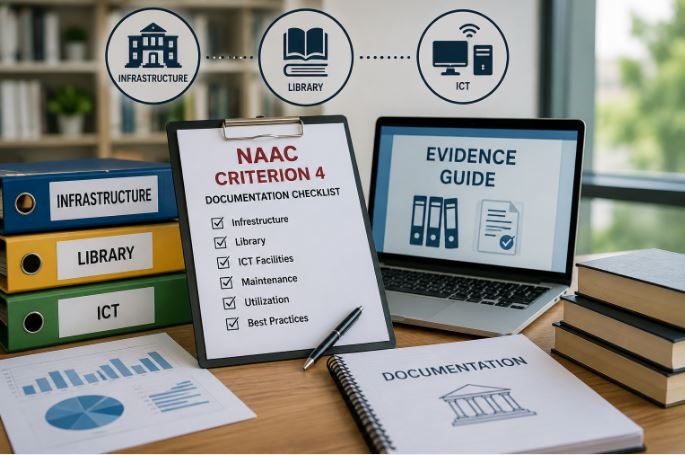
Criterion 4 is where NAAC checks whether your institution’s physical and digital environment actually supports learning, not just whether the buildings exist. Strong NAAC Criterion 4 documentation covers infrastructure, library resources, and ICT facilities together, since assessors expect these three areas to reinforce each other. This checklist breaks the criterion into its four sub-areas, so your committee can divide the work and collect the right evidence the first time. If you are working through the criteria in sequence, our sister guide on the NAAC Criterion 2 Documentation Checklist covers teaching-learning and evaluation evidence in the same format.
Criterion 4 evidence is unusual in one respect: much of it is physically verifiable. Assessors can walk into your library or computer lab and check whether what you documented actually matches what they see. That makes accuracy here even more important than in criteria assessed purely on paper.
🚀 Ready to build a complete, DVV-ready Criterion 4 evidence set? Get Criteria-wise Documentation Support from BGC today.
When Should Colleges Start Collecting Criterion 4 Evidence?
Infrastructure, library, and IT records accumulate naturally over an academic year, but only if someone is actively filing them as they are generated. Purchase bills, AMC renewals, and library subscription invoices are easy to trace when fresh and surprisingly difficult to reconstruct two or three years later.
- Log infrastructure purchase and maintenance bills as soon as they are processed, not at year-end
- Update library and IT records each semester rather than compiling them once before SSR submission
- Photograph new facilities and installations at the time of setup, since “as of today” photos cannot substitute for dated evidence
- Assign one owner each for physical facilities, library, and IT, so no single person is responsible for the entire criterion alone

What Is NAAC Criterion 4 and Why It Carries Weight
NAAC Criterion 4, titled Infrastructure and Learning Resources, evaluates the physical and digital environment your institution provides for teaching, learning, and campus life. It looks at classroom and lab adequacy, library automation and resources, IT infrastructure and connectivity, and how consistently the institution maintains what it has built.
This criterion connects closely with budget and planning decisions, which is why library and ICT upgrades are worth documenting as they happen rather than reconstructing later. If your institution is also building out physical spaces like smart classrooms, our partner guide on the ergonomic blueprint for smart classrooms and hybrid labs covers infrastructure planning from a design perspective that pairs well with this documentation checklist.
The Four Key Areas Under NAAC Criterion 4 (Quick Overview)
- 4.1 Physical Facilities
- 4.2 Library as a Learning Resource
- 4.3 IT Infrastructure
- 4.4 Maintenance of Campus Infrastructure
Each area has its own quantitative (QnM) and qualitative (QlM) metrics. The checklist below follows this same order, so your Criterion 4 committee can divide responsibility area by area.
NAAC Criterion 4 Documentation Checklist (Area by Area)
4.1 Physical Facilities
This area covers classrooms, laboratories, sports facilities, and cultural spaces, along with the infrastructure budget behind them. Assessors typically walk through a sample of these spaces during the peer team visit, so documentation should match what a visitor would actually see on that day.
- Photographic and floor-plan evidence of classrooms, laboratories, and seminar halls
- Proof of ICT-enabled classrooms, including smartboard or projector installation records
- Sports and cultural facility documentation, including equipment inventories and usage records
- Year-wise budget allocation for infrastructure augmentation, excluding salary components
- Audited utilisation statements confirming infrastructure spending matches allocated budgets
4.2 Library as a Learning Resource
This area is judged on how well the library functions as an active learning resource, not just a book repository.
- Proof of library automation through an Integrated Library Management System (ILMS)
- E-resource and journal subscription bills, including consortium memberships such as N-LIST
- Library usage records, such as footfall registers, OPAC access logs, or digital attendance data
- Book and journal purchase bills for the last five years
- Records of library orientation sessions or user training programmes conducted for students and faculty
📚 Need your library evidence organised and DVV-ready before submission? Get Criteria-wise Documentation Support from BGC.
4.3 IT Infrastructure
This area checks whether your ICT facilities genuinely support digital learning, not just whether computers exist on campus. A high computer count means little if bandwidth is inconsistent or half the machines are non-functional by the time of the visit.
- Wi-Fi and internet bandwidth upgrade records, with dates and technical specifications
- Student-computer ratio data, backed by purchase bills for the latest completed academic year
- IT policy documents covering acceptable use, data security, and maintenance protocols
- Records of software licensing and digital tools available to students and faculty
4.4 Maintenance of Campus Infrastructure
This area confirms that infrastructure investment is followed by consistent upkeep, not left to deteriorate after initial installation.
- Year-wise maintenance expenditure records, excluding salary components
- Annual Maintenance Contracts (AMCs) for equipment, IT systems, and campus facilities
- A documented maintenance policy describing how upkeep requests are logged and resolved
- Evidence of periodic facility inspections or audits
🏗️ Struggling to pull infrastructure and maintenance records into one consistent evidence set? Get Criteria-wise Documentation Support from BGC.
Organising Criterion 4 Evidence for Easy Retrieval
Criterion 4 generates a large volume of bills, contracts, and photographic evidence, which makes folder structure especially important here. A useful approach is to mirror the four sub-areas directly in your folder system, rather than organising by department or by year alone.
- Create separate parent folders for Physical Facilities, Library, IT Infrastructure, and Maintenance
- Within each, sub-folder by year, so five-year trends can be assembled quickly when drafting the SSR narrative
- Keep a single index sheet linking each metric to its supporting file, matching the structure covered in our broader guide on evidence preparation for DVV
- Store high-resolution photographs separately from financial documents, since assessors and DVV reviewers use them differently

Common Documentation Mistakes Colleges Make in Criterion 4
Because Criterion 4 evidence is often physical and easy to verify, small documentation gaps here tend to surface quickly during a peer team visit, more so than in criteria assessed purely through paperwork.
- Claiming ICT-enabled classrooms without photographic or installation-date evidence
- Submitting library subscription bills that do not match the journals actually accessible to students
- Reporting a student-computer ratio that cannot be traced to actual purchase records
- Treating maintenance as undocumented routine work instead of a tracked, evidenced process
- Letting infrastructure budget figures drift out of sync with the audited utilisation statements submitted alongside them
Because much of Criterion 4 is physically checkable, discrepancies here are often caught quickly during the peer team visit. Our guide on
how to prepare evidence for DVV covers the broader discipline of building evidence that survives this kind of scrutiny across every criterion.
How Criterion 4 Evidence Overlaps with NBA for Engineering Institutions
Engineering colleges preparing NAAC and NBA submissions in parallel can reuse much of their Criterion 4 evidence, since NBA also evaluates library and IT infrastructure, though at the program level rather than institution-wide. Our guide on designing a modern library for engineering colleges under NBA and NAAC norms covers this dual-purpose planning in more depth, and our SAR Preparation Guide for NBA Accreditation explains how NBA’s program-wise structure differs from NAAC’s institution-wide approach.
🎓 Preparing both NAAC and NBA infrastructure evidence at once? Talk to a BGC Accreditation Consultant about aligning both submissions.
Conclusion
NAAC Criterion 4 rewards institutions that treat infrastructure, library, and ICT resources as living systems, documented as they grow, not reconstructed under deadline pressure. Because assessors can verify much of this evidence in person, consistency between your documentation and what actually exists on campus matters more here than in almost any other criterion. A library subscription bill that does not match what students can actually access, or a computer lab photo that no longer reflects current equipment, undermines trust in the rest of your submission far more than the specific metric alone would suggest.
Work through each of the four areas in this checklist, assign clear ownership, and keep budget, purchase, and maintenance records updated continuously. For the next criterion in this series, our sister guide on NAAC Criterion 2 documentation is a useful companion resource.
FAQs:
Physical infrastructure, library resources, IT facilities, and campus maintenance.
Installation dates, photographs, and equipment purchase records.
Yes, ILMS implementation is a specific, checkable metric under Criterion 4.
Through purchase bills matched against enrolled student numbers.
It proves infrastructure investment is sustained, not just a one-time purchase.



2 thoughts on “NAAC Criterion 4 Documentation Checklist: Infrastructure, Library, and ICT Evidence Guide”