
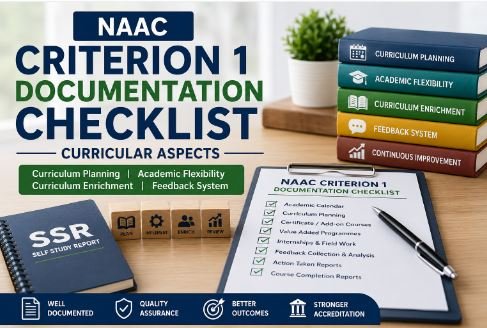
NAAC Criterion 1 documentation forms the foundation of the Self Study Report (SSR) because it demonstrates how an institution plans, implements, enriches, and reviews its curriculum. Whether a college is affiliated with a university or operates as an autonomous institution, maintaining proper documentation under Criterion 1 is essential for showcasing academic quality, curriculum delivery, and continuous improvement.
Many higher education institutions successfully conduct curriculum planning, value-added courses, certificate programmes, feedback collection, and academic enrichment activities throughout the year. However, these efforts often fail to receive proper recognition during accreditation because documentary evidence is incomplete, scattered across departments, or not mapped correctly to NAAC metrics.
For Principals, IQAC Coordinators, Directors, Heads of Departments, and faculty members, Criterion 1 requires systematic planning and documentation rather than last-minute file collection. Every academic initiative—from curriculum planning meetings to stakeholder feedback and academic flexibility—should be supported with authentic records that clearly demonstrate institutional commitment to quality education.
This comprehensive guide explains the documentation requirements of NAAC Criterion 1, the evidence expected for each metric, practical documentation checklists, and best practices that help institutions strengthen their SSR and accreditation readiness.
1. What is NAAC Criterion 1 Documentation?
NAAC Criterion 1 focuses on Curricular Aspects, evaluating how effectively an institution plans, implements, enriches, and reviews the curriculum to achieve academic excellence. Although affiliated colleges generally follow the curriculum prescribed by their parent university, they are still expected to demonstrate active participation in curriculum planning, enrichment, stakeholder engagement, and continuous academic improvement.
NAAC Criterion 1 documentation refers to the systematic collection and maintenance of documentary evidence supporting every activity related to curricular planning and implementation. Every statement made in the SSR must be supported with authentic records that show how the institution contributes to improving teaching-learning processes.
Criterion 1 is not limited to classroom teaching. It includes curriculum planning, academic flexibility, certificate courses, feedback mechanisms, value-added programmes, cross-cutting issues such as environmental studies and professional ethics, and curriculum review initiatives.
Institutions should develop a structured documentation system where every department contributes evidence throughout the academic year instead of collecting documents only before accreditation.
Objectives of Criterion 1 Documentation
A well-organized documentation system helps institutions:
- Demonstrate effective curriculum planning.
- Showcase curriculum enrichment initiatives.
- Provide evidence of academic flexibility.
- Present stakeholder feedback mechanisms.
- Support claims made in the SSR.
- Strengthen institutional quality assurance.
- Simplify peer team verification.
Types of Documents Required
Typical documents maintained under Criterion 1 include:
- Academic calendar
- Department academic plans
- Curriculum planning meeting minutes
- Timetables
- Bridge course reports
- Induction programme reports
- Certificate course files
- Value-added course records
- Academic flexibility documents
- Course completion reports
- Curriculum feedback forms
- Feedback analysis reports
- Action Taken Reports
- Circulars
- Notices
- Photographs
- Attendance sheets
- Programme reports
- MoUs related to curriculum enrichment
Each document should clearly mention the date, academic year, department, approving authority, and supporting evidence.
2. Why NAAC Criterion 1 Documentation Matters for Colleges and Universities
Criterion 1 establishes how an institution translates curriculum into meaningful learning experiences. It reflects the institution’s commitment to academic planning, innovation, stakeholder participation, and quality enhancement.
Well-maintained documentation under this criterion offers several advantages.
Supports Strong SSR Preparation
The Self Study Report relies heavily on documentary evidence. Institutions that maintain organized records throughout the academic year can prepare accurate responses for every metric without searching for missing files.
Demonstrates Curriculum Planning
NAAC expects institutions to show that curriculum implementation follows a structured process. Academic calendars, teaching plans, departmental meetings, and workload allocation records collectively demonstrate systematic planning.
Highlights Academic Flexibility
Academic flexibility includes certificate courses, interdisciplinary learning opportunities, elective options, and skill-based programmes. Proper documentation showcases the institution’s efforts to provide students with learning opportunities beyond the prescribed syllabus.
Strengthens Stakeholder Participation
Feedback from students, teachers, employers, alumni, and parents is an important quality indicator. Documentation should demonstrate not only feedback collection but also analysis and implementation through Action Taken Reports.
Improves Peer Team Verification
During accreditation visits, peer reviewers often request evidence for curriculum planning, enrichment activities, and feedback systems. Organized documentation enables quick retrieval and creates confidence in institutional processes.
Promotes Continuous Quality Improvement
Criterion 1 encourages institutions to evaluate academic practices regularly. Feedback analysis, curriculum review meetings, and implementation reports help institutions identify strengths, address gaps, and improve learning outcomes.
3. Understanding the Metrics Under NAAC Criterion 1
Criterion 1 is divided into several qualitative and quantitative metrics that assess different aspects of curriculum planning and implementation. Institutions should understand each metric clearly before preparing documentation.
Metric 1.1 – Curricular Planning and Implementation
This metric evaluates how effectively the institution plans and implements the curriculum prescribed by the affiliating university or designed by the institution itself.
Important Documents
- Academic calendar
- Department academic plans
- Time tables
- Workload distribution
- Lesson plans
- Teaching diaries
- Curriculum planning meeting minutes
- Departmental meetings
- Course allocation orders
- Course completion reports
The institution should demonstrate that academic activities are planned before the commencement of every semester and monitored periodically.
Metric 1.2 – Academic Flexibility
Academic flexibility reflects the institution’s efforts to provide additional learning opportunities beyond the standard curriculum.
Examples include:
- Certificate courses
- Diploma programmes
- Add-on courses
- Skill development courses
- Interdisciplinary programmes
- Online learning initiatives
- Choice Based Credit System (where applicable)
Required Documents
- Course approval letters
- Brochures
- Student enrolment lists
- Attendance records
- Assessment reports
- Certificates issued
- Programme completion reports
- Photographs
- Feedback reports
Every programme should have clearly defined objectives, learning outcomes, and evaluation procedures.
Metric 1.3 – Curriculum Enrichment
NAAC expects institutions to enrich the curriculum by integrating cross-cutting issues and experiential learning opportunities.
Examples include:
- Environmental sustainability
- Gender sensitivity
- Human values
- Professional ethics
- Entrepreneurship
- Internship programmes
- Field projects
- Community engagement
- Extension activities linked with curriculum
Documentation Required
- Course schedules
- Programme reports
- Internship records
- Field visit reports
- Student project reports
- Mentor reports
- Industry collaboration documents
- Participation certificates
- Outcome reports
Each enrichment activity should demonstrate measurable academic or skill development outcomes.

4. Understanding the Remaining Metrics of NAAC Criterion 1
While curriculum planning and academic flexibility form the foundation of Criterion 1, institutions must also demonstrate effective curriculum enrichment, stakeholder participation, and continuous curriculum review. Proper documentation of these activities reflects an institution’s commitment to improving academic quality.
Metric 1.3.2 – Project Work, Field Work and Internships
Experiential learning is an important component of quality education. NAAC expects institutions to provide students with practical exposure through internships, field visits, industrial training, surveys, community engagement, and project-based learning.
Documents Required
Maintain the following records:
- Internship policy
- Internship guidelines
- MoUs with industries and organizations
- Internship allotment letters
- Student internship lists
- Attendance records
- Internship completion certificates
- Industry mentor feedback
- Faculty mentor reports
- Student internship reports
- Project reports
- Field visit approvals
- Field visit schedules
- Photographs
- Outcome reports
Best Practice
Every internship or field visit should have complete documentation beginning with approval, followed by implementation, evaluation, and outcome assessment.
Metric 1.4 – Feedback System
One of the most important components of NAAC Criterion 1 documentation is the institutional feedback mechanism. Feedback demonstrates that the institution regularly evaluates academic processes and uses stakeholder suggestions for continuous improvement.
NAAC encourages institutions to collect feedback from:
- Students
- Teachers
- Employers
- Alumni
- Parents
The focus should not only be on collecting feedback but also on analysing responses and implementing improvements.
Documents Required
Maintain:
- Feedback policy
- Feedback questionnaires
- Online feedback forms
- Student feedback reports
- Alumni feedback reports
- Employer feedback reports
- Parent feedback reports
- Teacher feedback reports
- Statistical analysis
- Summary reports
- IQAC review minutes
- Action Taken Reports
- Circulars implementing improvements
Action Taken Reports
Action Taken Reports are particularly important because they demonstrate that feedback results in meaningful institutional changes.
Examples include:
- Revision of teaching methodologies
- Introduction of certificate courses
- Additional laboratory sessions
- New industry collaborations
- Improved library resources
- Enhanced student support services
5. Complete NAAC Criterion 1 Documentation Checklist
A structured checklist helps departments maintain records throughout the academic year instead of preparing documentation only during accreditation.
The following checklist can be adapted by every department.
A. Curriculum Planning Documents
Maintain:
- Academic calendar
- Department academic calendar
- Course allocation orders
- Faculty workload distribution
- Time tables
- Lesson plans
- Teaching plans
- Course completion reports
- Department meetings
- Academic monitoring reports
B. Curriculum Implementation Records
Maintain:
- Attendance registers
- Classroom teaching records
- Practical schedules
- Laboratory records
- Internal assessment records
- Continuous evaluation reports
- Mentor-Mentee records
- Student participation records
C. Academic Flexibility Documents
Maintain:
- Add-on course approvals
- Certificate course brochures
- Course schedules
- Student enrolment lists
- Attendance
- Assessment records
- Certificates issued
- Feedback reports
- Outcome reports
D. Curriculum Enrichment ocuments
Maintain records for:
- Environmental awareness programmes
- Human values sessions
- Gender sensitization programmes
- Professional ethics workshops
- Entrepreneurship programmes
- Skill development activities
- Community engagement
- Value-added programmes
Each activity should include:
- Circular
- Attendance
- Photographs
- Report
- Feedback
- Outcome analysis
E. Internship and Field Work Documents
Maintain:
- Internship agreements
- Industry collaborations
- Student allocation
- Internship reports
- Faculty monitoring
- Employer feedback
- Completion certificates
- Student presentations
F. Feedback System Documentation
Maintain:
- Feedback questionnaires
- Raw responses
- Analysis reports
- Graphical summaries
- IQAC discussion
- Action Taken Reports
- Improvement implementation reports
6. Department-wise Responsibility Matrix
Criterion 1 documentation becomes much easier when responsibilities are clearly assigned.
| Responsibility | Department/Person |
|---|---|
| Academic Calendar | Principal & IQAC |
| Curriculum Planning | Head of Department |
| Lesson Plans | Faculty Members |
| Academic Monitoring | Department Committee |
| Certificate Courses | Course Coordinator |
| Curriculum Enrichment | Programme Coordinators |
| Internship Records | Placement Cell & Departments |
| Feedback Collection | IQAC |
| Feedback Analysis | IQAC Committee |
| Action Taken Reports | Principal & IQAC |
This responsibility matrix ensures accountability and reduces duplication of work.
7. Creating an Effective Documentation Folder Structure
Institutions often lose valuable time searching for files because documents are stored randomly. A well-organized digital repository improves accessibility and simplifies SSR preparation.
Recommended Folder Structure
Criterion 1

│
├── Metric 1.1
│   ├── Academic Calendar
│   ├── Lesson Plans
│   ├── Course Allocation
│
├── Metric 1.2
│   ├── Certificate Courses
│   ├── Add-on Courses
│   ├── Academic Flexibility
│
├── Metric 1.3
│   ├── Curriculum Enrichment
│   ├── Internships
│   ├── Field Projects
│
└── Metric 1.4
    ├── Student Feedback
    ├── Alumni Feedback
    ├── Employer Feedback
    ├── Action Taken Reports
Within each folder, documents should be organized by:
- Academic year
- Department
- Programme
- Activity
- Supporting evidence
Standard File Naming Convention
Avoid vague names like:
- Final.pdf
- Report.doc
- New File.pdf
Instead, use descriptive names such as:
- C1_Metric1.2_CertificateCourse_Python_2025.pdf
- C1_Feedback_StudentAnalysis_2025.pdf
- C1_ActionTakenReport_2024-25.pdf
Consistent file naming improves document retrieval and supports efficient verification during peer team visits.

8. Preparing Evidence for the Self Study Report (SSR)
The Self Study Report should not merely describe institutional activities—it must present verifiable evidence for every claim.
Before uploading documents, verify that each file:
- Is relevant to the corresponding metric.
- Contains dates and official approvals.
- Includes signatures where applicable.
- Is clear and readable.
- Matches the information reported in the SSR.
- Is free from duplication.
- Is saved using a standardized file name.
Creating a Metric-to-Evidence Mapping Sheet can help institutions quickly locate supporting documents during SSR preparation and peer team verification.
This systematic approach reduces errors, saves time, and strengthens the credibility of institutional documentation.
9. Common Mistakes Institutions Should Avoid in NAAC Criterion 1 Documentation
Many colleges perform exceptionally well in curriculum delivery but fail to present their achievements effectively because of weak documentation practices. Avoiding the following mistakes can significantly improve the quality of institutional evidence.
9.1 Preparing Documentation Only During Accreditation
One of the most common mistakes is beginning documentation only after the institution decides to apply for NAAC accreditation.
This approach often results in:
- Missing records
- Incomplete reports
- Duplicate documents
- Faculty workload pressure
- Inconsistent institutional data
Instead, documentation should become a routine institutional practice throughout every academic year.
9.2 Missing Supporting Evidence
Institutions sometimes upload event reports without including the supporting records required for verification.
For every academic activity, the documentation file should include:
- Approval or circular
- Programme schedule
- Attendance sheet
- Photographs
- Feedback forms
- Outcome report
- Certificates (where applicable)
- Newspaper coverage (if available)
A report without supporting evidence weakens the institution’s claim.
9.3 Inconsistent Academic Data
Data inconsistency is one of the major concerns identified during SSR verification.
Examples include:
- Different student strength across reports
- Mismatched faculty workload records
- Inconsistent certificate course enrolment
- Different attendance figures
- Conflicting feedback statistics
The IQAC should periodically verify institutional data to ensure consistency across departments.
9.4 Poor File Organization
Randomly stored files increase the time required for document verification.
Avoid folder names like:
- Final
- New Folder
- Latest Report
Instead, organize documents by:
- Criterion
- Metric
- Academic year
- Department
- Activity
A logical folder hierarchy improves accessibility and simplifies SSR preparation.9.5 Lack of Action Taken Reports
Many institutions collect stakeholder feedback but fail to demonstrate how it influences institutional improvement.
Feedback should always be followed by:
- Analysis
- Discussion in IQAC
- Recommendations
- Implementation
- Action Taken Report
This closes the quality improvement loop expected by NAAC.
9.6 Unauthenticated Documents
Documents without signatures, official approvals, or institutional identification reduce credibility.
Every important document should contain:
- Institution name
- Date
- Signature
- Designation
- Official seal (where required)
9.7 Poor Quality Scanned Files
Blurry or incomplete scanned documents make verification difficult.
Institutions should:
- Use high-resolution scanning.
- Check readability before uploading.
- Save files as searchable PDFs wherever possible.
- Ensure all pages are included.
10. Best Practices for NAAC Criterion 1 Documentation
Institutions that consistently perform well during accreditation usually follow structured documentation systems rather than relying on individual efforts.
Establish a Documentation Calendar
Create an annual documentation schedule aligned with the academic calendar.
For example:
| Month | Documentation Activity |
|---|---|
| June | Academic planning and timetable preparation |
| July | Lesson plans and course allocation |
| August | Certificate course documentation |
| September | Feedback collection |
| October | Internship records update |
| November | Curriculum enrichment reports |
| December | Internal documentation review |
| January | Academic audit |
| February | Action Taken Reports |
| March | Documentation verification and backup |
This schedule helps departments update records regularly instead of accumulating work at the end of the year.
Standardize Documentation Templates
Prepare institution-wide templates for:
- Academic calendars
- Lesson plans
- Course completion reports
- Meeting minutes
- Event reports
- Internship reports
- Feedback forms
- Feedback analysis
- Action Taken Reports
Standardization improves consistency and simplifies document review.
Conduct Internal Documentation Audits
Quarterly documentation audits help institutions:
- Identify missing files
- Verify evidence quality
- Correct inconsistencies
- Improve indexing
- Prepare for SSR
Internal audits should be coordinated by the IQAC with participation from departmental representatives.
Create a Central Digital Repository
A centralized repository should organize documents by:
- Criterion
- Metric
- Department
- Academic year
Cloud-based storage with appropriate access controls ensures secure and efficient document management.Train Faculty and Staff
Faculty members are responsible for generating much of the evidence required under Criterion 1. Regular orientation programmes should cover:
- NAAC documentation expectations
- Standard reporting formats
- File naming conventions
- Evidence collection methods
- Timeline for document submission
Training fosters a culture of documentation rather than treating it as an administrative burden.
Link Documentation with Continuous Quality Improvement
Documentation should not only preserve records but also support institutional improvement.
Examples include:
- Using student feedback to enhance teaching methods.
- Introducing new certificate courses based on employer feedback.
- Revising curriculum enrichment activities according to stakeholder suggestions.
- Expanding internship opportunities through industry collaborations.
This demonstrates that documentation contributes directly to quality enhancement.
11. How Bhavya Gyan Consultants Can Help with NAAC Criterion 1 Documentation
Preparing NAAC Criterion 1 documentation requires coordination across departments, consistent record-keeping, and a clear understanding of NAAC metrics. Bhavya Gyan Consultants (BGC) works closely with colleges and universities to simplify this process through practical guidance and documentation support.
Our services include:
- Criterion 1 documentation planning
- Curriculum planning documentation support
- SSR documentation assistance
- Evidence mapping for NAAC metrics
- Department-wise documentation reviews
- IQAC mentoring and capacity building
- Academic audit services
- Documentation gap analysis
- Faculty development workshops
- Documentation templates and formats
- Mock peer team preparation
- Accreditation readiness assessment
Our consultative approach helps institutions create sustainable documentation systems that support not only NAAC accreditation but also long-term quality assurance.
Official External Link
- NAAC Official Website
- University Grants Commission (UGC)
- All India Council for Technical Education (AICTE)
12. Conclusion
Effective NAAC Criterion 1 documentation is more than maintaining files—it is about demonstrating how an institution plans, delivers, enriches, and continuously improves its curriculum. Strong documentation supports every claim in the Self Study Report, enables smooth peer team verification, and reflects an institution’s commitment to academic excellence.
By adopting standardized templates, maintaining a centralized digital repository, conducting regular documentation audits, and involving every department in the process, colleges and universities can significantly improve their accreditation readiness. Continuous documentation also reduces last-minute pressure and creates a strong foundation for future accreditation cycles.
FAQs:
NAAC Criterion 1 documentation includes all records related to curricular planning, implementation, academic flexibility, curriculum enrichment, internships, and stakeholder feedback that support the Self Study Report.
The Principal, IQAC Coordinator, Heads of Departments, faculty members, academic coordinators, and administrative staff should collectively maintain and verify Criterion 1 documentation.
Essential documents include the academic calendar, lesson plans, curriculum planning records, certificate course files, internship reports, stakeholder feedback, feedback analysis, and Action Taken Reports.
Documentation should be updated continuously throughout the academic year. Quarterly reviews and internal audits help maintain accuracy and completeness.
A structured feedback system demonstrates that the institution values stakeholder input and uses it to improve teaching, curriculum delivery, and academic quality through documented Action Taken Reports.