

Maintaining a comprehensive department file checklist is essential for every college and university striving to improve academic quality, strengthen institutional governance, and prepare confidently for accreditation and ranking exercises. Whether an institution is working towards NAAC accreditation, NIRF participation, or internal quality enhancement, organized department documentation serves as the foundation for demonstrating compliance, transparency, and continuous improvement.
Unfortunately, many higher education institutions struggle with scattered records, inconsistent file formats, missing evidence, and last-minute document collection. These issues often create unnecessary stress during inspections, audits, and accreditation visits. A well-structured department file system helps departments maintain updated records throughout the academic year rather than collecting information only when required.
This comprehensive guide explains how colleges and universities can develop an effective department file checklist, organize accreditation files, assign documentation responsibilities, and establish sustainable documentation practices that support quality assurance and institutional excellence.
Book your department documentation consultation with BGC experts today.
1. What Is a Department File Checklist?
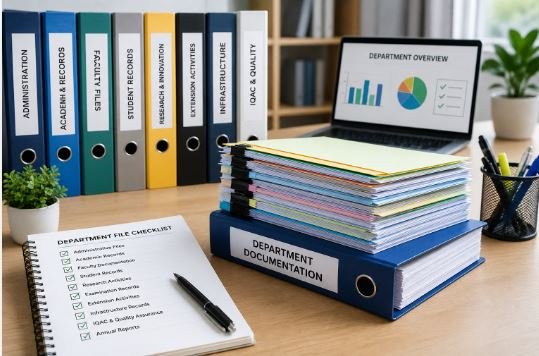
A department file checklist is a structured list of documents, records, registers, reports, and evidence that every academic department should maintain throughout the academic year. These files provide documented proof of departmental activities, academic performance, faculty achievements, student progress, research initiatives, outreach programmes, and administrative processes.
Rather than maintaining records only during accreditation cycles, institutions should develop a continuous documentation system where every important activity is recorded, verified, and archived systematically. This approach simplifies internal reviews, academic audits, accreditation assessments, and institutional rankings while reducing administrative workload.
Department files are not limited to paper documents. Modern institutions increasingly maintain both physical files and digital repositories to ensure secure storage, easy retrieval, and long-term preservation of records.
Purpose of a Department File Checklist
An organized documentation framework helps institutions:
- Maintain consistent academic records
- Improve departmental transparency
- Support accreditation requirements
- Simplify internal and external audits
- Preserve institutional memory
- Improve administrative efficiency
- Strengthen quality assurance practices
- Facilitate evidence-based decision-making
A standardized checklist ensures that every department follows the same documentation standards regardless of discipline.
Types of Department Files
Every department should maintain a combination of academic, administrative, research, and quality-related records.
Common categories include:
| File Category | Examples |
|---|---|
| Administrative Files | Department profile, faculty details, committee records |
| Academic Files | Timetables, lesson plans, course files, attendance |
| Student Files | Admissions, mentoring, achievements, progression |
| Research Files | Publications, projects, patents, consultancy |
| Quality Files | IQAC reports, academic audits, action taken reports |
| Examination Files | Internal assessment, result analysis, moderation |
| Extension Activity Files | NSS, outreach programmes, collaborations |
| Infrastructure Files | Laboratory records, equipment, maintenance |
Each file should be updated regularly with supporting evidence.
Why Every Department Needs Standardized Documentation
Many colleges allow departments to maintain records according to their own preferences. While this may work for daily operations, it often creates difficulties during institutional reviews because documentation formats vary considerably.
Standardization ensures:
- Uniform reporting across departments
- Easy document verification
- Faster information retrieval
- Better coordination with IQAC
- Improved institutional reporting
- Consistent evidence management
Standardized documentation also reduces duplication and improves overall efficiency.
Physical and Digital Documentation
An effective department documentation system combines physical records with digital storage.
Physical Files
These include:
- Signed registers
- Meeting minutes
- Official circulars
- Examination records
- Laboratory registers
- Student files
- Committee reports
Physical records should be properly indexed and stored securely.
Digital Files
Digital repositories should contain:
- PDF reports
- Faculty profiles
- Research publications
- Student databases
- Attendance records
- Presentations
- Event photographs
- Scanned supporting documents
Cloud-based storage with controlled access improves security and accessibility.
Role of Department Heads
The Head of Department plays a critical role in maintaining the quality of departmental records.
Key responsibilities include:
- Assigning documentation responsibilities
- Monitoring file updates
- Verifying departmental records
- Coordinating with IQAC
- Ensuring documentation completeness
- Reviewing evidence before audits
- Supporting institutional reporting
Regular monitoring prevents documentation gaps from accumulating throughout the academic year.
Request expert department documentation audit for accreditation readiness today.
Benefits of Maintaining Updated Department Files
Well-maintained accreditation files benefit institutions in several ways.
Some important advantages include:
- Faster accreditation preparation
- Improved institutional transparency
- Better academic planning
- Reduced administrative workload
- Stronger evidence during inspections
- Easier data collection for ranking exercises
- Better coordination between departments
- Continuous quality improvement
Institutions that update files regularly spend significantly less time preparing for inspections compared to those relying on last-minute documentation.
Characteristics of an Effective Department Documentation System
A strong documentation framework should include:
- Standard file structure
- Department-wise checklists
- File numbering system
- Evidence indexing
- Version control
- Regular updates
- Digital backups
- Periodic verification
Such systems ensure long-term sustainability and support multiple institutional quality initiatives.
2. Why Department Documentation Matters for Colleges, Universities, and IQAC Teams
Effective department documentation is the backbone of institutional quality assurance. Every academic achievement, faculty contribution, student activity, research project, committee meeting, and administrative process should be supported by authentic records. Without organized documentation, even well-performing departments may struggle to demonstrate their accomplishments during accreditation, ranking submissions, and internal audits.
For colleges and universities, maintaining updated department files is not merely an administrative requirement—it is an essential component of institutional governance and continuous improvement.
1. Supports Accreditation Readiness
Accreditation bodies require documented evidence of departmental activities. Organized accreditation files make it easier to present accurate records during peer team visits and institutional assessments.
2. Strengthens IQAC Functions
The Internal Quality Assurance Cell depends on department-level records for quality monitoring, annual reporting, and institutional planning. Consistent documentation enables IQAC to coordinate more effectively with academic departments.
3. Improves Academic Planning
Department files provide valuable insights into:
- Student performance trends
- Faculty workload
- Research productivity
- Curriculum implementation
- Resource utilization
These records support informed decision-making and future planning.
4. Simplifies Academic and Administrative Audits
Well-maintained documentation reduces the time required for internal and external audits by ensuring that evidence is readily available and properly organized.
5. Preserves Institutional Knowledge
Faculty transfers and administrative changes can result in the loss of important records if documentation systems are weak. Organized department files preserve institutional memory and ensure continuity.
6. Enhances Transparency and Accountability
A structured department file checklist promotes accountability by assigning clear documentation responsibilities and maintaining verifiable records for every departmental activity.
By establishing strong documentation practices, colleges and universities create a solid foundation for accreditation, quality assurance, academic excellence, and long-term institutional development.
4. Common Documentation Mistakes Departments Should Avoid
Even departments with experienced faculty and well-established academic processes can encounter documentation challenges if records are not maintained systematically. Most documentation issues arise due to inconsistent practices, delayed updates, or lack of coordination rather than a shortage of institutional activities.
Understanding these common mistakes helps departments strengthen their department documentation, improve record management, and remain prepared for accreditation, academic audits, and institutional quality assessments.
1. Maintaining Files Only Before Accreditation
One of the most common mistakes is preparing department files only when an accreditation visit or institutional audit is approaching.
This often results in:
- Missing documents
- Incomplete records
- Poor-quality evidence
- Increased faculty workload
- Inconsistent documentation
Recommended Practice
Update department files throughout the academic year instead of relying on last-minute preparation.
2. Inconsistent File Formats
Different faculty members often maintain documents using different formats.
Examples include:
- Different attendance formats
- Multiple lesson plan templates
- Various report structures
- Different file naming methods
These inconsistencies create confusion during reviews.
Recommended Practice
Adopt standardized templates across every department.
3. Missing Supporting Evidence
Many reports mention activities without attaching proper evidence.
Frequently missing documents include:
- Attendance sheets
- Event photographs
- Circulars
- Feedback forms
- Certificates
- Brochures
- Permission letters
- News coverage
Every activity should include complete documentary proof.
4. Poor Digital File Organization
Files stored across multiple computers, pen drives, or personal email accounts are difficult to retrieve.
Common problems include:
- Duplicate files
- Missing versions
- Lost documents
- Outdated reports
Recommended Practice
Maintain a centralized digital repository with controlled access.
5. Faculty Profile Not Updated
Faculty achievements often remain undocumented.
Missing updates usually include:
- Publications
- FDP participation
- Research projects
- Awards
- Consultancy work
- Patents
- Memberships
Updating faculty profiles every semester ensures accurate institutional reporting.
6. Incomplete Student Documentation
Departments sometimes maintain admission records but overlook:
- Mentoring records
- Student achievements
- Internship details
- Placement information
- Alumni progression
- Feedback analysis
These records demonstrate student development and departmental effectiveness.
7. Ignoring Internal Verification
Documentation should never be stored without periodic review.
Verification should include:
- Completeness
- Accuracy
- Evidence availability
- Signatures
- Date verification
- Proper indexing
Quarterly verification significantly improves documentation quality.
8. No File Indexing System
Without indexing, departments spend unnecessary time locating documents during inspections.
A simple numbering system helps organize files efficiently.
Example:
- ADM-01 – Department Profile
- ACD-01 – Academic Calendar
- FAC-01 – Faculty Profiles
- RES-01 – Publications
- STD-01 – Student Records
Proper indexing improves accessibility and consistency.
Download complete department file checklist for institutional documentation success.
5. Best Practices and Annual Roadmap for Department Documentation
Developing a sustainable department file checklist requires continuous effort, clear responsibilities, and institutional commitment. The following best practices can help departments maintain high-quality documentation throughout the academic year.
Establish Documentation Responsibility
Each file should have a designated faculty member responsible for updating and maintaining it.
Suggested responsibilities include:
- Academic Coordinator
- Research Coordinator
- Examination Coordinator
- Placement Coordinator
- Mentoring Coordinator
- IQAC Department Coordinator
- Laboratory In-charge
Clearly defined ownership reduces documentation gaps.
Create Standard Operating Procedures (SOPs)
Prepare written SOPs covering:
- File preparation
- Update frequency
- Documentation standards
- Evidence collection
- Approval process
- Record retention
- Digital storage
SOPs help maintain consistency even when faculty members change.
Conduct Quarterly Documentation Reviews
Departments should schedule reviews every three months.
Review checklist:
- Missing documents
- Faculty updates
- Student records
- Research activities
- Infrastructure additions
- Committee meetings
- Action Taken Reports
Quarterly reviews prevent documentation backlogs.
Maintain Digital and Physical Records
A hybrid documentation system offers greater flexibility.
Digital repository should include:
- Scanned documents
- PDF reportsExcel databases
- Faculty profiles
- Event photographs
- Annual reports
Physical files should contain:
- Signed registers
- Original approvals
- Official correspondence
- Examination records
- Committee files
Encourage Continuous Documentation
Documentation should become part of routine departmental activities.
Immediately after every event, update:
- Reports
- Attendance
- Photographs
- Feedback
- Certificates
- Circulars
This practice minimizes missing evidence.
Annual Department Documentation Roadmap
| Timeline | Activity |
|---|---|
| April–June | Update faculty profiles, department profile, academic calendar |
| July–September | Teaching records, research, student mentoring |
| October–December | Outreach, placements, infrastructure updates |
| January | Internal academic audit |
| February | IQAC verification |
| March | Annual report preparation and documentation review |
Department Readiness Checklist
| Documentation Item | Status |
| Department Profile Updated | ☐ |
| Faculty Profiles Verified | ☐ |
| Course Files Complete | ☐ |
| Student Records Updated | ☐ |
| Research Documentation Available | ☐ |
| Extension Activities Documented | ☐ |
| Infrastructure Records Updated | ☐ |
| IQAC Documentation Verified | ☐ |
| Digital Repository Organized | ☐ |
| Annual Report Prepared | ☐ |
Completing this checklist helps departments remain prepared for accreditation, inspections, and academic audits at any time.

6. How Bhavya Gyan Consultants (BGC) Can Help
Developing and maintaining an effective department file checklist requires planning, standardized documentation, and continuous monitoring. Bhavya Gyan Consultants (BGC) supports colleges and universities in building robust documentation systems that strengthen quality assurance and accreditation readiness.
Our services include:
- Department documentation audits
- Documentation gap analysis
- Standard file formats and templates
- IQAC documentation support
- Academic department documentation planning
- Faculty documentation systems
- Evidence management guidance
- Internal academic audits
- Accreditation readiness workshops
- End-to-end documentation support for higher education institutions
BGC helps institutions establish sustainable documentation practices that simplify accreditation preparation and improve overall institutional efficiency.
Improve accreditation readiness through organized departmental documentation systems today.
Conclusion
An effective department file checklist is much more than a collection of documents—it is a systematic framework that supports academic excellence, institutional transparency, and continuous quality improvement. Colleges and universities that maintain organized department documentation throughout the academic year are better prepared for accreditation, academic audits, ranking submissions, and institutional reviews.
By standardizing documentation practices, assigning clear responsibilities, maintaining digital repositories, and conducting regular internal reviews, institutions can significantly reduce administrative workload while improving the quality and accessibility of their records. Strong documentation systems also contribute to better decision-making, enhanced governance, and long-term institutional growth.
FAQs:
A department file checklist is a structured list of academic, administrative, research, and quality-related documents that every department should maintain to support institutional management, accreditation, and audits.
Department documentation provides verifiable evidence of academic and administrative activities, helping institutions demonstrate compliance, transparency, and continuous improvement during accreditation and quality assessments.
Departments should update files regularly throughout the academic year, preferably every month or immediately after significant academic, administrative, or research activities.
Essential files include department profiles, faculty records, course files, student records, research documentation, examination records, extension activity reports, infrastructure files, IQAC documents, and annual reports.
Yes. Maintaining both physical and digital records improves document security, accessibility, backup, and long-term preservation while making audits and accreditation visits more efficient.
Official External Links
Use official resources for documentation and quality guidance: