
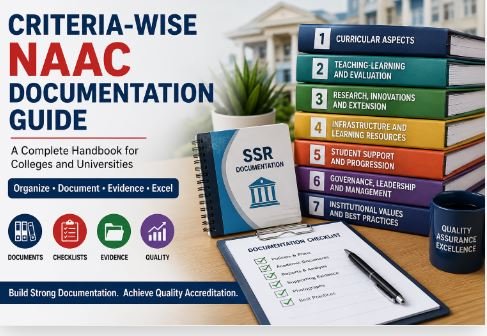
Criteria-wise NAAC documentation is the backbone of a successful accreditation process. While many colleges and universities invest significant effort in academic activities, research, student support, and governance, they often face challenges during NAAC assessment because their documentation is incomplete, scattered, or not aligned with the required criteria. In many cases, institutions perform commendable work throughout the year but fail to present convincing documentary evidence to support their achievements.
The National Assessment and Accreditation Council (NAAC) evaluates institutions not only on their performance but also on how effectively they document policies, processes, outcomes, and continuous quality improvement initiatives. Every claim made in the Self Study Report (SSR) should be supported by authentic, organized, and verifiable records. Without proper documentation, even excellent institutional practices may receive limited recognition during assessment.
For Principals, Directors, IQAC Coordinators, Heads of Departments, faculty members, and administrative teams, preparing documentation for all seven NAAC criteria can appear overwhelming. Each criterion demands different types of evidence, ranging from curriculum planning and teaching practices to research outputs, governance records, financial management, infrastructure maintenance, and institutional best practices. Managing thousands of files across multiple departments requires careful planning, standardized procedures, and continuous monitoring.
This comprehensive guide has been prepared to help higher education institutions understand what criterion-wise documentation actually means, why it plays such a vital role in accreditation, and how institutions can build a sustainable documentation system instead of rushing to collect evidence just before NAAC submission. Throughout this guide, you will also find practical recommendations, documentation checklists, and proven best practices that institutions can implement immediately.
Request Expert Criteria-wise NAAC Documentation Support From BGC Today
1. What is Criteria-wise NAAC Documentation?
Criteria-wise NAAC documentation refers to the systematic collection, organization, verification, maintenance, and presentation of institutional records according to the seven assessment criteria prescribed by NAAC. It is a structured process through which colleges and universities preserve documentary evidence that demonstrates compliance with quality standards, institutional performance, and continuous improvement initiatives.
Documentation is much more than maintaining files in cupboards or uploading PDFs during the accreditation process. It represents the institutional culture of accountability, transparency, quality assurance, and evidence-based governance. Every activity carried out by an institution—whether academic, administrative, financial, research-oriented, or student-centric—should leave behind documented evidence that can be verified whenever required.
During the NAAC accreditation process, peer reviewers examine not only the Self Study Report but also the supporting documents that validate every metric claimed by the institution. Therefore, documentation should be viewed as a continuous institutional practice rather than a one-time exercise conducted only before accreditation.
A well-maintained documentation system enables institutions to:
- Demonstrate compliance with NAAC quality benchmarks.
- Support every quantitative and qualitative metric in the SSR.
- Maintain consistency between institutional reports and supporting records.
- Simplify peer team verification during assessment visits.
- Promote transparency and accountability in governance.
- Preserve institutional knowledge for future accreditation cycles.
- Reduce last-minute stress during document collection and verification.

Characteristics of Effective NAAC Documentation
High-quality documentation should possess the following characteristics:
Authentic
Every document must originate from official institutional activities and should be duly approved by the competent authority. Fabricated or unofficial records can adversely affect institutional credibility.
Complete
Supporting documents should include all necessary details, such as dates, signatures, approvals, participant information, photographs, reports, and relevant annexures.
Organized
Files should be arranged criterion-wise, metric-wise, department-wise, and academic year-wise. Proper indexing significantly improves accessibility during verification.
Accessible
Authorized institutional stakeholders should be able to retrieve documents quickly whenever required. Digital repositories are highly recommended.
Consistent
Data presented in different reports should match across departments. Student strength, faculty numbers, financial records, and research outputs should remain consistent in all institutional documents.
Secure
Institutions should maintain both physical and digital backups to protect valuable records from accidental loss or damage.
Types of Documents Commonly Required
Although each criterion has its own requirements, institutions generally maintain the following categories of evidence:
- Academic calendars
- Curriculum planning documents
- Meeting minutes
- Governing Body resolutions
- IQAC reports
- Faculty workload records
- Student attendance registers
- Internal assessment reports
- Examination records
- Research publications
- Consultancy agreements
- Memorandums of Understanding (MoUs)
- Financial statements
- Audit reports
- Infrastructure maintenance records
- Library usage reports
- Laboratory stock registers
- Student feedback analysis
- Action Taken Reports
- Placement records
- Scholarship details
- Alumni activities
- Extension programme reports
- Best practice documentation
- Institutional distinctiveness reports
Maintaining these records throughout the academic year makes SSR preparation significantly easier.
2. Why Criteria-wise Documentation Matters for Colleges, Universities, and IQAC Teams
Many institutions focus extensively on conducting academic activities, organizing seminars, publishing research, supporting students, and strengthening governance. However, these efforts contribute to accreditation only when they are supported by proper documentation. NAAC assessment is evidence-based, meaning that institutional claims must be substantiated with authentic documentary proof.
Criteria-wise documentation is therefore not merely an administrative responsibility but an essential component of institutional quality assurance.
Supports Accurate SSR Preparation
The Self Study Report serves as the primary document through which institutions present their performance before NAAC. Preparing the SSR becomes considerably easier when all relevant documents are systematically maintained throughout the year. Institutions can retrieve accurate information quickly without depending on memory or incomplete records.
Enhances Institutional Transparency
Well-documented processes demonstrate that the institution follows established procedures rather than ad hoc practices. Policies, committee decisions, financial transactions, academic planning, and student support activities become transparent and verifiable.
Facilitates Smooth Peer Team Verification
During NAAC visits, peer reviewers request documentary evidence for various metrics. Institutions with organized documentation can produce the required records promptly, creating a positive impression regarding administrative efficiency and quality culture.
Strengthens IQAC Functioning
The Internal Quality Assurance Cell (IQAC) plays a central role in monitoring quality initiatives across the institution. Systematic documentation enables IQAC to track departmental progress, identify gaps, recommend improvements, and monitor implementation of quality enhancement measures throughout the year.
Encourages Continuous Improvement
Documentation is not limited to recording achievements. It also enables institutions to evaluate outcomes, identify shortcomings, and implement corrective actions. Annual reports, feedback analysis, Action Taken Reports, and academic audits collectively contribute to continuous quality improvement.
Preserves Institutional Memory
Leadership and faculty members may change over time, but institutional records preserve valuable information regarding policies, initiatives, achievements, and best practices. Proper documentation ensures continuity across accreditation cycles.
Reduces Last-Minute Pressure
Many institutions begin collecting documents only a few months before SSR submission, leading to confusion, missing records, duplicate evidence, and unnecessary workload. Continuous documentation eliminates this problem and improves overall preparedness.
3. Understanding the Seven NAAC Criteria
Before collecting documents, every institution should clearly understand what each NAAC criterion evaluates. Documentation should reflect the objectives and quality indicators associated with each criterion rather than simply accumulating files.
Criterion 1: Curricular Aspects
This criterion evaluates how effectively the institution plans, implements, enriches, and reviews its curriculum. Although affiliated colleges often follow university-prescribed syllabi, they are expected to demonstrate curriculum planning through academic calendars, bridge courses, value-added programmes, feedback systems, certificate courses, and stakeholder participation.
Documentation should illustrate that curriculum delivery is systematic, learner-centric, and continuously improved through feedback and institutional initiatives.
Criterion 2: Teaching-Learning and Evaluation
Criterion 2 examines the effectiveness of teaching methodologies, student learning experiences, evaluation practices, mentoring systems, faculty development, learning outcomes, and academic support mechanisms.
Institutions should maintain comprehensive evidence related to admissions, attendance, lesson plans, internal assessments, result analysis, remedial coaching, advanced learner initiatives, and programme outcome attainment.
Criterion 3: Research, Innovations, and Extension
Research activities significantly influence institutional quality. This criterion assesses research culture, funded projects, consultancy, publications, patents, innovation ecosystems, extension programmes, collaborations, and community engagement.
Documentation should clearly demonstrate research productivity as well as social responsibility initiatives undertaken by the institution.
4. Understanding Documentation Requirements for Criteria 4 to 7
Each of the remaining four criteria focuses on a different dimension of institutional quality. Proper documentation under these criteria demonstrates how effectively an institution manages its infrastructure, supports students, ensures good governance, and promotes social responsibility.
Criterion 4: Infrastructure and Learning Resources
Infrastructure plays a vital role in creating an effective learning environment. NAAC evaluates whether the institution has adequate physical and digital resources to support teaching, learning, research, and student development.
However, simply having modern infrastructure is not sufficient. Institutions must also demonstrate proper planning, maintenance, utilization, and continuous improvement through documentary evidence.
Documents Required for Criterion 4
The following records are generally maintained under this criterion:
- Campus master plan
- Building completion certificates
- Floor plans
- Classroom allocation records
- Laboratory utilization registers
- Equipment purchase invoices
- Laboratory stock registers
- Asset registers
- Annual maintenance contracts (AMC)
- Repair and maintenance records
- Library accession registers
- Library automation reports
- E-resource subscription details
- ICT infrastructure reports
- Internet bandwidth reports
- Wi-Fi usage records
- Computer laboratory inventory
- Smart classroom details
- Sports facility records
- Hostel maintenance reports (if applicable)
- Green campus initiatives
- Energy conservation reports
- Water conservation records
Evidence Tips
Rather than uploading only photographs, institutions should provide supporting records such as purchase bills, maintenance logs, utilization reports, and committee approvals. Photographs become stronger evidence when accompanied by official documentation.
Criterion 5: Student Support and Progression
Student development remains one of the central objectives of higher education. This criterion evaluates how effectively institutions support students academically, financially, professionally, and personally.
Documentation should clearly demonstrate that students receive opportunities beyond classroom learning.
Important Documents
Institutions should maintain records such as:
- Scholarship lists
- Scholarship sanction letters
- Student welfare schemes
- Placement reports
- Higher education progression data
- Competitive examination coaching records
- Soft skill development programmes
- Career counselling reports
- Entrepreneurship programmes
- Alumni association activities
- Student council reports
- Cultural programme reports
- Sports achievements
- Student grievance records
- Anti-ragging committee reports
- Women development cell activities
- Equal opportunity cell reports
Maintaining Student Progression Data
One common challenge is inconsistency in student progression data.
For example:
- Students graduating
- Students pursuing higher education
- Students placed
- Students qualifying competitive examinations
These numbers should remain consistent across annual reports, SSR metrics, departmental records, and placement office documentation.
Maintaining a centralized database significantly reduces reporting errors.
Book Your Comprehensive NAAC Documentation Audit With Our Experts
Criterion 6: Governance, Leadership and Management
This criterion evaluates institutional leadership, strategic planning, financial management, policy implementation, faculty development, and overall governance.
Unlike academic criteria, Criterion 6 requires extensive administrative documentation.
Documents Required
Typical documents include:
- Vision and Mission statements
- Organizational structure
- Strategic development plan
- Perspective plan
- Governing Body minutes
- Finance Committee minutes
- Academic Council records
- IQAC meeting minutes
- Action Taken Reports
- Annual reports
- Internal audit reports
- External audit reports
- Budget allocation documents
- HR policy
- Recruitment policy
- Promotion policy
- Leave policy
- Performance appraisal records
- Faculty Development Programme reports
- Administrative training records
Governance Documentation Best Practices
Every committee should maintain:
- Notice
- Agenda
- Attendance sheet
- Minutes of meeting
- Resolutions
- Action Taken Report
This sequence demonstrates that institutional decisions are implemented effectively rather than merely discussed.
Criterion 7: Institutional Values and Best Practices
Criterion 7 reflects the institution’s commitment to ethics, sustainability, inclusiveness, and societal development.
Many institutions underestimate this criterion because its activities often extend beyond academics. However, strong documentation here significantly enhances the institution’s quality profile.
Important Documentation
Maintain evidence relating to:
- Gender equity initiatives
- Women’s safety measures
- Environmental awareness programmes
- Green audit reports
- Energy audit reports
- Waste management systems
- Water harvesting
- Plastic-free campus initiatives
- Disability support services
- Inclusive education practices
- Human values programmes
- Professional ethics activities
- Institutional best practices
- Institutional distinctiveness reports
Documenting Best Practices
Every best practice should include:
- Title
- Objectives
- Context
- Implementation process
- Stakeholders involved
- Outcomes achieved
- Challenges faced
- Supporting evidence
- Photographs
- Reports
- Future plans
This structured format improves clarity and demonstrates continuous improvement.
5. Criteria-wise NAAC Documentation Checklist
Preparing documentation becomes much easier when institutions follow a standardized checklist for every criterion. Rather than collecting documents at the last moment, departments should update these records throughout the academic year.
Criterion 1 Checklist
Academic documents include:
- Academic calendar
- Curriculum planning
- Department timetable
- Bridge course reports
- Certificate courses
- Value-added programmes
- Feedback forms
- Feedback analysis
- Action Taken Reports
Criterion 2 Checklist
Teaching-learning documents include:
- Student admission records
- Lesson plans
- Teaching diaries
- Attendance registers
- Internal assessment records
- Mentor-Mentee reports
- Learning outcome assessment
- Result analysis
- Slow learner support
- Advanced learner initiatives
Criterion 3 Checklist
Research documentation includes:
- Research policy
- Seed money records
- Publications
- Book chapters
- Patents
- Consultancy
- MoUs
- Collaborative activities
- Extension programmes
- NSS reports
- Outreach activities
- Research grants
Criterion 4 Checklist
Infrastructure records include:
- Building maintenance
- Asset register
- Laboratory inventory
- Equipment purchase
- Library reports
- ICT reports
- Maintenance contracts
- Campus utilization reports
- Internet facilities
- Sports facilities
Criterion 5 Checklist
Student support records include:
- Scholarships
- Placement reports
- Alumni activities
- Student progression
- Student council
- Sports participation
- Cultural events
- Career guidance
- Competitive exam coaching
Criterion 6 Checklist
Governance documents include:
- Vision
- Mission
- Strategic Plan
- IQAC meetings
- Finance records
- Audit reports
- Budget documents
- HR policy
- Faculty appraisal
- FDP reports
Criterion 7 Checklist
Institutional values documentation includes:
- Green audit
- Energy audit
- Gender audit
- Environmental initiatives
- Best practices
- Institutional distinctiveness
- Community engagement
- Inclusive campus initiatives
6. Mapping Documents with SSR Metrics
One of the biggest challenges faced by accreditation teams is identifying which document supports which SSR metric.
Instead of storing documents in large folders, institutions should create a metric-wise documentation matrix.
A typical documentation matrix should include:
| Metric | Required Evidence | Department Responsible | File Location | Verification Status |
|---|---|---|---|---|
| 1.1.1 | Academic Calendar | Academic Section | Criterion 1 Folder | Verified |
| 2.3.1 | Lesson Plans | Departments | Criterion 2 Folder | Verified |
| 3.2.2 | Research Publications | Research Cell | Criterion 3 Folder | Verified |
| 4.1.2 | Laboratory Facilities | Administration | Criterion 4 Folder | Verified |
| 5.2.1 | Placement Reports | Training & Placement Cell | Criterion 5 Folder | Verified |
| 6.2.1 | Strategic Plan | IQAC | Criterion 6 Folder | Verified |
| 7.1.2 | Green Audit | Green Committee | Criterion 7 Folder | Verified |
Creating such a matrix helps institutions quickly retrieve evidence during SSR preparation and peer team visits. It also minimizes duplication, reduces confusion among departments, and ensures that every metric is backed by appropriate documentary proof.
7. Common Documentation Mistakes Institutions Should Avoid
Even institutions with excellent academic performance often lose valuable assessment opportunities because of poor documentation practices. NAAC evaluates evidence, consistency, and systematic processes. Small documentation gaps can weaken otherwise strong institutional achievements.
Understanding these common mistakes helps institutions build a more reliable documentation system.
7.1 Collecting Documents Only Before Accreditation
One of the biggest mistakes is treating documentation as a last-minute activity. Many colleges begin gathering files only after deciding to apply for NAAC accreditation. This often leads to missing records, incomplete reports, and unnecessary pressure on faculty and administrative staff.
A better approach is to integrate documentation into everyday institutional operations. Every meeting, event, workshop, committee decision, or academic activity should be documented immediately after completion.
7.2 Inconsistent Data Across Departments
Different departments sometimes report different figures for the same academic year.
For example:
- Student enrolment numbers differ between the admission office and departments.
- Placement statistics do not match training and placement records.
- Faculty strength varies between HR records and departmental reports.
- Research publication counts differ between departments and the research cell.
Such inconsistencies raise questions during peer team verification.
Best Practice: Maintain a centralized institutional database that is periodically reviewed by the IQAC.
7.3 Missing Supporting Evidence
Many institutions prepare detailed reports but fail to include the supporting documents required to validate them.
For example, an event report without:
- Attendance sheets
- Event circular
- Programme schedule
- Photographs
- Feedback forms
- Media coverage
- Certificates
is considered incomplete evidence.
Each institutional activity should have a complete documentation file from planning to outcome.
Download The Complete Criteria-wise NAAC Documentation Preparation Checklist Today
7.4 Poor File Naming and Organization
Folders named “New Folder,” “Final Report,” or “Document1” make retrieval difficult during SSR preparation.
A standardized naming convention is highly recommended.
Example:
C3_Research_Publications_ComputerScience_2025.pdf
or
C5_Placement_Report_2024-25.pdf
This makes searching, indexing, and verification much easier.
7.5 Duplicate or Misplaced Documents
The same document is sometimes uploaded under multiple metrics without relevance or placed under the wrong criterion.
Although some evidence may support more than one metric, institutions should clearly identify its primary purpose and maintain cross-references rather than unnecessary duplication.
7.6 Lack of Authentication
Documents without signatures, approval dates, official seals, or competent authority endorsements may not be considered reliable institutional evidence.
Every official document should include:
- Date
- Signature
- Designation
- Institution name
- Approval details (where applicable)
7.7 Poor Quality Scanned Documents
Blurred scans, cropped pages, missing signatures, or unreadable PDFs create difficulties during document verification.
Institutions should:
- Scan documents at appropriate resolution.
- Save files in searchable PDF format where possible.
- Ensure all pages are included.
- Verify readability before uploading.
8. Best Practices for Criteria-wise NAAC Documentation
Strong documentation systems are built gradually through standardized processes rather than one-time efforts. The following best practices help institutions maintain high-quality records throughout the accreditation cycle.
Create a Documentation Responsibility Matrix
Documentation should not depend on a single individual. Assign clear responsibilities to institutional stakeholders.
| Responsibility | Assigned To |
|---|---|
| Overall monitoring | Principal |
| Documentation coordination | IQAC Coordinator |
| Criterion documentation | Criterion Coordinators |
| Department records | Heads of Departments |
| Academic records | Faculty Members |
| Administrative records | Administrative Office |
| Finance records | Accounts Section |
| Research documentation | Research Cell |
| Student support records | Student Affairs Cell |
Clearly defining roles improves accountability and prevents duplication of work.
Develop Standard Documentation Templates
Uniform templates ensure consistency across departments.
Templates should be prepared for:
- Meeting minutes
- Event reports
- Attendance sheets
- Feedback forms
- Feedback analysis
- Action Taken Reports
- Workshop reports
- Guest lecture reports
- Faculty development programmes
- Extension activities
Standardized formats reduce errors and simplify verification.

Maintain a Central Digital Repository
Modern institutions increasingly rely on digital documentation systems.
An ideal folder structure may look like:
NAAC Documentation

├── Criterion 1
│   ├── Metric 1.1
│   ├── Metric 1.2
│
├── Criterion 2
│
├── Criterion 3
│
├── Criterion 4
│
├── Criterion 5
│
├── Criterion 6
│
└── Criterion 7
Within each metric, documents can be further arranged by:
- Academic year
- Department
- Activity
- Supporting evidence
This structure improves accessibility and reduces retrieval time.
Conduct Quarterly Documentation Audits
Waiting until the end of the academic year often results in missing records.
Quarterly internal reviews help institutions:
- Identify documentation gaps.
- Verify data consistency.
- Update missing evidence.
- Improve file organization.
- Ensure departmental compliance.
Regular audits also reduce workload during SSR preparation.
Maintain Both Physical and Digital Records
Although digital repositories are convenient, important institutional records should also be preserved physically whenever required by institutional policy.
Maintaining both versions minimizes the risk of accidental data loss.
Build Faculty Awareness
Faculty members generate a large proportion of institutional documentation through teaching, research, mentoring, and extension activities.
Periodic orientation programmes should help faculty understand:
- What evidence should be maintained.
- How documents should be prepared.
- Standard reporting formats.
- File naming conventions.
- Documentation timelines.
When documentation becomes part of the institutional culture, accreditation preparation becomes much smoother.
Use Documentation as a Continuous Quality Improvement Tool
Documentation should not merely preserve records; it should also support institutional improvement.
Examples include:
- Analysing student feedback to improve curriculum delivery.
- Reviewing examination results to identify learning gaps.
- Monitoring research outputs to encourage publications.
- Evaluating placement trends to strengthen employability initiatives.
- Tracking audit observations and implementing corrective actions.
This approach aligns closely with the philosophy of continuous quality improvement promoted by NAAC.
Request Customized Documentation Planning For Every NAAC Assessment Criterion
9. How Bhavya Gyan Consultants Supports Criteria-wise NAAC Documentation
Preparing institution-wide documentation requires expertise, coordination, and continuous monitoring. Many colleges have dedicated teams but still struggle to organize evidence according to NAAC expectations.
Bhavya Gyan Consultants (BGC) partners with higher education institutions to simplify this process through structured documentation support and accreditation-focused consulting.
Our services include:
- Criteria-wise documentation planning
- SSR documentation guidance
- Evidence mapping with NAAC metrics
- Department-wise documentation reviews
- IQAC strengthening and mentoring
- Documentation audits
- Academic audits
- Gap analysis before accreditation
- Faculty orientation programmes
- Mock peer team preparation
- Documentation templates and standard formats
- Digital documentation system design
- Accreditation readiness assessment
Rather than focusing only on document collection, BGC helps institutions establish sustainable systems that support quality assurance throughout the accreditation cycle.
Whether your institution is preparing for its first NAAC assessment or planning for a subsequent accreditation cycle, a structured documentation framework can significantly improve institutional preparedness and operational efficiency.
Official External Link
- NAAC Official Website
- University Grants Commission (UGC)
- All India Council for Technical Education (AICTE)
Conclusion
Effective criteria-wise NAAC documentation is far more than a compliance requirement—it is the foundation of institutional quality assurance and continuous improvement. Well-organized documentation demonstrates transparency, accountability, and evidence-based governance while simplifying the preparation of the Self Study Report (SSR) and peer team verification.
Institutions that maintain documentation throughout the academic year are better positioned to present their achievements confidently, identify quality gaps early, and strengthen every aspect of their accreditation journey. Instead of treating documentation as a one-time exercise, colleges and universities should integrate it into their regular academic and administrative processes.
By adopting standardized templates, maintaining centralized digital repositories, conducting periodic documentation audits, and engaging all stakeholders in the process, institutions can create a robust documentation ecosystem that supports long-term excellence.
With expert guidance from Bhavya Gyan Consultants (BGC), institutions can streamline documentation practices, improve SSR readiness, and build a sustainable quality culture aligned with NAAC expectations.
FAQs:
Criteria-wise NAAC documentation is the systematic collection, organization, and maintenance of institutional records aligned with the seven NAAC assessment criteria. These documents provide evidence for every claim made in the Self Study Report (SSR).
Documentation is a shared responsibility involving the Principal, IQAC Coordinator, Criterion Coordinators, Heads of Departments, faculty members, administrative offices, finance section, examination cell, library, and research cell.
Documentation should be updated continuously throughout the academic year. Quarterly reviews and internal audits help ensure records remain accurate, complete, and ready for accreditation.
Common evidence includes institutional policies, committee minutes, academic calendars, lesson plans, attendance records, research publications, financial statements, audit reports, student feedback, Action Taken Reports, photographs with supporting documents, and infrastructure maintenance records.
A centralized digital repository improves document organization, enables quick retrieval during SSR preparation and peer team visits, reduces duplication, and protects institutional records through secure backups.